

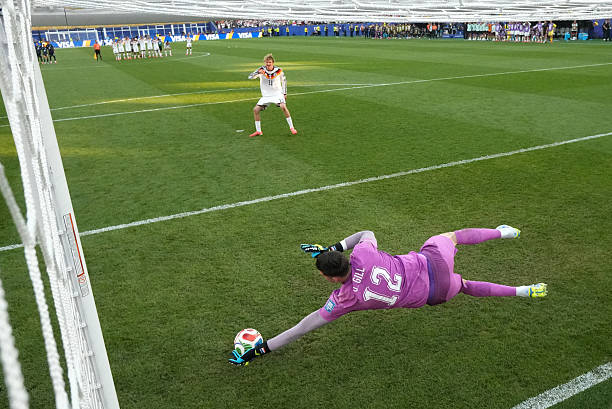
Often portrayed as a game of chance, penalty shootouts are actually among the most strategic moments in soccer. From technical preparation and statistical analysis to the selection of penalty takers and emotional management, a shootout is shaped long before the first player steps up to the spot. While an element of uncertainty is inevitable, reducing the exercise to a simple lottery means overlooking everything teams can control.
Few moments in soccer can concentrate as much tension into just a few seconds. After 120 minutes of play, two teams face each other in a contest that leaves almost no room for error. A goalkeeper, a penalty taker, a ball and a goal measuring 8 yards wide. The scenario seems simple, but the consequences can be enormous. A place in the next round, a trophy or elimination can sometimes come down to a single shot. It is precisely this dramatic dimension that has gradually made the word “lottery” part of soccer vocabulary.
The French national team has experienced this on several occasions. Their elimination against Switzerland at Euro 2020, followed by their defeat to Argentina in the 2022 World Cup final, reignited the debate surrounding penalty shootout preparation. After the latter match, Didier Deschamps notably discussed how difficult it was to recreate the emotional conditions of an actual shootout during training. It was a valid observation, but it does not mean that penalty shootouts are beyond preparation. No one can perfectly reproduce the pressure of a World Cup final, but teams can work on technique, study their opponents and prepare players to deal with different situations.
Research into penalty shootouts also shows that success does not depend solely on a player’s technical ability. Shot direction, ball height, execution speed, goalkeeper positioning and psychological context all directly influence the outcome. Statistics can help identify certain patterns in penalty takers. A player might favor a particular area of the goal, repeat the same run-up or change his habits depending on the pressure applied by the goalkeeper. Goalkeepers, meanwhile, now have access to video analysis tools that allow them to study their opponents’ preferences. The duel does not begin when the referee blows the whistle: it may have been in preparation for several days.
Behind the penalty spot, a psychological battle
Affiliate disclosure: the links below are affiliate links. If you buy through them, Soccer Legends may earn a commission at no extra cost to you.

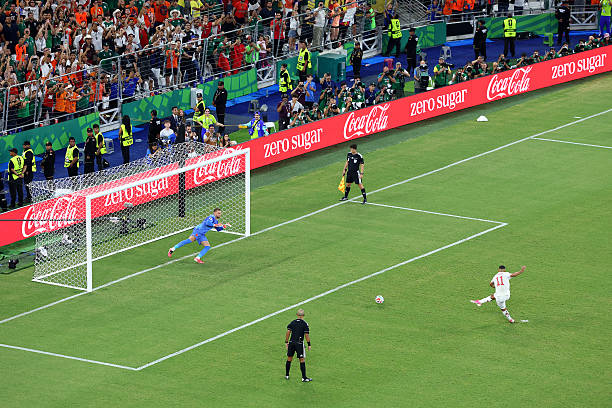
The order in which players take their penalties is one of the first strategic decisions involved in a shootout. Contrary to popular belief, the best players do not necessarily have to be saved for the final attempts. Several scientific studies have examined the psychological effects of the shooting order, particularly the pressure players experience when they have to equalize or preserve a lead. A study published in 2020 by Luc Arrondel, Richard Duhautois and Jean-François Laslier in the journal Statistique et Société examined these mechanisms. Its findings suggest that performance can be negatively affected by the stakes and the difficulty of the situation. They encourage us to view a shootout as a succession of psychological decisions rather than simply a contest of penalty kicks. For a coach, selecting the first five penalty takers therefore requires consideration not only of technical ability, but also of each player’s personality and capacity to handle responsibility in such a crucial moment.
Statistical analysis also plays a role in choosing where to place a shot. Historical data can identify the areas of the goal that are hardest for goalkeepers to defend. Shots close to the posts and far enough away from the goalkeeper naturally reduce the chances of a save. By contrast, an attempt that is too central or poorly placed makes the goalkeeper’s job easier. However, power is not a universal solution. A technically flawless shot can be more effective than a powerful strike lacking precision. The objective is primarily to give the player a reference point and a well-established routine, helping him avoid changing his intentions under pressure.
The goalkeeper also plays a crucial role. Long regarded as the last line of defense, he is now a central figure in the shootout. His job is to analyze penalty takers’ habits, observe their run-ups, body positioning and previous attempts. Some coaches specializing in goalkeeper preparation also emphasize the importance of giving goalkeepers room to make their own decisions. Video analysis can provide valuable information, but it should not turn the goalkeeper into someone simply following a predetermined script. The player standing in front of him can always change his habits. Data must therefore be combined with observation and instinct.
The example of Andrew Redmayne, who became famous during the 2022 World Cup qualifying playoff between Australia and Peru, perfectly illustrates this psychological dimension. Brought on just before the shootout, the Australian goalkeeper repeatedly moved along his goal line in an attempt to unsettle his opponents. He also tried to disrupt their preparation by examining the instructions written on the Peruvian goalkeeper’s water bottle. Beyond the theatrical nature of his behavior, the strategy served as a reminder that penalty shootouts are also a mental battle. The goalkeeper is not simply trying to anticipate a shot’s trajectory: he is attempting to create doubt in his opponent’s mind.
This approach helps explain why several national teams have gradually developed specialized preparation methods. England, a country long haunted by its failures in penalty shootouts, notably strengthened its psychological and statistical work under Gareth Southgate. As a former player whose missed penalty against Germany at Euro 1996 had left a lasting mark, the manager wanted to turn a historical weakness into an area of improvement. Ahead of the 2018 World Cup, England’s preparation included psychological assessments and collective work designed to help players cope with pressure. Their penalty shootout victory over Colombia marked an important step in this evolution. Other national teams have also experimented with intensive preparation methods, including Luis Enrique’s Spain, whose players were instructed to take numerous penalties before the 2022 World Cup.
French soccer, however, remains divided over how to approach this exercise. Didier Deschamps has repeatedly highlighted the limitations of specific penalty training, arguing that it is difficult to recreate the conditions of a final or a major international competition. Conversely, several specialists believe this difficulty should not be used to justify inadequate preparation. The debate extends beyond the national team. In youth academies, professional clubs and youth national teams, mental preparation remains a central issue. Working on penalty shootouts does not simply mean asking a player to take a few shots after a training session. It involves developing automatic responses, establishing routines, simulating high-pressure situations and familiarizing players with individual responsibility.
The distinction is important: penalty shootouts can never be completely controlled. A goalkeeper might produce the save of his career, a ball might hit the post or a usually reliable player might crumble under pressure. Chance therefore remains part of the equation. But it is not a sufficient explanation. The difference between a well-prepared team and one that improvises can be measured through the quality of its penalties, the confidence of its players and the goalkeeper’s ability to make the right decisions. In a sport where statistical data is playing an increasingly important role, continuing to describe penalty shootouts as a simple lottery is almost paradoxical. Shootouts are not won through training alone, but they can certainly be prepared for. And when everything comes down to 12 yards, every detail matters.