

It took Antonio Conte just a few weeks to transform a struggling team into a winning machine. In the summer of 2016, Chelsea were coming off a disastrous season, finishing tenth in the Premier League after having won the title just a few months earlier under José Mourinho. The Portuguese manager’s departure, instability in the dressing room, and disappointing results had severely weakened the London club. Having arrived after leading Italy at Euro 2016, Antonio Conte inherited a talented squad whose confidence appeared to have completely vanished. His challenge was enormous: rebuild a collective identity and restore the Blues to the ranks of title contenders. At the time, nobody could have imagined that the Italian manager would oversee one of the most remarkable tactical transformations in recent Premier League history.
The opening months, however, offered little reassurance. Chelsea began the season with a 4-2-3-1 formation before gradually switching to a 4-3-3. The Londoners lacked defensive stability and struggled to impose their rhythm against the league’s strongest teams. The defeat against Liverpool at Stamford Bridge, followed by an especially humiliating 3-0 loss to Arsenal at the Emirates Stadium, proved to be an early turning point. At halftime of that match, Conte decided to fundamentally change his team’s structure. He abandoned his back four and introduced a three-man central defense, supported by two wing-backs and two central midfielders. It was a decision that would change the course of his season.
Following that tactical adjustment, Chelsea went on a run of 13 consecutive league victories, matching the Premier League record for most successive wins within a single season at the time. The Blues rediscovered remarkable defensive solidity while developing a much more fluid attacking structure. The 3-4-3 formation, sometimes described as a 3-4-2-1 depending on the positioning of the attacking players, quickly became Conte’s trademark. His ability to adapt the principles of Italian football to the demands of the English game proved to be one of the defining successes of the 2016-17 campaign.
Conte’s 3-4-3: A Collective Machine Built Around Individual Talent
Affiliate disclosure: the links below are affiliate links. If you buy through them, Soccer Legends may earn a commission at no extra cost to you.

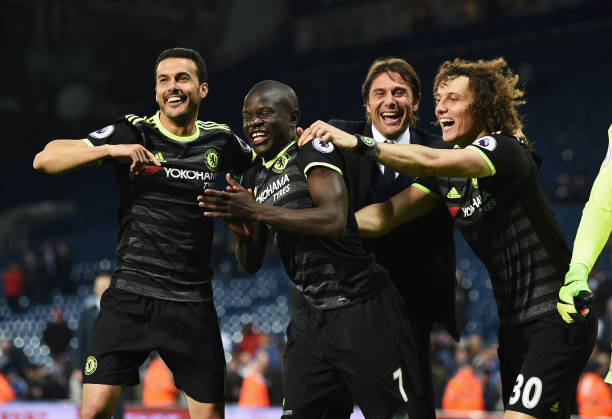
Chelsea’s tactical revolution was about far more than simply adding another center-back. It transformed the responsibilities of almost every player on the pitch. At the back, David Luiz found an environment perfectly suited to his ball-playing abilities, flanked by César Azpilicueta and Gary Cahill. Having returned from Paris in the summer of 2016, the Brazilian benefited from constant defensive cover, allowing him to take greater risks with his passing and break through the opposition’s first line of pressure. This structure also protected his teammates, as the two outside center-backs could step into the wide areas while Luiz provided cover and anticipated potential threats.
Ahead of them, N’Golo Kanté and Nemanja Matić formed an exceptionally complementary double pivot. The Frenchman brought his incredible work rate, aggression in winning the ball back, and ability to cover space, while the Serbian relied on his physical presence, strength, and technical quality to retain possession and dictate play. Their partnership allowed Chelsea to control opposition transitions and quickly recover possession after losing the ball. In a league where transitions and physical intensity play such a central role, this balance proved to be a considerable advantage.
However, some of the system’s most important elements were also found out wide. Victor Moses and Marcos Alonso were repositioned as wing-backs, taking on particularly demanding attacking and defensive responsibilities. Moses, who had long been regarded as a rotational winger, became one of the season’s biggest revelations. His work rate allowed him to make repeated runs down the flank, provide width, and contribute to the pressing game. Meanwhile, Alonso used his positional intelligence and powerful shooting ability to become a genuine attacking threat. Together, the two players gave Chelsea excellent width without sacrificing their defensive balance.
Further forward, Eden Hazard and Pedro operated in the half-spaces behind Diego Costa. This positioning particularly benefited the Belgian, who no longer needed to constantly drift away from central areas to receive the ball. He could combine with his teammates, attack spaces between the lines, and take on defenders in dangerous positions. Pedro, thanks to his intelligent movement and work rate off the ball, perfectly complemented this attacking structure. Finally, Diego Costa brought his physical strength, aggression, and finishing ability to the center-forward position. Together, the players formed a collective capable of defending in a compact block, pressing high up the pitch, and quickly transitioning into attack.
This structure also allowed Chelsea to occupy central areas more effectively. In previous formations, the movement of midfielders and attacking players could leave significant gaps without options between the lines. The switch to a 3-4-3 created more connections through the middle while preserving opportunities to progress down the flanks. Opponents were consequently faced with a dilemma: defend narrowly to prevent Hazard and Pedro from combining, or spread their defensive block to control the wing-backs. In either situation, Chelsea had the tools to exploit the spaces left behind.
Another major strength of Conte’s management was his uncompromising approach to standards. The Italian introduced intense training sessions, precise instructions, and strict collective discipline. His fiery temperament on the touchline reflected his constant involvement in his team’s performances. This demanding approach helped rebuild a squad that had lost its direction just a few months earlier. Individual talent was not sacrificed for the sake of the system; instead, players were placed in the best possible positions to showcase their abilities.
As the weeks went by, Chelsea became almost impossible to destabilize. Victories against Manchester United, Tottenham, Manchester City, and Leicester demonstrated the Blues’ ability to adapt to different opponents. Their run of 11 consecutive victories after implementing the 3-4-3, during which they scored 25 goals and conceded just two, highlighted the immediate effectiveness of their new structure. Even when Tottenham eventually brought the winning streak to an end, Chelsea’s momentum did not collapse. The Blues maintained their advantage and continued their march toward the title.
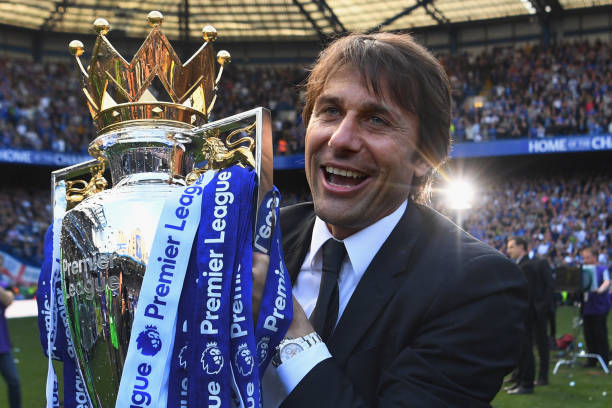
On May 12, 2017, Chelsea secured a 1-0 victory away at West Bromwich Albion thanks to a late goal from Michy Batshuayi. The result officially crowned them Premier League champions with two games remaining. Chelsea ultimately finished the season with 93 points, 30 wins from 38 matches, and 85 goals scored. The club established a new record for most victories in a single Premier League season while claiming its fifth English league title. Antonio Conte also became the fourth Italian manager to win the English championship, following Carlo Ancelotti, Roberto Mancini, and Claudio Ranieri.
The following season, Chelsea failed to defend their crown. Tensions between Conte and the club’s hierarchy, disagreements over recruitment, and increasingly strained relationships with several players gradually undermined his project. The Blues finished fifth in the league but still managed to win the FA Cup against Manchester United in May 2018. That victory proved to be the Italian’s final major trophy at Stamford Bridge before his departure just a few weeks later.
In retrospect, the 2017 title represented far more than a simple sporting achievement. Antonio Conte restored Chelsea’s identity within a matter of months while popularizing a tactical system that would have a lasting influence on English football. His 3-4-3 demonstrated how a midseason tactical adjustment could completely reshape the balance of power within a league. Since then, the Blues have returned to the top of European football, most notably by winning the Champions League in 2021, but they have yet to lift the Premier League trophy again. The 2017 triumph therefore remains Chelsea’s most recent English league title and one of the finest demonstrations of the impact a manager can have on a team.