

After five Premier League games, Chelsea have already shown two very different sides under Xabi Alonso. Capable of producing spectacular attacking soccer and scoring 10 goals, the London club have also conceded 12, more than all three promoted teams. Their record of seven points from 15 reflects that inconsistency. The 3-0 defeat at Brentford, following the loss to Arsenal and the draw against Hull City, has above all highlighted problems that go beyond the result of a single night.
Make the defense reliable


This is the most obvious issue. Chelsea have not kept a clean sheet in the Premier League since January 17 and have now gone 21 league games without finishing a match without conceding, their longest such run since 1965. Under Alonso, the problem has continued, with the Blues conceding at least two goals in each of their first five league games, an extremely rare occurrence in Premier League history.
The problem does not only come from the center backs. Chelsea can lose their structure as soon as the first defensive line is breached. Against Arsenal, the team notably left too much space through the middle, while at Brentford, they gradually lost control after conceding the opening goal. Alonso himself admitted after that game that his team had “lost its structure” and become “out of control.” Levi Colwill also admitted that Chelsea had at times been “bullied,” meaning they had been physically dominated in duels.
The return of a midfielder capable of protecting the defense will therefore be just as important as the work done on the back line. Summer additions Emiliano Martínez and Maxence Lacroix have not, for now, been enough to solve the problem: Chelsea have already conceded 12 goals in five games. Alonso’s priority will therefore be to find a structure capable of resisting when his team loses possession, without abandoning the aggressive and vertical soccer he wants to establish.
Get the key players back and rebuild a midfield able to protect the team
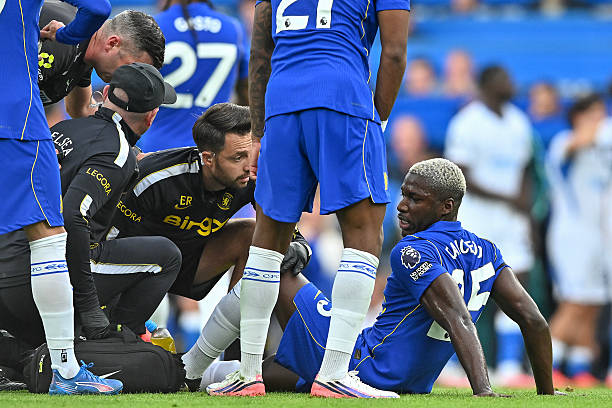
The second problem is closely linked to the first: Chelsea currently do not have enough reliable options in midfield. The absence of Moisés Caicedo is particularly significant. The Ecuadorian has played just 14 minutes of league soccer this season, and his profile as a ball-winner capable of covering large distances, winning duels and protecting the defense does not really have an equivalent in the squad.
The game against Arsenal illustrated this particularly well. Declan Rice was able to progress through the middle, while Martin Ødegaard took advantage of Reece James failing to track his movement to score the decisive goal. James, used in midfield, is still learning the position, while Roméo Lavia, despite posting defensive numbers closer to Caicedo’s, has struggled to play full matches consistently since joining Chelsea. Against Arsenal, he was substituted after an hour, forcing Alonso to finish the game with two players normally used as fullbacks in the heart of midfield.
The numbers illustrate the gap. At the start of this season, James has averaged 0.6 tackles and no interceptions per 90 minutes, compared with 2.1 tackles and 2.1 interceptions for Lavia. By comparison, Caicedo recorded 2.8 tackles and 1.9 interceptions per 90 minutes in 2025-26. Chelsea must therefore hope that his return can restore a balance that the summer recruitment failed to secure. Enzo Fernández’s departure to Manchester City and the failed pursuit of Lamine Camara have left Alonso with few natural alternatives.
Stop relying exclusively on attacking trio

The other paradox of Chelsea’s start to the season is that they are scoring plenty despite an attacking output that is not always as impressive as the results might suggest. The Blues have scored 10 goals after five games, but their xG stands at just 7.3, a total that places them significantly lower in the league hierarchy. In other words, their attackers have so far scored more goals than the quality and volume of the chances created would have suggested.
This difference is largely explained by the efficiency of several attacking players. João Pedro, Morgan Rogers and Cole Palmer have been directly involved in a very large proportion of the team’s goals. The problem becomes immediately apparent when one of them disappears from the equation. João Pedro is currently out with a knee injury, and his temporary suspension coincided with a much less threatening attack at Brentford. Chelsea had possession but failed to turn it into clear-cut chances: 28 crosses attempted, only two completed, 12 corners and just 0.85 xG compared with 2.65 for Brentford.
Alonso therefore has to find a way to make his team dangerous without relying on individual brilliance. That means greater presence in the box, better use of his attacking players and, above all, more consistent collective production. A team that relies too heavily on the success of a few attackers can maintain positive results for a while, but it becomes much more predictable when its best players are absent, neutralized or less effective.
Fix the set piece problems
The set-piece problem has become impossible to ignore. Jaidon Anthony’s opening goal at Brentford came from a relatively simple corner, after which Chelsea failed to defend their zone properly. According to data reported after the game, the Blues had already conceded five goals from set pieces this season, putting them last in the Premier League in that category.
The situation is even more concerning because Chelsea had specifically hired Austin MacPhee, a set-piece specialist who arrived from Aston Villa during the summer, to improve this area. Last season, the Blues conceded 17 goals from set pieces, already a problematic total. Yet the opening weeks of the new season have not shown any significant improvement. Since the beginning of last season, Chelsea have even conceded 23 goals from set pieces, the highest or joint-highest total in the Premier League according to data cited by TNT Sports.
The problem is therefore not simply about poor marking on an isolated play. Chelsea need to improve their organization, their aggression in duels and their concentration on second balls. For a team looking to play high up the field and impose an intense tempo, set pieces also provide opponents with a way to bypass their press and attack them in a situation where their structure is fixed.
Make a better used of the bench
The final issue concerns game management. The Athletic has notably highlighted Alonso’s substitution decisions during the opening weeks. Estêvão, for example, came on between the 81st and 87th minutes in each of his first four Premier League appearances. Against Arsenal, with Chelsea trailing 2-1, the attacking substitutions intended to find an equalizer did not come until the 87th minute. Against Hull, Danny Welbeck came on in the 78th minute, while Estêvão once again had to wait.
This management is particularly important because Chelsea have a young squad and several players capable of changing the course of a game. The League Cup match against Leeds is revealing: Alonso made four substitutions at halftime while Chelsea were trailing 1-0, before watching his team turn the game around and win 6-3. In the Premier League, the Spanish coach must now find a way to have the same impact when the situation requires it.
That does not necessarily mean making more substitutions or routinely taking his best players off. The issue is rather about adapting his decisions more effectively to the scenario of each game. When Chelsea dominate without creating enough chances, when a midfielder begins to run out of energy or when a game requires greater attacking presence, the bench should allow the balance of power to be changed before the final minutes. With a team still under construction, Alonso’s ability to read these moments will be just as important as his starting system.
After five games, Chelsea therefore do not have a single problem to solve but several issues that feed into one another. The defense is suffering from a lack of midfield protection, Caicedo’s absence is intensifying that vulnerability, the attack still relies heavily on individual players and set pieces are regularly giving opponents dangerous opportunities. Added to that is the need for Alonso to make better use of the resources available on his bench. The international break therefore arrives at an important moment: Chelsea have seven points, but above all, 12 goals conceded and no clean sheet since January. The gradual return of injured players, particularly Caicedo, should allow Alonso to stabilize his team before the ambitions of this new era can truly be measured.