


Zidane, Henry, Barthez, Thuram, Desailly. Those names alone take you back to one of the strongest sides France has ever produced, feared across the continent and full of players the biggest European clubs wanted. That squad delivered France’s first World Cup in 1998 and a Euro title two years later. The 2002 World Cup turned out to be the opposite story: a first-round exit without a single goal scored.

How does a team that dominant and that widely backed to win end up suffering one of the most humiliating collapses in World Cup history?
Euro 2000 : the peak of Zidane’s generation

Sunday, July 2nd, 2000. Extra time in the Euro final between France and Italy. After 90 grueling minutes against a rugged Italian defense, supersub Sylvain Wiltord finally equalizes following a long clearance from Barthez. 1–1. In extra time, as so often since 1998, the bounce went France’s way. Robert Pires sprinted down the left on one of his trademark runs and slid a perfect pass to David Trezeguet, inside the box, ball at his feet. Trezeguet finished, and in 2000 a single golden goal ended the match on the spot. Just as against Paraguay in the 1998 round of 16, France escaped by the narrowest margin, only this time they walked away with the Euro 2000 title.
After Raul’s missed penalty against Spain and a hard-fought extra-time win over Portugal thanks to a Zidane penalty, France had proven it could outlast and outfight anyone. Ninety minutes on the edge of disaster, yet the Blues always came out on top. This team had an armor that made it impervious to pressure.
In 1999, qualification for the Euros hadn’t been easy. Roger Lemerre, who succeeded World Cup–winning coach Aimé Jacquet, initially struggled to impose his style. Offensively toothless, France drew too many matches, and criticism mounted. But by July 2, 2000, those doubts were long gone. Forced to rebuild during qualification, France had rediscovered what it thrived on: adversity.
Unlike in 1998, the challenge this time came from the opponents rather than the media. Teams had studied France’s style and set out to neutralize it. The French had to push themselves to get past a brutal set of rivals: Raul’s Spain, Figo’s Portugal, and an Italy stacked with stars from what was then the world’s best league, Serie A.
The 16-team Euro was arguably tougher than a World Cup, with fewer mismatches and far more tactical parity. As the Bosman ruling reshaped European football, France embodied a rare hybrid: the defensive rigor of the best Serie A sides, the physicality of the Premier League, and real French flair. The 2000 vintage blended discipline and creativity even better than the 1998 one. Deschamps, Zidane, Henry, Barthez, Thuram, all at their peak. They could absorb pressure for an hour and then strike, and that was what defined them.
Then came the next challenge: a place in history. France had pulled off the double, so why not the triple? No nation had won back-to-back World Cups since Brazil in 1962.
In 2002, France would confront history itself.
2001: the beginning of the downfall
- France becomes a commercial and political tool
Between the Euro 2000 final and the start of the 2002 World Cup lay two long years of friendlies. Back then, the defending champion, like the host nation, automatically qualified for the next tournament. So France had to fill its calendar with exhibition matches against non-qualifying opponents. From September 2000 to November 2001, the world champions became globe-trotters: Johannesburg, Istanbul, Santiago, Melbourne, a bizarre and exhausting world tour.
In October 2000, they traveled to South Africa, still healing from apartheid, greeted warmly by Nelson Mandela himself. The French squad, symbols of the “black-blanc-beur” multicultural ideal, were celebrated as a living emblem of unity. In Chile in September 2001, then in Australia that November, the welcome was just as grand, even if the trips were punishing. A chartered plane carried the entire delegation across 12 time zones, complete with onboard massages to aid recovery.
Between those two trips came the infamous France–Algeria match on October 6, 2001, halted after a pitch invasion. “The Blues were being used as a tool to patch up issues of integration and diplomatic reconciliation between the two nations.” The French team had become an instrument of politics and commerce, each friendly negotiated for profit rather than preparation. They played with no tactical coherence and no real purpose, while every opponent was desperate to beat them.

- Mounting fatigue

In Chile, fatigue and aggression from the hosts overwhelmed them. Against Algeria, the symbolic weight of the event overshadowed the football itself. And the Australia trip? It reached the height of absurdity. A 22-hour flight, in the middle of the club season, to face an Australian side brimming with intensity. Kevin Muscat’s brutal tackle on Christophe Dugarry’s knee was a warning shot. Bixente Lizarazu saw it clearly:
“Let’s not kid ourselves — it’ll be the same at the World Cup. Teams will compensate for their lack of talent with pure physical commitment. Forget the image of France soaring like an eagle; we have to become wild boars again, putting our snouts back in the mud.”

Beyond tactics, the players’ physical condition was alarming. Since 1998, seasons had grown longer, matches more intense, and recovery time shorter. The Champions League now had two group stages. Domestic leagues were expanding. The schedule was brutal. Between club and country, players were caught in constant tension. By November 2001, before that trip to Australia, Arsenal’s Arsène Wenger and David Dein, responsible for Henry, Pires, Vieira and Wiltord, joined Sir Alex Ferguson (Barthez’s coach) in publicly criticizing the tour: “The French can’t complain when their players get injured before the World Cup.”
Then came the breaking point. In March 2002, Robert Pires went down clutching his knee. Torn ligaments. Out of the World Cup. Before that FA Cup quarterfinal he had already played 48 matches. Vieira reached 61, Wiltord 59, Henry 55, Zidane 51, Makelele 55, all far above FIFA’s recommended 45-match limit. Pires’s injury was the predictable result of greed and overexertion: the French Football Federation had milked its stars for every last cent, and their bodies finally gave out. By May 2002, when the 23-man squad assembled, fitness tests showed alarming exhaustion, and some players were still finishing their club seasons. The tournament had been moved up to May 31–June 30 to avoid Asia’s monsoon season, so preparation time was minimal. Instead of resting the players, the FFF piled on more games: a farewell match against Belgium, then a friendly against South Korea just five days before the opener. Scheduled mainly for money and publicity, that match proved disastrous. An already tired Zidane tore his thigh. France now had to start the World Cup without its two creative engines, two leaders whose games completed each other: Zidane’s finesse and Pires’s acceleration. In return for its mismanagement, the FFF had stripped the team of both.
- Roger Lemerre’s system never evolved
For two years, Roger Lemerre had prepared nothing: no tactical evolution, no plan B. “What’s there to fear? I’ve got the best players in the world,” he told France’s rugby coach Bernard Laporte. Lemerre had inherited a great team and simply rode its momentum. After the vicious media treatment of Jacquet in 1998, French sports daily L’Équipe refused to criticize Lemerre, invoking “the Jacquet precedent.” Every defeat was rationalized away: Spain had been “more motivated,” Chile too far a trip, and so on. No self-reflection. No changes. The 4-2-3-1 system worked with both Pires and Zidane, but without one of them, the flaws showed. Russia exposed them. Zidane was forced to cover too much ground, Djorkaeff couldn’t replicate Pires’s link-up play, Henry was exiled to the left wing he hated, and Trezeguet was starved of service. The team looked sterile up front and shaky at the back. With Deschamps and Laurent Blanc both retired, balance and leadership had evaporated. Desailly, though experienced, lacked Deschamps’s authority and communication. The locker room split into cliques: the Arsenal group, Zidane’s friends, and isolated newcomers. Only Cissé stood out as a fresh face. Four years on, the hunger had naturally faded. After a shaky warm-up against South Korea on May 26, France again escaped with illusions intact. Many still believed destiny would favor them. But beneath the surface, their solid certainties had crumbled. Fatigue, injuries, retirements, aging leaders and arrogance had all stacked up at once. France entered the first-ever Asian World Cup against Senegal in decline.
The World Cup: the final phase of an already dead team
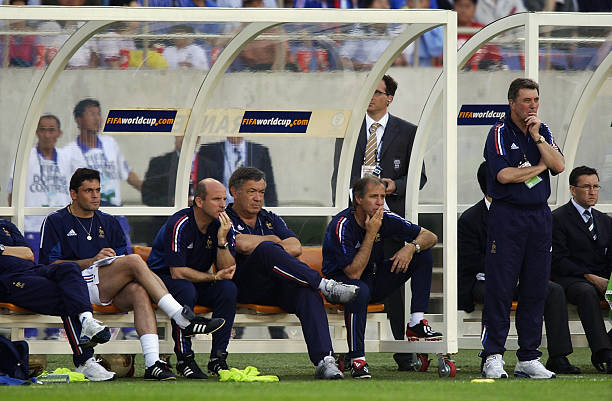
Canal+’s documentary Les Yeux dans les Bleus 3 captured the tense mood: the anxiety around Zidane’s injury and a general atmosphere of denial. France approached its opener against Senegal with shocking complacency. No pitch inspection, no local training, details the Senegalese took very seriously.
The Lions of Teranga were dismissed as amateurs: “most of their players play in France,” scoffed the media.
France lined up in its usual 4-2-3-1, but without Zidane or Pires, and with Djorkaeff “slowing the play,” there was no rhythm. Senegal’s double-teams on Henry and Wiltord neutralized the flanks and left Trezeguet isolated. The Africans’ energy and discipline paid off. El Hadji Diouf, brilliant and fearless, served Papa Bouba Diop for the opening goal.
France threw on more strikers, but nothing worked. To the world’s shock, though perhaps not to the closest observers, the champions fell. The “invincible” team that hadn’t lost since 1996 had been exposed.
Reality hit. Panic set in. Years later, Christophe Dugarry revealed on French radio RMC in 2020 how the players tried to confront their coach: “Before the Uruguay game, a few of us went to Roger’s room to discuss tactics — just like we used to with Jacquet. We thought we’d agreed. Zidane left the room saying, ‘Everything’s fine!’ But two hours before kickoff, we saw the lineup board — same system, same players. Zidane, Djorkaeff, Desailly — they were furious. ‘He’s mocking us,’ Zidane muttered. Roger was paranoid — he meant well but couldn’t let go of control.”

Against Uruguay, the luck stayed bad. France started well, aggressive and intense, even scoring through Trezeguet before the goal was disallowed. Thuram’s sharp right-side play gave them life, but when Leboeuf limped off and Candela came on, Thuram shifted to center back and Recoba took over that flank. Then disaster, in the 25th minute: Thierry Henry sent off for a late tackle, harshly judged. France played an hour with ten men. Barthez kept them alive with seven saves. Petit hit the post and picked up a booking that ruled him out of the Denmark match. 0–0. Hanging by a thread.
Only one path remained: beat Denmark by two goals or go home. Zidane was back, barely fit, his thigh strapped tight. It never happened. Denmark 2, France 0, at Incheon’s Munhak Stadium. That was the end of an era.
Defeat has a distinctly French flavor. The same nation that thrives on adversity is also gifted at self-destruction: Bulgaria 1993, Euro 1992, a long line of European club failures. Arrogance and complacency had doomed a great team that badly needed renewal.
Even with the 1998 Ballon d’Or winner, the top scorers from Italy, France and England (Trezeguet, Cissé, Henry) and a world-class defense, they showed that football is not about assembling stars but about building a collective. Lemerre refused to adapt, clinging to his 4-2-3-1 until it sank him.
Incheon 2002 was more than a defeat. It opened a long, painful fall, remembered as “the greatest fiasco in the history of French sport.”
 France
 Thierry Henry
 Zinédine Zidane
Great job