

Every World Cup leaves behind a story, but this one leaves behind a spreadsheet. The 2026 edition was the biggest sporting event ever staged, spread across three countries and 16 cities, and by the time Spain and Argentina walked out at MetLife Stadium for the final, the tournament had already broken more records than most editions manage in their entirety. Some of those numbers are structural, the byproduct of a format nobody had tried before. Others are pure theater. Here are the 10 that define it.
48
The number that changed everything. For the first time in the 96 year history of the competition, 48 nations qualified for the final tournament instead of 32, a decision FIFA pushed through in 2017 and that critics spent nearly a decade calling a dilution of the sport. The verdict is messier than either side predicted. The 12 group format produced some genuinely flat matches, but it also gave Cape Verde, Jordan, Uzbekistan and Curaçao a stage they had never reached, and several of those teams did not simply show up to make the numbers.
- Teams making their World Cup debut in 2026: six
104
The match count, up from 64 in Qatar. That is 40 additional games, an extra week of tournament, and a competition that ran from June 11 in Mexico City to July 19 in New Jersey. For American broadcasters and bars, it meant nearly six weeks of near daily soccer in domestic time zones, which is arguably the single biggest reason this tournament will change the sport’s commercial standing in the United States more than 1994 did.
6.5 million
The attendance figure, and the one FIFA will put on every slide deck for the next decade. More than 6.5 million fans passed through the turnstiles, obliterating the previous record of roughly 3.6 million set at USA 1994. The group stage alone drew 4,644,549 spectators at an average of 64,508 per match and filled 99.7 percent of available seats. On June 25, FIFA logged its highest single day attendance in tournament history with 426,834 fans across multiple stadiums.
- Fans attended from 210 countries and territories
22
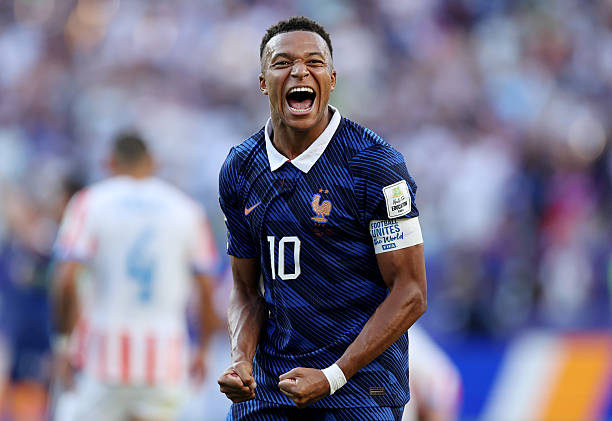
Kylian Mbappé’s career World Cup goals, and a new all time record. He arrived in North America level with the greats and left the semifinal round tied with Lionel Messi on 21. Then came the bronze final in Miami, where his second half double against England pushed him clear at 22, a mark set at the age of 27 with at least two more tournaments plausibly ahead of him. Whatever happens in the final, the ceiling on this record has not been reached.
10
The goals scored in France against England, the most chaotic third place match the World Cup has produced. England led 4-0 at halftime through Declan Rice, Ezri Konsa and a Bukayo Saka brace, then watched France score three in 20 minutes before holding on to win 6-4. It was the highest scoring World Cup match since Hungary beat El Salvador 10-1 in 1982 and the highest scoring third place game ever played. Jude Bellingham’s late finish took him to seven goals for the tournament, the most by any England player in a single edition.
- Saka completed his hat trick from the penalty spot in the 87th minute
3,000
The number of goals scored in World Cup history, a milestone reached in the round of 16 when Enzo Fernández completed Argentina’s 3-2 comeback against Egypt. For context on how long the competition has been accumulating them, the 1,000th was scored by Rob Rensenbrink at Argentina 1978 and the 2,000th by Marcus Allbäck at Germany 2006. The 3,000th arrived exactly 20 years after the 2,000th, which tells you how much the calendar has expanded.
8
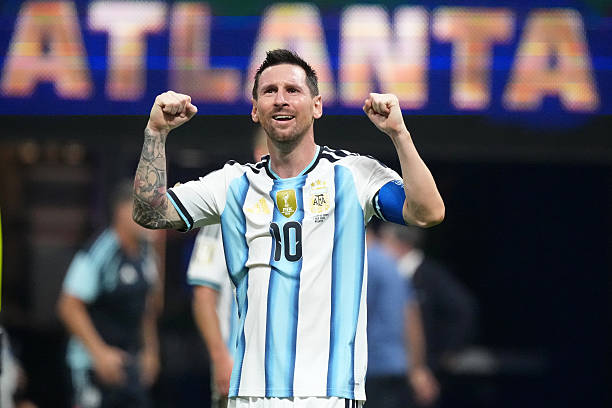
Messi’s goals in what is almost certainly his final World Cup, at 39 years old. He opened with a hat trick against Algeria, scored against Austria, Jordan, Cape Verde and Egypt, and then produced two assists in the semifinal win over England without finding the net himself. His nine match scoring streak, dating back to Qatar, ended in Atlanta. He has never won a World Cup Golden Boot and heads into the final trailing Mbappé, needing a big night to close a gap that has defined the tournament’s individual narrative.
609
Unai Simón’s consecutive minutes without conceding a goal in World Cup competition, a streak that stretched across editions and turned Spain’s route to the final into an exercise in suffocation rather than spectacle. Spain beat France 2-0 in the semifinal and reached the showpiece as the European champions who had quietly conceded almost nothing since arriving.
6
The number of different World Cups in which Cristiano Ronaldo has scored, a first in the history of the competition. At 41, he added three goals in 2026 to reach 11 career World Cup goals, making him Portugal’s all time leading scorer at the tournament and stretching a scoring range that now covers 2006 through 2026. Twenty years of finding the net at the sport’s biggest event is a record that requires longevity no active player is close to matching.
0
Host nations in the quarterfinals. All three co hosts went out in the round of 16, with Canada losing to Morocco, Mexico falling to England and the United States beaten 4-1 by Belgium. For a tournament sold to American audiences as a launchpad, it was a sobering weekend, and it left Mauricio Pochettino facing pointed questions about a squad that produced record television numbers and not much else.
The final belongs to Spain and Argentina, and to a version of this tournament that was never supposed to work. The numbers say it worked anyway.
 Cristiano Ronaldo
 Erling Haaland
 Kylian Mbappé
 Lamine Yamal
 Lionel Messi