

There are matchups that, on their own, encapsulate an entire season. Manchester City vs. Arsenal belongs in that category. A game that goes beyond a simple clash between two title contenders and feels like a true final before its time. Unexpected, first, given how winding the paths of both teams have been this season. Tense, above all, because it pits two visions, two psychological dynamics, and two different ways of dealing with pressure against each other.
A title race despite City inconsistency
What makes this clash so unique is the paradox embodied by Manchester City. Rarely has a Pep Guardiola team seemed so vulnerable while remaining so dangerous.
City have dropped valuable points throughout the season, particularly against supposedly weaker opposition. Poorly managed games, messy finishes, and an overall sense of imbalance—unusual for a team historically associated with methodical dominance. The draw conceded against West Ham, for example, highlights this inability to close out games that seemed well within their grasp. And yet, Manchester City are still in the race.
This paradox can partly be explained by the nature of the Premier League this season: inconsistent, tense, defined more by fluctuations in form than by sustained momentum. But it is also explained by a constant: even weakened, City remain a machine capable of producing irresistible spells of football. Guardiola himself admitted it with unusual frankness—defeat against Arsenal could mean the end of their title hopes. A statement that contrasts with his typically measured tone, but reflects the current reality.
City are walking a tightrope, oscillating between survival and resurgence. What makes their presence in the title race almost “miraculous” is not just the number of points dropped, but how they were dropped. Unlike previous seasons, where City gradually overwhelmed their rivals, this team gives the impression it could collapse… or suddenly put together a perfect run at any moment. And that is precisely what makes them so dangerous.
Arsenal : dominance shaken by doubts
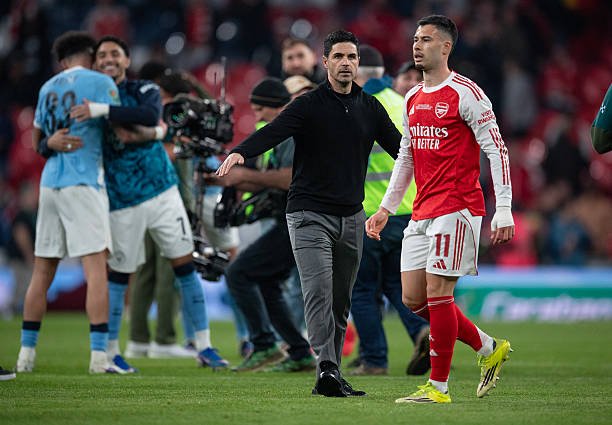
On the other side, Arsenal are not in a more comfortable position, despite often sitting higher in the standings. Because while the Gunners long appeared to have the title in their hands, their recent form tells a different story: that of a team beginning to wobble.
Their attacking struggles have become a central issue. Arsenal are finding it harder to create clear chances with the regularity that once defined them. Their play can feel too predictable, too lateral, too dependent on individual moments. Where the collective once thrived on fluidity, it now appears hesitant.
But the problem is also, and perhaps above all, psychological. The pressure of the title race acts as a magnifying glass. It amplifies every imperfection, turns every mistake into doubt, and every setback into a potential crisis. In this context, manager Mikel Arteta appears more exposed than ever.
Unlike Guardiola, whose résumé allows him to put things into perspective, Arteta is still seeking validation. Winning the title would be a crowning achievement, definitive proof that his project has succeeded. But that pursuit now seems to weigh heavily on his shoulders—and on those of his players.
Recent analyses point to a significant psychological shift: Arsenal no longer play with the same freedom. Decisions are more cautious, risks less willingly taken. It is as if the fear of losing has gradually replaced the desire to win. And against a team like Manchester City, that mindset can be fatal.
Beyond the pitch, this match is also a clash between two approaches to handling pressure. Guardiola embodies a kind of paradoxical calm. Even in difficult moments, he maintains a clear line: focus on the game, on principles, on what can be controlled. His experience allows him to put things in perspective, to defuse extreme situations.
This attitude directly impacts his players. It provides them with a stable framework, a kind of emotional security. Even when results disappoint, the team retains a strong identity, a clear thread.
By contrast, Arteta seems more affected by the season’s fluctuations. His total, almost obsessive involvement is a strength—but it can also become a weakness in moments of tension. Arsenal’s players feel that intensity. And while it has long been a driving force, it can now become a burden. Every match becomes a test, every dropped point a source of frustration.
This contrast is key to understanding the current dynamics. Where City seem capable of playing freely despite the stakes, Arsenal sometimes appear to be battling themselves.
The X factors
In this context, certain players crystallize the stakes of the match. Declan Rice is one of them. Recruited to bring stability and leadership, he has become indispensable over the past three years—perhaps too indispensable since the team’s defensive shift.
His hybrid role—ball-winner, distributor, and occasional attacking outlet—makes him the heart of Arsenal’s system. But that omnipresence comes at a cost. Signs of fatigue are beginning to show. Less sharp in duels, slightly slower in transitions, Rice appears to be feeling the accumulation of effort.
Against a team like City, which excels at exploiting even the smallest spaces, the slightest drop in level can be punished. His midfield battle will be decisive. If he can impose his rhythm and disrupt City’s passing lanes, Arsenal may be able to control the game. But if he is overwhelmed, the entire structure of the Gunners risks collapsing.
On Manchester City’s side, one name stands out: Rayan Cherki. His gradual integration into Guardiola’s system has added a new dimension to City’s play. Less structured, more instinctive, Cherki embodies a kind of raw creativity that contrasts with City’s usual discipline.
Used in a more central role, he contributes to build-up play while retaining his ability to beat defenders, surprise opponents, and create openings where none seem to exist. In a match this tight and tense, that kind of profile can make the difference.
Where Arsenal sometimes search for collective solutions without finding them, City can rely on individual inspiration from players like Cherki to unlock situations. His freedom of movement, vision, and technical ability make him a constant threat.
But that freedom is also a gamble. It can destabilize the team if not perfectly integrated. Guardiola’s challenge will be to channel that creativity without stifling it.
A true final
Ultimately, this Manchester City vs. Arsenal clash goes far beyond 90 minutes.
It is a game that could redefine a season. For City, it is a chance to prove that despite doubts and dropped points, they can still deliver on the biggest stage. For Arsenal, it is a test of maturity, an opportunity to show that the group has taken the next step.
But it is also a confrontation between two mindsets.
One team moves forward without certainty, but with a form of calm. The other may have more guarantees on paper, but is battling its own doubts.
In this kind of duel, football often defies logic. It is not always the best team that wins, but the one that manages the moment best.
And that may be where this “unexpected and tense final” will be decided.
Because beyond systems, statistics, and individual talent, one simple question remains: who will handle the pressure best?