

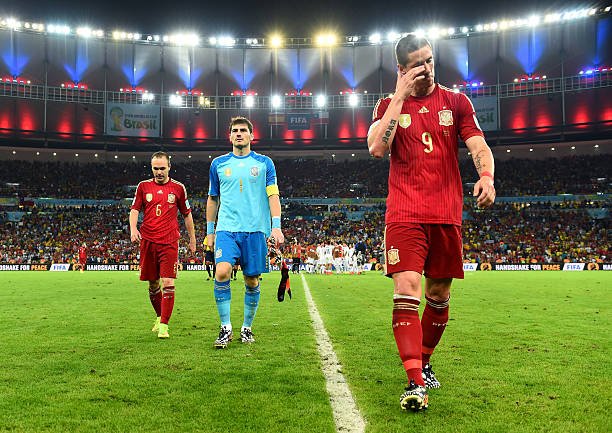
In just a matter of days, a dynasty that once seemed indestructible collapsed. World champions in 2010 and back-to-back European champions in 2008 and 2012, Spain entered the 2014 World Cup in Brazil as overwhelming favorites. But instead of writing another glorious chapter, La Roja experienced one of the most brutal downfalls in the history of international football. Eliminated in the group stage after two consecutive defeats, humiliated by the Netherlands and then beaten by Chile, Spain came to symbolize the fragility of dominant cycles. This collapse was not just a sporting failure—it was part of a broader narrative, that of the “World Cup champions’ curse,” and marked the end of an era that had redefined modern football.
2008-2012 : a historic dominance and overwhelming favorite status
To understand the magnitude of the shock in 2014, we must go back to what Spain represented before the tournament. Between 2008 and 2012, La Roja established an unprecedented dominance in international football.
The triumph began at Euro 2008, where Spain ended decades of frustration by winning the tournament. Two years later, they captured their first World Cup in South Africa in 2010, before confirming their hegemony with another title at Euro 2012.
This winning cycle was built on a clear identity: tiki-taka, a style based on possession, quick ball circulation, and exceptional technical mastery. Players like Xavi, Iniesta, Xabi Alonso, and Sergio Busquets embodied this philosophy. Sometimes more direct, as in Euro 2008, and sometimes slower, as in the 2010 World Cup, Spain consistently displayed total control over their matches.
Spain didn’t just win—they dominated, controlled, and suffocated their opponents. They became the ultimate benchmark.
An undisputed favorite in 2014 despite some worries…
Arriving in Brazil, Spain was logically considered the top favorite. According to multiple pre-tournament analyses, they were seen as the most feared team, ahead of nations like host country Brazil or Germany, a traditional World Cup powerhouse.
This status was explained by several factors. The core of the golden generation was still intact, with players like Xavi, Iniesta, Busquets, Xabi Alonso, as well as the defensive spine of Piqué, Ramos, and Casillas. These players had already won everything and possessed unmatched experience in major tournaments, both internationally and at club level. With many of them playing for Real Madrid or Barcelona, the squad was accustomed to high-pressure title races and Champions League semifinals.
However, behind this façade of strength, warning signs had already begun to appear as early as Euro 2012. Spain’s style was becoming increasingly understood by opponents, particularly through exploiting the space behind their very high defensive line. Italy demonstrated this effectively in the group stage of Euro 2012, and even in the final, where the first half was far more balanced than expected.
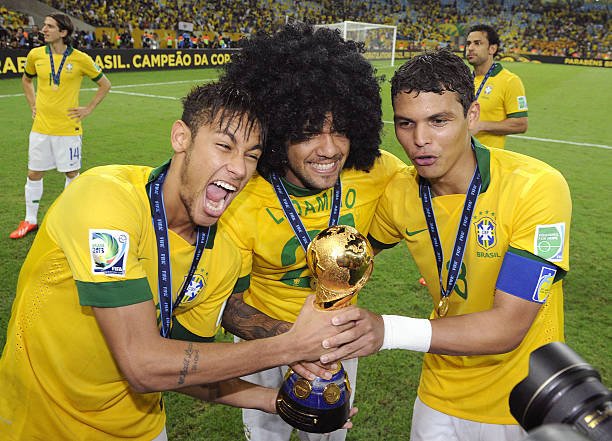
The golden generation was also aging and had endured marathon seasons since 2008 at both club and international levels. Some performances between Euro 2012 and the 2013 Confederations Cup were underwhelming. France challenged Spain and could have won in Madrid in 2012. Brazil also exposed Spain’s defensive weaknesses with a dominant victory in the 2013 Confederations Cup final.
Despite these signs, very few observers imagined such a rapid collapse.
A fatal double blow
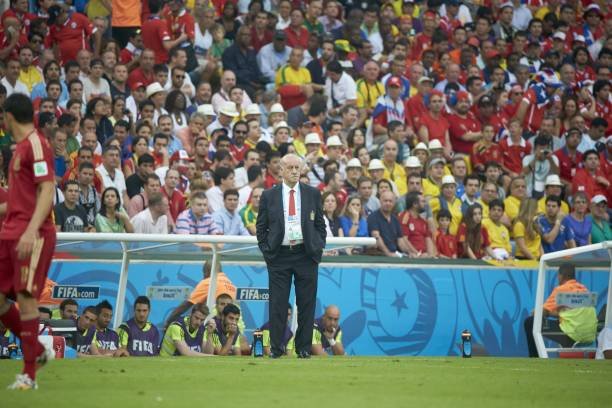
Rio de Janeiro, Brazil 6/18/2014
CREDIT: Simon Bruty (Photo by Simon Bruty /Sports Illustrated via Getty Images)
(Set Number: X158391 TK1 )
Even if signs of decline existed, no one anticipated such humiliation in the opening match.
On June 13, 2014, Spain faced the Netherlands in a rematch of the 2010 final. The game started well: Xabi Alonso opened the scoring with a penalty, and Spain looked dominant, even coming close to making it 2–0 through David Silva.
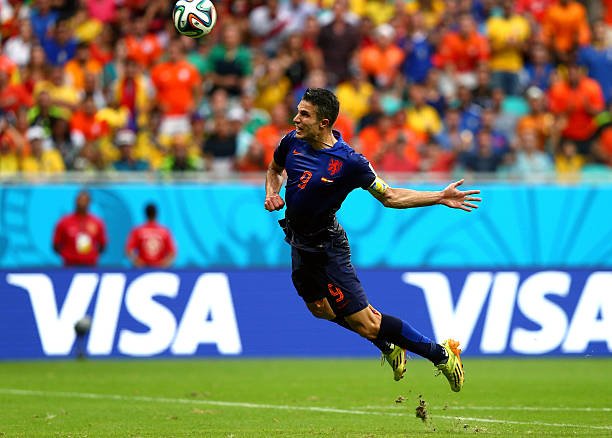
But what followed turned into a nightmare. Spain’s high defensive line became their downfall. Robin van Persie equalized with a spectacular header, and then the Dutch took over in the second half, exploiting the huge spaces behind Spain’s defense. Arjen Robben, in particular, tormented the Spanish backline with his blistering pace.
The 5–1 defeat was historic for several reasons. It was Spain’s heaviest World Cup loss in decades, it brutally exposed the team’s defensive flaws in a major match, and it ended La Roja’s aura of invincibility in official competitions since their loss to Switzerland in 2010.
Spain suddenly looked outdated: slow, predictable, and unable to respond.
This match highlighted the obsolescence of Spain’s model against teams capable of rapid transitions. The Netherlands perfectly exploited the weaknesses of a high line combined with sterile possession.
Tiki-taka, once a deadly weapon, had become a weakness.
Four days later, Spain faced Chile in a must-win game. But instead of bouncing back, they collapsed further. Chile imposed intense pressing, disrupted Spain’s buildup play, and scored twice before halftime. Spain, unable to respond, lost 2–0. This defeat sealed their elimination in the group stage.
As reigning world champions, Spain exited the tournament in the first round—a rare humiliation for a nation of this stature.
Beyond the results, it was the image that stood out: a team lacking energy, disorganized, and unable to adapt. The final match against Australia (a 3–0 win) changed nothing—the damage was already done.
World Champions curse
Since the early 2000s, several reigning champions have suffered early exits: France in 2002, eliminated in the group stage without scoring a single goal; Italy in 2010, also eliminated in the group stage; Spain in 2014; and Germany in 2018.
This pattern has led observers to speak of a true “curse.”
Several factors explain this phenomenon. There is physical and mental fatigue—winning a World Cup requires extreme intensity, and four years later, without renewal, the same players often arrive exhausted or declining, as seen with France in 2002.
Being world champions also makes a team the one to beat. Their style is studied, analyzed, and neutralized, as seen with Germany’s sterile possession game in 2018.
Finally, there can be a form of unconscious complacency. After reaching the summit, it is difficult to maintain the same hunger and intensity.
Spain was the perfect victim of this pattern. Their once-revolutionary style became predictable. Their veteran core was no longer at its peak. And against better-prepared opponents, La Roja lost what had made them dominant: control.
This context partly explains the brutality of their elimination, but it alone cannot fully account for the scale of the disaster.