

Filippo Inzaghi was never the kind of striker who made defenders tremble with dazzling footwork, explosive acceleration, or extraordinary physical strength. He was not particularly elegant on the ball, rarely involved in elaborate build-up play, and certainly not the most technically gifted forward of his generation. Yet, for more than a decade, the Italian striker found a way to terrorize some of Europe’s greatest defenses. His secret was simple, almost primitive in its execution: he knew exactly where the goal was, and more importantly, how to get there before everyone else.
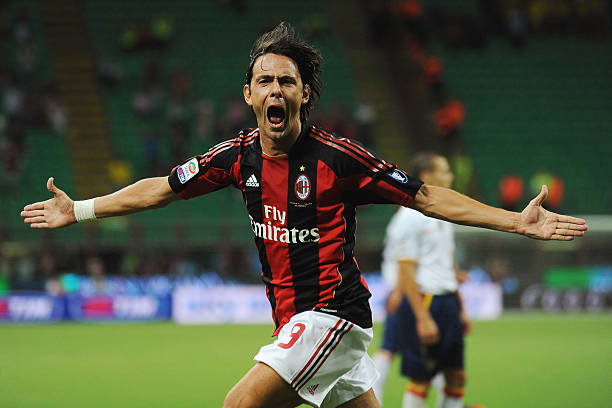
Nicknamed “Super Pippo,” Inzaghi built his reputation around an extraordinary instinct for scoring. Born in Piacenza on August 9, 1973, he developed through Italian football’s lower divisions before establishing himself as one of the country’s most prolific forwards. His breakthrough came during the 1996-97 season with Atalanta, where he scored 24 Serie A goals and finished as the league’s leading scorer. It was a remarkable achievement for a player who had previously struggled to establish himself at Parma. Juventus quickly recognized his potential, signing him in 1997 and giving him the opportunity to compete at the highest level.
At Juventus, alongside Alessandro Del Piero and Zinedine Zidane, Inzaghi demonstrated that his unusual style could be effective even against Europe’s most sophisticated defensive systems. He was not a traditional target man, nor was he a forward who could consistently create opportunities through individual brilliance. Instead, he specialized in exploiting the smallest gaps between defenders. A slight hesitation, a poorly timed step, a moment of lost concentration: that was often all he needed.
His movement was his greatest weapon. Inzaghi constantly operated on the shoulder of the last defender, adjusting his positioning according to the movement of his teammates and the trajectory of the ball. He could disappear from a defender’s field of vision before suddenly reappearing in the six-yard box. His ability to anticipate rebounds, deflections, and loose balls made him particularly dangerous. While other forwards waited for the perfect pass, Inzaghi was already preparing for the possibility that the first attempt would be blocked or saved.
A striker who made a science out of the penalty box
There was something almost frustrating about watching Inzaghi play. His goals were not always beautiful. Some came from awkward touches, others from deflections, knees, shoulders, or scrappy situations in crowded penalty areas. He could score after seemingly losing control of the ball, or arrive at the far post when the entire defense was convinced the danger had passed. Critics often questioned his technical limitations and accused him of contributing very little outside the penalty area. His tendency to be caught offside also became part of his public image.
But those criticisms overlooked the intelligence behind his apparently chaotic style. Inzaghi understood the geometry of the penalty box better than almost anyone. His runs were rarely random, even when they appeared desperate. He constantly tested the defensive line, forced center backs to turn toward their own goal, and positioned himself to benefit from second balls. His game was built on anticipation rather than acceleration, timing rather than strength, and repetition rather than improvisation.
Carlo Ancelotti understood how to maximize those qualities at AC Milan. After arriving at San Siro in 2001, Inzaghi became an important component of a team filled with extraordinary technical talent. With Andrea Pirlo orchestrating play from deep, Kaká carrying the ball through midfield, and players such as Clarence Seedorf and Rui Costa providing creativity, Milan had the personnel to supply their striker with the right kind of service. Inzaghi did not need to dominate possession or dictate the rhythm of the game. He needed one decisive opportunity.
His partnership with Ancelotti was particularly significant because it gave him an environment in which his limitations became less important than his strengths. The Italian coach did not ask him to become a different type of forward. Instead, he built an attacking structure that allowed Inzaghi to concentrate on what he did best: finding space, attacking crosses, anticipating rebounds, and finishing moves with ruthless efficiency.
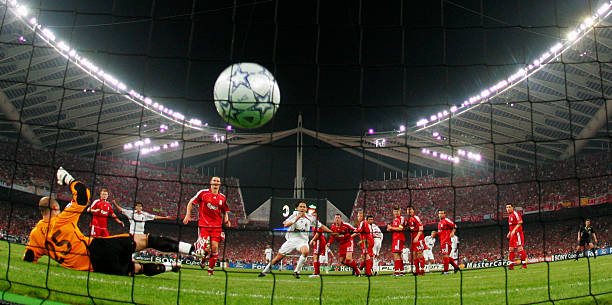
The results were spectacular. Inzaghi helped Milan win the Champions League in 2003 and again in 2007, becoming one of the defining figures of the club’s European success. He also played a major role in the 2007 final against Liverpool in Athens, scoring twice in a 2-1 victory. His first goal, a deflected free kick from Andrea Pirlo that struck his shoulder before beating Pepe Reina, was almost a caricature of his entire career. His second, however, was a demonstration of his intelligence and composure, as he ran onto Kaká’s pass, rounded the goalkeeper, and finished with precision.
Inzaghi’s career was also defined by his remarkable consistency in European competition. He finished with 70 goals in UEFA club competitions and 46 in the Champions League, figures that underline his extraordinary ability to deliver on the biggest stage. His international career with Italy also brought him a World Cup winner’s medal in 2006, adding another achievement to an already impressive collection.
What made Inzaghi special was not simply his ability to score goals, but his determination to find solutions despite his physical and technical limitations. He understood that football did not require every striker to be a complete player. Some forwards could dominate defenders through strength, others through speed or technique. Inzaghi chose a different route, turning positioning and anticipation into an art form.
His celebrations were as recognizable as his goals. Whenever the ball crossed the line, he exploded with an almost uncontrollable sense of joy, sprinting toward the stands with his arms spread wide. It was the reaction of a player who understood that every goal was the culmination of countless movements, rehearsed instincts, and relentless concentration.
In an era increasingly obsessed with versatile forwards capable of pressing, creating, dribbling, and linking play, Filippo Inzaghi represented something different. He was a specialist in the purest sense of the word. He did not need to touch the ball 50 times to influence a match, nor did he need to produce spectacular individual moments to decide a final. He simply needed to be in the right place at the right time.
That was the genius of Super Pippo. He did not redefine what a striker could do with the ball. He redefined how much a striker could achieve without it.
 AC Milan