

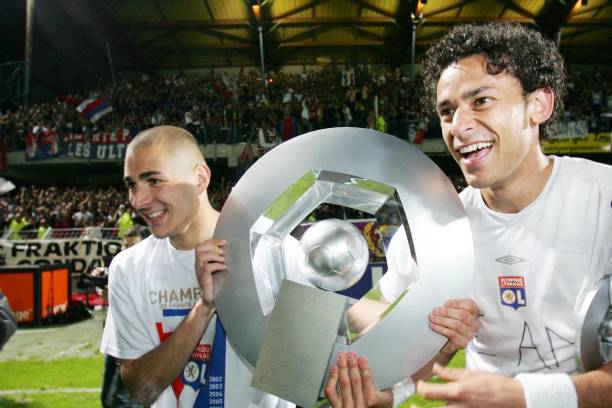
Some dynasties are built through blockbuster signings and seemingly unlimited spending. Others emerge from years of careful planning, smart recruitment, and an organization that knows how to turn success into a habit. Olympique Lyonnais belonged to the latter category. Between 2002 and 2008, Lyon won seven consecutive Ligue 1 titles, establishing a record that remains one of the defining achievements in French soccer. Yet behind this remarkable run was a more complicated story: a club that learned how to win, developed a sustainable model for domestic success, and repeatedly tried to translate its superiority in France into European glory. To understand Olympique Lyonnais’ dominance in the 2000s, it is necessary to return to the late 1990s, when chairman Jean-Michel Aulas began building a project that went far beyond the immediate pursuit of trophies.
When Aulas took over the club in 1987, Lyon lacked the history, financial resources, and reputation of France’s established soccer powers. His ambition, however, was straightforward: establish Lyon among the country’s elite and keep it there. The transformation was gradual. Lyon returned to the top flight, established itself in Ligue 1, expanded its revenue streams, and became increasingly attractive in the transfer market. Investment from external partners and a more professional approach to club management supported a sporting project that eventually delivered results. In 1999, investment from Pathé strengthened Lyon’s financial position and helped accelerate its development. The club was no longer content with competing for a place near the top of the standings. It wanted to build a team capable of overcoming player departures, managerial changes, and increasingly ambitious rivals.
The first major breakthrough came in 2001, when Lyon defeated Monaco 2-1 to win the Coupe de la Ligue. A year later, the club claimed its first French championship in dramatic fashion. On May 4, 2002, Jacques Santini’s team defeated Lens 3-1 at Stade de Gerland, securing the result it needed to finish ahead of its rival in the title race. The celebrations in Lyon marked the beginning of a new era. One championship did not yet constitute a dynasty, but it provided the foundation for a run that would fundamentally reshape French soccer.
What followed was remarkable in its consistency. Paul Le Guen replaced Santini and maintained the club’s momentum. Lyon won the league again in 2003, 2004, and 2005. The opposition changed and the circumstances varied, but the outcome remained the same. Brazilian midfielder Juninho Pernambucano became the face of the team, capable of changing a game with one of his extraordinary free kicks. Around him, players such as goalkeeper Grégory Coupet, defender Cris, Michael Essien, Mahamadou Diarra, Florent Malouda, Sidney Govou, and Sylvain Wiltord formed a remarkably deep squad. Lyon did not depend on one goalscorer or a single tactical approach. It had the personnel to control midfield, attack through the wings, and find decisive contributions in the biggest moments.
A winning machine

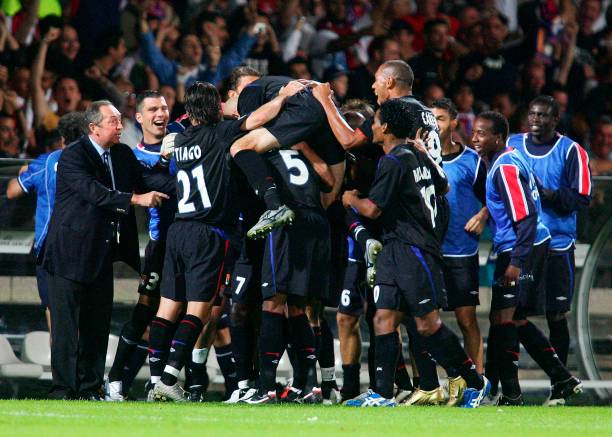
One of Olympique Lyonnais’ greatest strengths was its ability to rebuild without losing its identity. The departure of a major player, often for a substantial transfer fee, did not trigger the collapse that many observers expected. When Michael Essien joined Chelsea in 2005, Lyon recruited Tiago and continued to progress. Mahamadou Diarra moved to Real Madrid in 2006, but Jérémy Toulalan and Kim Källström helped maintain the quality of a midfield that remained among the strongest in France. This recruitment strategy, combined with a coherent sporting structure, allowed Lyon to preserve its competitive edge. Gérard Houllier arrived in 2005 and inherited an already established winning culture. He guided the club to two more consecutive championships in 2006 and 2007, extending Lyon’s advantage over its domestic rivals. The 2006-07 season illustrated the team’s strength: Lyon finished first with 81 points, even though its Champions League campaign ended before the final stages. In 2008, Alain Perrin led the club to a seventh consecutive Ligue 1 title and added the Coupe de France after a victory over Paris Saint-Germain. The domestic double represented the peak of Lyon’s supremacy. Its success was not simply a product of talented players. It came from an ability to anticipate departures, recruit effectively, and turn victories into the financial and sporting resources needed to keep winning.
There was, however, one persistent limitation to Lyon’s dominance: Europe. As the Ligue 1 titles accumulated, the Champions League became the ultimate objective for Aulas. Lyon had developed the resources to compete with the continent’s biggest clubs, but every European campaign highlighted the difficulty of taking the final step. In 2004, José Mourinho’s Porto eliminated Lyon in the quarterfinals. A year later, PSV Eindhoven knocked the French side out after a tense tie decided by a penalty shootout. A growing sense of frustration emerged. Lyon had become too strong for France, yet it still needed to prove that it could consistently overcome Europe’s established giants.
The 2006 quarterfinal against AC Milan remains one of the defining moments of that frustration. Lyon had impressed during the group stage, including a convincing victory over Real Madrid, before facing Milan for a place in the semifinals. The first leg ended 0-0, leaving the tie finely balanced ahead of the return game at San Siro. Lyon appeared close to pulling off a historic upset, but Filippo Inzaghi scored in the 88th minute before Andriy Shevchenko added another goal moments later. With qualification seemingly within reach, Lyon’s European dream collapsed. The defeat represented more than an elimination. It captured the gap between a team that dominated its domestic league and one capable of winning the most prestigious competition in European club soccer.
Lyon refused to abandon its ambitions. In 2007, AS Roma eliminated the French champions in the round of 16. Manchester United repeated the feat a year later. Meanwhile, Lyon’s domestic winning streak ended after the 2008 championship. The club remained a major force, but its cycle was beginning to lose momentum. Rivals had improved, key players were aging or leaving, and the dominance that once seemed inevitable became increasingly difficult to sustain.
The 2009-10 season nevertheless delivered one final European chapter for that generation. Now managed by Claude Puel, Lyon had lost Juninho, who departed in 2009, and was no longer the reigning French champion. Yet the team produced an outstanding Champions League run. Lyon eliminated Real Madrid in the round of 16, then defeated domestic rival Bordeaux in the quarterfinals to reach the first Champions League semifinal in its history. Bayern Munich proved too strong over two legs, ending Lyon’s hopes of reaching the final. Even so, the campaign demonstrated that the club’s legacy extended beyond its seven consecutive league titles. The organization had established Lyon as a regular presence among Europe’s leading teams.
Olympique Lyonnais’ dominance in the 2000s remains one of the most remarkable periods in Ligue 1 history. Seven consecutive championships, a domestic double in 2008, a recruitment strategy capable of absorbing major departures, and repeated appearances in the Champions League established the club as a genuine European contender. The absence of a continental trophy remains an obvious source of frustration, but it should not overshadow the scale of the achievement. Under Aulas, Lyon changed its status and demonstrated that a club outside Europe’s traditional elite could build a lasting period of supremacy. Lyon never conquered Europe during that era, but it ruled France like few teams before it. That combination of sustained success, ambition, and missed opportunities is precisely what makes its dynasty so compelling.
 Lyon