

As the UEFA Champions League enters its decisive stage, the competition shifts into its most intense and unforgiving phase. With the league phase now behind us, the tournament becomes a pure test of nerve, experience, and elite performance. From this point on, there are no safety nets, no second chances, and no room for complacency.
The Champions League final phase begins with the Knockout Play-offs, a newly introduced stage that adds another layer of drama before the traditional Round of 16. From there, Europe’s best clubs embark on a high-pressure journey toward continental immortality.
This article explains how the Champions League final phase works, the rules that define it, and the top clubs to watch as the road to European glory truly begins.
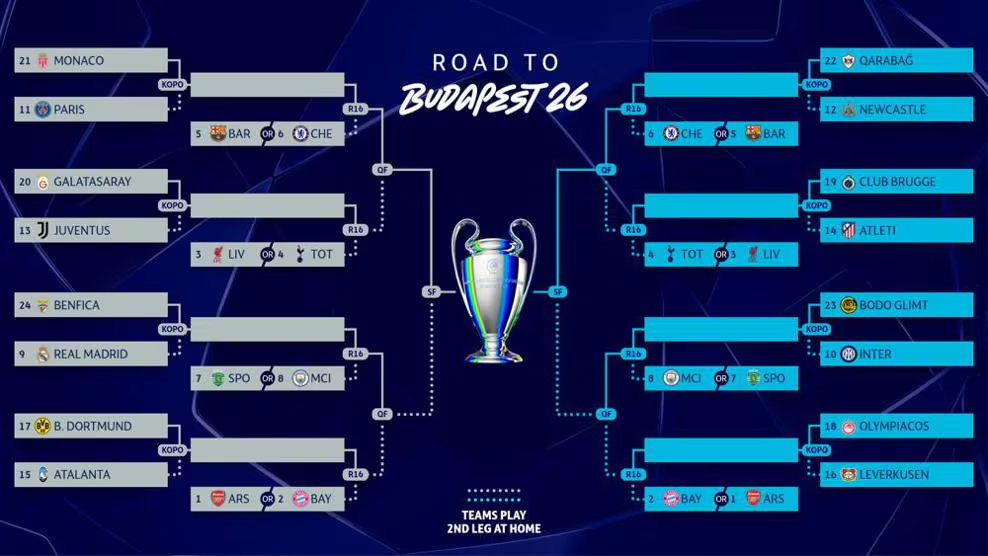
Knockout play-offs : the gateway to the Round of 16
The Knockout Play-offs represent the first step of the Champions League’s final phase. This round exists to determine the final teams that will join the competition’s elite in the Round of 16.
Format
- Two-legged ties (home and away)
- Aggregate score over both legs decides the winner
- If the aggregate score is tied:
- Extra time is played
- Followed by a penalty shootout if needed
There is no away goals rule. A goal scored away from home holds the same value as one scored at home.
Seeding rules
- Teams are divided into seeded and unseeded groups
- Seeded teams generally play the second leg at home
- Seeded teams cannot face clubs from the same country
This structure is designed to reward stronger performances while maintaining competitive balance.
Why the knockout play-offs matter
The play-offs are often brutal. Clubs entering this round face immediate elimination, and many traditional giants find themselves under pressure far earlier than in previous Champions League formats.
These matches are:
- High-intensity
- Strategically cautious
- Emotionally charged
For many teams, the Knockout Play-offs feel like a final before the final.
Round of 16 : where the Champions League identity emerges
Once the Knockout Play-offs conclude, the competition narrows to 16 teams, and the Champions League enters its most recognizable phase.
Format
- Two-legged knockout ties
- One match at home, one away
- Aggregate score determines the winner
- Extra time and penalties if tied
The removal of the away goals rule has transformed this round, encouraging more attacking football and reducing overly defensive approaches in away matches.
Strategic importance
The Round of 16 is often where:
- Tournament favorites assert dominance
- Dark horses reveal their potential
- Tactical battles become decisive
A strong first leg can provide psychological control, while a poor start can leave even elite teams scrambling to recover.
Quarterfinals : only the elite survive
By the quarterfinal stage, only eight teams remain — each one capable of winning the competition.
Format
- Two legs
- No seeding
- Any team can face any opponent
At this stage, experience becomes invaluable. Players and managers must manage:
- Fatigue
- Injuries
- Suspension risks
- Tactical adjustments across two demanding matches
The quarterfinals often deliver some of the most iconic matchups and unforgettable moments in Champions League history.
Semifinals : pressure at its absolute peak
The Champions League semifinals represent the highest level of intensity in club soccer outside the final itself.
Format
- Two-legged ties
- Aggregate score decides the finalists
- Extra time and penalties if required
The mental battle
With the final within reach, pressure becomes immense. Teams must:
- Control emotions
- Handle hostile atmospheres
- Manage expectations from fans and media
Mistakes at this stage are rarely forgiven. A single lapse in concentration can undo an entire campaign.
The Final : one match, one champion
The Champions League final is the ultimate test.
Format
- Single match
- Played at a neutral venue
- 90 minutes, followed by:
- Extra time if necessary
- Penalty shootout if the tie remains level
There is no second leg, no recovery. Everything is decided on one night.
What defines a Final
- Tactical discipline
- Individual brilliance
- Composure under pressure
Some finals are cagey and tense, others explode into attacking spectacles, but all share the same truth: only one team leaves as champion.
Key rules that shape the Final phase
No away goals rule
The removal of the away goals rule encourages balanced approaches and ensures that every goal carries equal value, regardless of venue.
Squad management
Teams rely on their registered squads, making rotation and depth critical. Injuries or suspensions can dramatically shift the balance of a tie.
Discipline and suspensions
Yellow cards accumulate, and suspensions at this stage can deprive teams of key players in decisive matches.
What it takes to win the Champions League Final phase
Winning the Champions League requires more than star power. Successful teams usually combine:
- Tactical adaptability
- Mental resilience
- Squad depth
- European experience
- Clinical execution in key moments
Coaches must manage not only tactics, but also emotions, recovery, and game management across multiple high-pressure fixtures.
Top clubs to watch in the final phase
Real Madrid
No club understands Champions League knockout football better. Their history, mentality, and ability to thrive under pressure make them perpetual contenders.
Manchester City
Built for control and dominance, City are structured to excel in two-legged ties, combining possession with relentless attacking quality.
Bayern Munich
Physically imposing and tactically disciplined, Bayern are always dangerous once the competition reaches the knockout rounds.
Paris Saint-Germain
Driven by ambition and star talent, PSG seek consistency and composure in decisive moments — their greatest challenge in Europe.
Dark horses
Clubs like Arsenal, Atlético Madrid, Inter Milan, or Barcelona often thrive in knockout scenarios, where tactical intelligence can outweigh star power.
Why the final phase is the essence of Soccer
The Champions League final phase strips soccer down to its purest form:
- Win or be eliminated
- Glory or disappointment
- Legacy or regret
There are no long-term calculations, only immediate performance. Every decision matters. Every mistake is punished.
Conclusion : the road to European immortality
The Champions League’s final phase is where soccer history is written. From the unforgiving Knockout Play-offs to the grand final, the competition becomes a relentless test of quality, mentality, and ambition.
For players, it’s a stage that defines careers.
For clubs, it’s the ultimate measure of greatness.
For fans, it’s football at its most dramatic and emotional.
The road is brutal. The margins are thin.
Only one team will survive it all.
The race for European immortality has begun.