

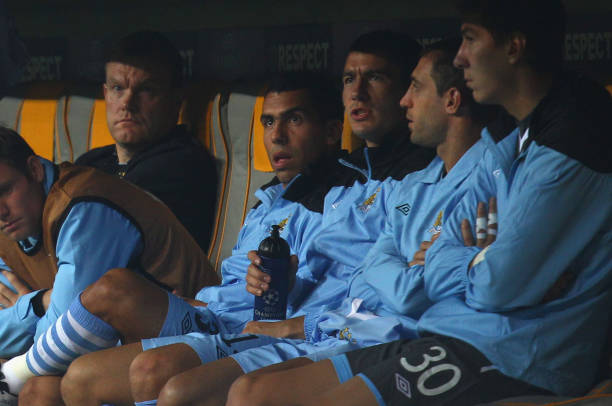
September 27, 2011, was supposed to be a historic night for Manchester City. Just a few months after winning the FA Cup, the English club was playing one of the first major European nights of its new era. The arrival of Abu Dhabi ownership had transformed the Citizens into contenders at the top of English soccer, but the Champions League still represented largely uncharted territory. For their second group-stage game, City traveled to the Allianz Arena to face Bayern Munich. Opposite them was a team accustomed to these European occasions, backed by a roaring home crowd. For Roberto Mancini and his players, the match was supposed to serve as a statement: Manchester City now wanted to establish itself among Europe’s elite.
On the field, however, the night would quickly turn into a nightmare. Manchester City started the game well enough and kept possession against Bayern. For around 30 minutes, the English side even managed to contain the Bavarians. But the Germans gradually took control of the match. Mario Gómez opened the scoring after Joe Hart’s initial save, before doubling the lead a few minutes later. At halftime, City was trailing 2-0 and Mancini was looking for a way to revive his team. The Italian decided to change his attack. Edin Džeko, who had started up front, was replaced by Nigel de Jong at the beginning of the second half. The Bosnian reacted angrily to the decision. Džeko openly showed his frustration toward his manager before heading to the bench.
It was in this tense atmosphere that Carlos Tévez became the center of one of the biggest controversies of the season. The Argentine, who had been Manchester City’s captain just a few months earlier, was sitting on the bench. Mancini wanted to use him to try to get back into the game. According to the account given by the Italian manager immediately after the match, Tévez then refused to come on. The incident was visible enough to cause an immediate shockwave: with City trailing 2-0 in the Champions League and desperately trying to get back into the game, one of its most important players appeared unwilling to take part in the comeback. Furious, Mancini then declared that Tévez was “finished” at Manchester City and that he wanted to see him leave the club.
But the story did not end with the final whistle. In the hours that followed, the account of the evening became the subject of a genuine media battle. The club presented the incident as a refusal to play. Tévez denied it. In a statement released the following day, his representatives explained that there had been confusion on the bench and that the Argentine had never refused to take part in the match. A few hours later, Tévez maintained that version and said his position had been misunderstood.
The stand off between Tevez and Mancini
Behind the incident was a relationship that had already become far more complicated than it had been just a few months earlier. Carlos Tévez was one of the central figures of the Manchester City built after the arrival of Abu Dhabi investment. He had just finished the 2010-11 season with 24 Premier League goals and had worn the captain’s armband for much of the campaign. But during the summer of 2011, the Argentine repeatedly expressed his desire to leave Manchester, particularly for family reasons. Mancini had already had to deal with his striker’s frustrations and had gradually reduced his influence within the squad. The captaincy had notably been taken away from him and given to Vincent Kompany.
In Munich, the conflict between the two men therefore appeared to reach a breaking point. Mancini believed Tévez had refused a direct instruction from his manager. Tévez told a different story. Several months later, when he reflected on that night, the Argentine explained that he had not wanted to refuse to play but had refused to go back out and warm up under the conditions imposed by Mancini. According to his version, the manager had spoken to him aggressively and treated him “like a dog.” He also claimed he was angry because Mancini had previously questioned his fitness and taken away the captaincy.
The incident became even more confusing because several events were unfolding almost simultaneously on the bench. Džeko had just been substituted and had shown particular frustration. Mancini was already angry with his Bosnian striker. The manager then turned to Tévez and asked him to warm up. According to Tévez, this was when he refused, believing Mancini was speaking to him disrespectfully. According to the club and Mancini, however, it was a refusal to participate in the match. The difference between the two accounts is crucial: one describes a player refusing to warm up in a tense situation, while the other describes a player refusing to obey an instruction and enter the field.
Manchester City quickly decided to suspend its striker. The club announced that he could be suspended for up to two weeks while it carefully examined the footage and testimony from the match. Tévez was no longer allowed to train or be selected during that period. Mancini, meanwhile, made no secret of his desire to see the player leave. The manager even publicly asked the club’s executives to bring the Argentine’s time at Manchester City to an end.
The conflict then took on a dimension that went far beyond a simple sporting incident. Tévez’s behavior became a national talking point in England and divided the soccer world. His alleged refusal came at a time when Manchester City was trying to build a new collective identity. The club now had considerable financial resources, a star-studded squad and unprecedented European ambitions. But that night in Munich portrayed a locker room still marked by tensions between individual personalities and the manager. The Guardian, in its match report, notably described the visible tensions between Džeko and Mancini before presenting the Tévez incident as a symbol of a team that still lacked cohesion.
The punishment would ultimately become far more serious than the initial suspension. After an internal investigation, Manchester City announced in October that Tévez had been found guilty of several contractual breaches related to his behavior during the match. The club cited five separate violations and initially fined him the equivalent of four weeks’ wages, around £1 million, along with a two-week suspension that was already considered served.
But even that decision did not end the controversy. The Professional Footballers’ Association’s intervention further complicated the case. The union argued that the available evidence did not establish that Tévez had refused to play and instead supported the idea that he had refused to warm up. The financial penalty was eventually reduced to two weeks’ wages. Tévez then chose not to appeal the decision, but he did not immediately offer the apology Mancini was demanding before considering his return to the team.
For several months, Carlos Tévez therefore disappeared from Manchester City’s plans. The club tried to find him an exit during the January transfer window, with talks involving Paris Saint-Germain, AC Milan and Inter among others. But no transfer materialized. City notably refused to sell its striker for a price it considered insufficient, even as Mancini had publicly suggested that his return would depend on an apology. Tévez eventually traveled to Argentina without the club’s permission in November, adding another episode to a relationship that had become almost impossible.
Yet the story would not end in Munich. Several months after the night that had appeared to permanently condemn Tévez to an exit from Manchester City, Mancini eventually reopened the door to a return. The Argentine gradually rejoined the squad in the spring of 2012. His return came in a particular context: Manchester City was fighting for the Premier League title and the season was entering its decisive stage. The striker returned to the field and began scoring again.
On May 6, 2012, just weeks after his return, Tévez played a part in City’s spectacular victory over Manchester United at the Etihad Stadium, a win that brought the Citizens closer to the title. He ultimately finished the season with Manchester City and helped the club win its first league title since 1968. The player who just a few months earlier had appeared destined to leave Manchester found himself crowned English champion with the same manager with whom he had been involved in a bitter dispute.
The night of September 27, 2011, nevertheless remains one of the most memorable episodes in Manchester City’s recent history. It sums up a period when the club was still searching for a balance between its new ambitions, its stars and the authority of a manager tasked with turning an accumulation of talent into a team. The Munich incident has never been told in exactly the same way by those involved: Mancini and Manchester City saw it as a refusal to obey and play, while Tévez has always maintained that he did not refuse to participate in the match, but only refused to warm up after a confrontation with his manager. The club’s internal investigation nevertheless found several contractual breaches and punished the player.
What was supposed to be nothing more than a 2-0 defeat to Bayern Munich therefore became a turning point in Manchester City’s history. In a matter of minutes, a decision on the bench triggered a rupture between one of the club’s most important players and his manager, sparked a media battle, resulted in a substantial financial penalty and kept Tévez away from the field for several months. And yet, less than a year later, the Argentine was lifting the Premier League trophy with Manchester City. An irony that perfectly reflected his time with the Citizens: as spectacular as it was chaotic.