

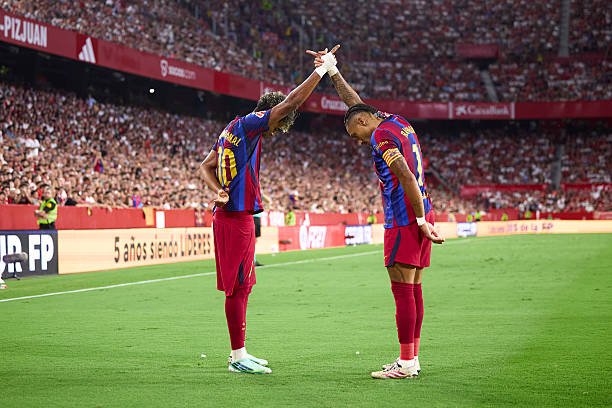
Barcelona have impressed since the start of the season with their ability to tear opposing defenses apart. Led by an increasingly aggressive collective approach and an especially mobile attacking unit, Hansi Flick’s Barça no longer relies solely on individual brilliance to make the difference. Rotations, pressing, and the use of space allow the Catalans to string together dominant performances, sometimes turning their games into genuine five-goal routs.
Big scorelines are nothing new under Hansi Flick, but the beginning of this season has shown an interesting evolution in the way Barcelona build their victories. After four La Liga games, the Catalans had already scored 17 goals, including a 5-0 win at Valencia. Against Athletic Club, Barcelona once again came away with a 2-0 victory in a game where their control of possession, movement, and pressing constantly caused problems for their opponents.
The first secret lies in Barcelona’s ability to change their structure without losing their reference points. On paper, Flick generally keeps a 4-3-3 formation. But during buildup, that structure can evolve into a 3-4-3 thanks to a fullback moving inside. Against Athletic, Xavi Espart moved into a central position to create a numerical advantage in the first line of buildup. Barcelona could then play out with a three-versus-two advantage against Athletic’s first line of pressure.
This flexibility is particularly useful because it allows the midfielders to receive the ball in better conditions. Pedri remains one of the team’s main playmakers, capable of quickly finding attacking players between the lines. His influence was once again evident against Athletic, as he provided the pass that allowed Raphinha to open the scoring.
But one of the defining characteristics of Flick’s Barcelona is their attacking rotations. Lamine Yamal and Raphinha are not simply wingers expected to remain glued to the touchline. They can move inside, attack the space in behind, or exchange positions with their teammates. This mobility makes the defenders’ jobs considerably more difficult, forcing them to constantly choose between following their direct opponent or protecting their zone.
An attack that no longer need to stay static
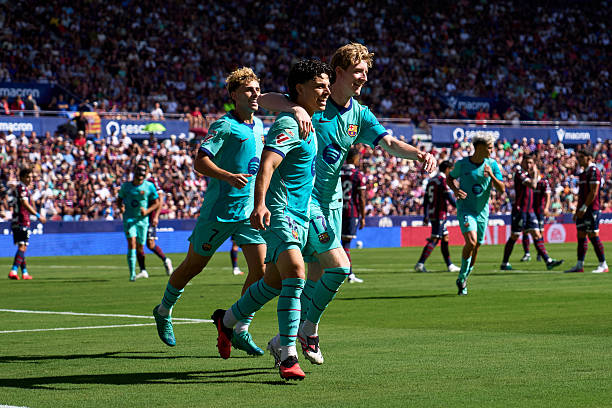
This attacking freedom is even more important because Barcelona can now vary where they launch their attacks. Lamine Yamal represents a constant threat when receiving the ball to feet, but he can also be found in behind the defense. Raphinha, meanwhile, can start on the left before moving into a more central area. The result is an attack in which the players’ starting positions do not necessarily correspond to their final positions.
One of the most interesting developments is the way Barcelona use the space created by the absence of a traditional center forward. Barça can have a player temporarily occupy the No. 9 position before that player drops deeper and opens up space for a winger or midfielder to attack. This movement makes individual marking particularly risky for opposing defenses.
Goals then come less from isolated actions than from a succession of movements. One player attracts a defender, another attacks the space that has been created, and a third arrives in support. Barcelona therefore look to move the opposing defensive block before accelerating.
The other fundamental weapon remains pressing. As soon as they lose the ball, Flick’s players look to win it back high up the field. The objective is not simply to regain possession immediately. It is also to prevent the opponent from playing out cleanly and force them into areas where Barcelona can recover the ball.
This aggression helps explain why the Catalans can sometimes score several goals within very short periods. A high recovery can immediately become a scoring opportunity, before another opponent turnover creates yet another attack.
The arrival of Rodri adds another dimension to this system. Against Athletic, the Spanish midfielder came on in the 62nd minute for Marc Bernal, allowing Flick to alter his midfield while maintaining control of the game. His profile provides an additional ability to secure buildup play and manage transitions.
Barcelona are therefore not simply a team that attacks frequently. They are a team that looks to keep opponents under pressure for long stretches, alternating possession, movement, acceleration, and high recoveries.
That is probably where the real secret behind their big wins lies. Their attacking displays are not solely the product of the talent of Yamal, Raphinha, or the other forwards. They are the consequence of a system in which the players are constantly moving, the team’s structures change depending on the phase of play, and the ball is immediately hunted down after possession is lost.
Flick’s Barcelona therefore retain the club’s traditional technical identity while combining it with a much more vertical intensity. When all the pieces work simultaneously, opponents can quickly become overwhelmed. And those five-goal routs become less surprising than they initially appear.