

November 17, 1993 remains one of the most painful dates in the history of French soccer. That night, at the Parc des Princes, the French national team believed it had secured qualification for the 1994 World Cup before collapsing in the final seconds against Bulgaria. Emil Kostadinov’s goal plunged an entire country into silence and instantly became a national trauma. Yet behind this legendary defeat also lies the starting point of a rebuilding process that would lead France to World Cup glory in 1998.


An explosive context : from arrogance to doubt
At the start of the 1990s, France was still trying to recover from the end of the Platini era. Absent from the 1990 World Cup and humiliated at Euro 1992, Les Bleus wanted to reclaim their place among the world’s elite. Under Gérard Houllier, a talented new generation emerged: Eric Cantona, Jean-Pierre Papin, Didier Deschamps, Laurent Blanc, and Marcel Desailly embodied this renewal.
Qualification for the World Cup in the United States seemed almost guaranteed. Before the final two matches, at home against Israel and Bulgaria, France needed just one point to punch its ticket. Qualification looked so certain that part of the country was already looking ahead to the tournament itself. That confidence even turned into overconfidence at times.
But on October 13, 1993, everything changed. At the Parc des Princes, France lost to Israel 3-2 after leading the match. An unimaginable defeat that threw Les Bleus into panic. The media spoke of humiliation, the players began to doubt themselves, and Bulgaria suddenly realized an upset was possible. The Bulgarians, led by Hristo Stoichkov, Balakov, and Kostadinov, arrived in Paris convinced France could mentally collapse under pressure.
The situation was also shaped by internal tensions within French soccer. The rivalry between Marseille and PSG players, both clubs at the top of European soccer at the time, poisoned the atmosphere inside the squad. Some observers described a divided locker room, unable to collectively handle the pressure. The Marseille contingent was the dominant group and isolated the PSG and Monaco players.
The game : four seconds that traumatized France forever
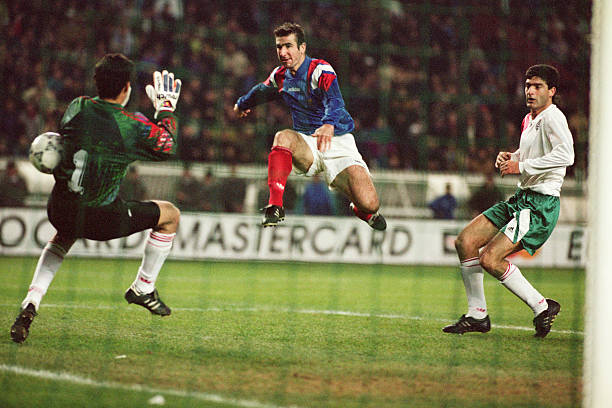
It was in this tense atmosphere that France hosted Bulgaria on November 17, 1993, in a packed Parc des Princes. The mood was heavy and nervous. Despite the Israel disaster, France still controlled its destiny: a draw would be enough. From the opening minutes, Les Bleus played with fear while Bulgaria displayed aggression and impressive technical quality.
In the 32nd minute, Eric Cantona gave France the lead from the penalty spot. The stadium erupted and the country could finally breathe again. But the relief lasted only five minutes. Emil Kostadinov equalized after a French defensive mistake. The tension became unbearable.
In the second half, France played less to win than to avoid losing. Every passing minute brought the World Cup closer, but every Bulgarian attack terrified the Parc. Didier Deschamps would later call it the darkest moment of his career.
Then came the final play.
In the dying seconds of regulation time, David Ginola attempted an attacking cross that was badly delivered, even though keeping possession seemed the smarter option. Bulgaria immediately recovered the ball. The counterattack was devastating. Within seconds, the ball reached Kostadinov, who unleashed a shot under Bernard Lama’s crossbar. Bulgaria led 2-1.
The Parc des Princes froze.
French commentator Thierry Roland delivered his now legendary line: “It’s a catastrophe.”
The final whistle plunged French soccer into chaos. Gérard Houllier publicly blamed David Ginola for the fatal play, creating a lasting fracture. The players left the field devastated. France would not play in the 1994 World Cup.
The founding trauma behind 1998
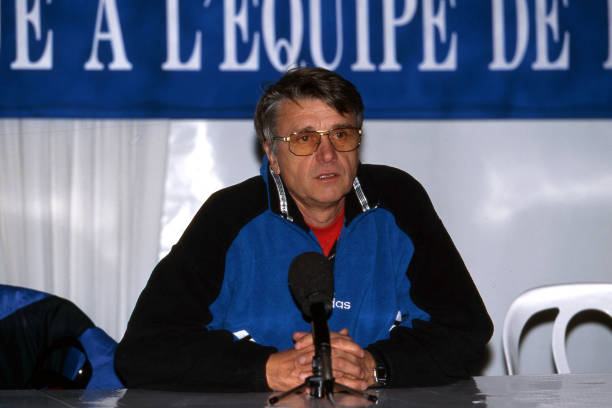
At the time, the defeat felt like the end of an era. It marked the collapse of a gifted generation unable to cope with pressure in decisive moments. Cantona and Ginola would never again become long-term fixtures for the national team. Houllier resigned, and French soccer entered a deep identity crisis.
Yet with hindsight, France-Bulgaria 1993 appears as the starting point of a rebirth.
A few weeks after the disaster, Aimé Jacquet took charge of the national team. In a climate of widespread distrust, he slowly rebuilt the squad around collective discipline, unity, and mental toughness. Didier Deschamps became the natural leader of a team that learned from its scars.
The trauma of 1993 psychologically shaped the future world champions. Many of the “damned” players from the Parc des Princes — Deschamps, Blanc, and Desailly among them — would become the pillars of France’s 1998 World Cup triumph at the Stade de France. That wound fueled their obsession with control, discipline, and emotional composure.
In France’s collective memory, two dates are now forever linked: November 17, 1993, and July 12, 1998. One symbolizes the greatest nightmare in the history of Les Bleus, the other their greatest triumph.
And if French soccer reached the summit five years later, it was also because it had first experienced its darkest night.
FranceFrance