

For several years, tensions between FIFA and UEFA have continued to escalate. From the failed European Super League project to the expansion of the FIFA World Cup and the creation of the new FIFA Club World Cup, the two governing bodies have repeatedly clashed over the direction world soccer should take.
But the crisis sparked by Gianni Infantino’s proposal to open FIFA’s commercial operations to private investors may represent a historic turning point. By unanimously threatening to boycott future World Cups if the reform is adopted, UEFA is no longer simply voicing criticism. For the first time with such determination, it is leveraging the sporting, economic, and political influence of its 55 member associations to try to curb Zurich’s ambitions.
This show of force raises a broader question: has UEFA become the primary counterweight to an increasingly centralized FIFA?
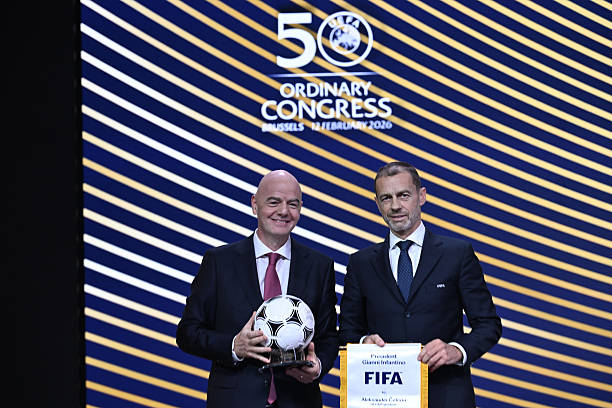
Why UEFA has the power to challenge FIFA ?
For decades, FIFA stood as the undisputed authority in world soccer, while the continental confederations focused primarily on organizing their own competitions.
That hierarchy gradually began to crack after Gianni Infantino became FIFA president in 2016.
The former UEFA general secretary quickly launched an ambitious strategy for global expansion: increasing the World Cup to 48 teams, creating an expanded FIFA Club World Cup, multiplying international competitions, and pursuing new revenue streams.
With every new reform, European officials have voiced the same concern: FIFA is steadily encroaching on both the club and international calendars while concentrating ever greater economic power in its own hands.
The proposal to open part of FIFA’s commercial activities to private investors was therefore seen by UEFA as a red line.
Behind the financial debate lies a much deeper issue: the independence of soccer’s governance.
The reason UEFA’s boycott threat is being taken seriously is simple: Europe occupies a unique position within the global soccer ecosystem.
The world’s leading national teams—including France, Spain, England, Germany, Italy, and Portugal—all compete under UEFA’s umbrella.
The biggest clubs, the most-watched domestic leagues, the sport’s biggest stars, and the overwhelming majority of global soccer revenues are also concentrated in Europe.
Imagining a World Cup without those national teams would mean stripping the tournament of a significant portion of both its sporting quality and its commercial appeal.
That is why Europe’s threat carries real weight: it directly targets FIFA’s flagship product.
For the first time in years, the organization in Zurich finds itself facing an institution capable of genuinely shifting the balance of power.
A counterweight… but not perfect one
That said, portraying UEFA as the selfless defender of world soccer would be overly simplistic.
UEFA is itself an enormously powerful organization, regularly criticized for the concentration of Champions League revenues, the increasingly crowded match calendar, and the widening financial gap between Europe’s elite clubs and smaller federations.
Its opposition to FIFA is therefore driven by more than democratic principles alone.
It is also defending its own interests.
Every new international competition reduces the space available for the Champions League, the European Championship, and other UEFA tournaments.
Behind the institutional rhetoric lies a major economic battle.
The governance of world soccer increasingly resembles a struggle for influence between two competing centers of power rather than a confrontation between right and wrong.
The debate now extends far beyond the question of private investment.
Two fundamentally different visions of soccer are colliding.
On one side, FIFA promotes a strategy of global expansion. It wants to create more competitions, attract new capital, and strengthen its role as a global economic powerhouse.
On the other, UEFA advocates for greater stability in the international calendar, the protection of historic competitions, and a governance model less dependent on financial interests.
This confrontation exposes a fundamental question: how far can soccer be transformed into an investment product without undermining the institutional framework that governs the sport?
Paradoxically, this crisis could ultimately benefit world soccer.
For decades, FIFA exercised almost unquestioned authority over the game’s major strategic decisions.
The emergence of a genuine counterweight now forces the most consequential reforms to be debated, negotiated, and, when necessary, challenged.
No single institution should wield absolute authority over a sport followed by billions of people.
A balance of power between multiple governing bodies can serve as an important safeguard against unilateral decision-making—provided those institutions truly act in the broader interest of the game rather than simply protecting their own financial positions.
The current standoff between UEFA and FIFA extends far beyond a dispute between executives.
It reflects the profound transformation of soccer governance in the 21st century.
As revenues continue to soar and investors become increasingly attracted to the global soccer market, the sport’s governing institutions are being forced to redefine their balance of power.
By threatening to boycott future FIFA World Cups, UEFA has sent a clear message: FIFA can no longer govern world soccer on its own.
Whether this confrontation marks the emergence of a genuine system of checks and balances—or merely another chapter in an ongoing power struggle in which each institution seeks above all to protect its own territory—remains to be seen.
One thing, however, is certain: the future of world soccer will no longer be decided solely on the field.
It will also be shaped in the boardrooms, where two competing visions of the world’s most popular sport are now battling for its future.