

Brighton’s 3-0 victory over Arsenal was not simply a surprise given the status of the two teams. Above all, it was a demonstration of how Fabian Hürzeler managed to prevent the Gunners from playing the type of soccer that usually allows them to control their games. While Arsenal had won its first four Premier League matches while conceding just one goal, Brighton managed to turn the game into a much more chaotic, intense and direct contest, exactly the type of game it wanted to impose. Individual pressing, central compactness, the ability to win second balls and the speed of its transitions prevented Mikel Arteta’s players from finding their usual rhythm. Arsenal finished the game with nearly 60 percent possession, but also lost the ball 41 times in its own dangerous areas, evidence that this apparent dominance never truly allowed the defending champions to control the match.
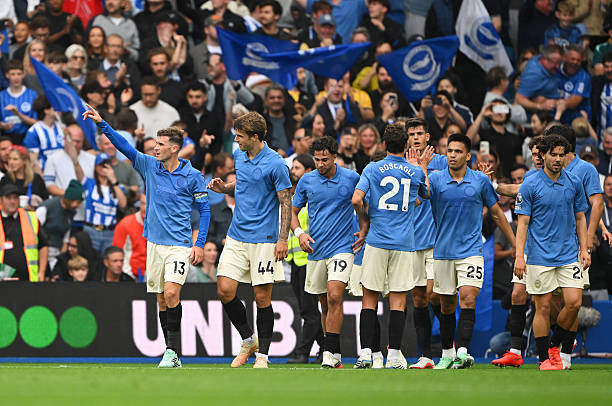
Brighton’s individual pressing that prevented the build up

The first key to Brighton’s victory was its pressing. Hürzeler did not ask his team to defend in a low block and wait for Arsenal to make mistakes. Instead, the Seagulls sought to prevent the Gunners from settling into their initial buildup phase. The principle was simple: each Brighton player had an individual reference, but the entire block remained compact enough to quickly transfer responsibilities whenever a player stepped out of position. Passes back to Bart Verbruggen or the center backs then became triggers that allowed Brighton to move forward collectively. Arsenal constantly had to play under pressure, without really being able to exploit the spaces created by its own movements. Hürzeler’s players notably closed down the inside passing options, forcing Arsenal to go around the block rather than through it. When the press was beaten, Brighton did not immediately drop back. The team could reorganize into a very compact 5-1-4, with a single player in front of the defense and four players narrowing the space to protect the middle. As soon as Arsenal played the ball backward, the press was triggered again. This alternation between a high press and a mid-block prevented the Gunners from establishing any truly stable possession sequences.
The problem for Arsenal was made worse by the absence of a genuine threat in behind. For such an aggressive pressing system to work, a team has to accept leaving space behind its last line. Brighton could do so because Arsenal was not able to attack that space consistently enough. Hürzeler’s players could therefore push forward without constantly fearing a pass that would force them to run toward their own goal. Every duel became easier to prepare for, and every turnover could immediately become an attacking situation. That was precisely what Brighton wanted: to turn Arsenal’s turnovers into attacking triggers rather than simply moments of regaining possession. The players closest to the ball were not necessarily looking to secure possession first. They immediately tried to progress toward goal, using a first vertical pass and quick runs around the player in possession. Brighton’s pressing was therefore not merely defensive: it was designed from the outset as the first stage of its attacks.
Hurzeler turns chaos into advantage
That is probably what distinguished Brighton’s performance most from a simply successful defensive display. Hürzeler did not try to control Arsenal by taking the ball away from them. He tried to control the conditions under which Arsenal could use it. That difference is essential. The Gunners needed a relatively organized game for their possession patterns to function, to draw the opposition press and then gradually find spaces. Brighton did exactly the opposite: it accelerated sequences, multiplied the number of duels and prevented Arsenal from stabilizing the game. The result was a match in which Arsenal’s possession no longer translated into its usual control. The defending champions had the ball, but Brighton often decided where that ball would be played and how Arsenal’s players would have to receive it.
Brighton’s buildup was itself designed to respond to Arteta’s pressing. Verbruggen was not afraid to hold onto the ball for a few extra seconds while his defenders spread out in order to draw Arsenal’s first line of pressure forward. But Brighton did not systematically try to play out from the back on the ground. A significant portion of the goalkeeper’s distributions were long, particularly toward the right side, where the Seagulls had prepared a structure capable of competing for second balls. Of the 40 passes from Verbruggen examined in Total Football Analysis’ study, 25 were long, or 62.5 percent. The objective, therefore, was not to beat Arsenal’s press at all costs through a succession of short passes, but sometimes to bypass it directly and turn an aerial duel into a new attacking phase.
This ability to alternate between short buildup and direct play made Brighton particularly difficult to read. On one side, the team could look to draw Arsenal’s players toward it before quickly switching play; on the other, it could use a higher and more physical structure to attack second balls. Brighton therefore did not play in exactly the same way on both sides of the field. This asymmetry allowed it in particular to move Arsenal’s players around, create one-on-one situations and maintain enough presence around the landing zone of long passes. Hürzeler thus used possession not as an end in itself, but as a way of provoking the reactions he wanted from his opponent. When Brighton won the ball back, the priority was then to play forward quickly. For Arsenal, this meant that every turnover could become a threat just seconds later.
Three goals, three weakness for holders
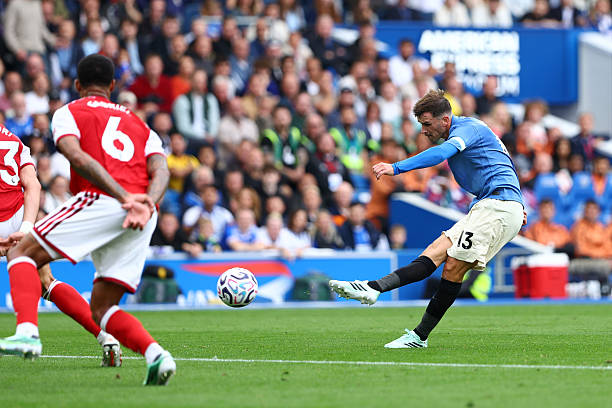
The three goals ultimately illustrated the diversity of Brighton’s game plan. The first, scored by Pascal Groß, rewarded the Seagulls’ ability to exploit the spaces created by their attacking movements and their aggression in the final third. The second, scored by Charalampos Kostoulas just before halftime, came at a moment when Arsenal was suffering even more from the consequences of its inability to play out cleanly under pressure. The third, scored by Chema Andrés from a corner, put the finishing touch on a game in which Brighton had also gained the upper hand in an area where Arsenal had nevertheless been particularly strong since the start of the season: duels and set pieces.
This variety is important because it shows that Brighton did not win by repeating a single tactical sequence. The first goal, the second and the third all came from different mechanisms. This is also what makes Hürzeler’s performance particularly interesting. The German coach had to deal with several important absences, particularly in his attacking department, while also starting Chema Andrés, just 21 years old, for his Premier League debut. Maxim De Cuyper was also continuing to adapt on the left wing, while Kostoulas was given an opportunity because of Georginio Rutter’s absence. Despite these changes, Brighton maintained an impressive level of collective cohesion.
For Arsenal, the problem was therefore not simply losing duels or making a few technical mistakes. The Gunners were gradually deprived of the environment in which they usually operate. Their possession was no longer clean enough to allow them to control the tempo, their buildup sequences were repeatedly disrupted and their turnovers in their own half immediately exposed their defense. Mikel Arteta acknowledged after the game that Brighton had been the better team and notably referred to the technical errors and duels lost by his players. The defeat therefore highlights a deeper question: when an opponent refuses to allow Arsenal to establish its control, the Gunners must find other ways to play through pressure and create danger.
Brighton’s 3-0 victory does not mean that Arsenal has been permanently “figured out.” One game is not enough to establish that a tactical model no longer works, especially since the Gunners had won their first four league matches and conceded just one goal. But it does show that there is a specific way to disrupt their organization: increase the intensity, defend on the front foot, close down the inside options and turn every recovery into a transition opportunity. Brighton above all demonstrated that it was not necessary to dominate Arsenal through possession in order to control the match. Hürzeler chose another definition of control, built around duels, pressing, second balls and the ability to dictate the tempo of transitions. Arsenal had more of the ball, but Brighton had more control over how the match was going to be played. That difference explains why the Seagulls were able to turn seemingly favorable possession for the defending champions into such a convincing and spectacular victory.