

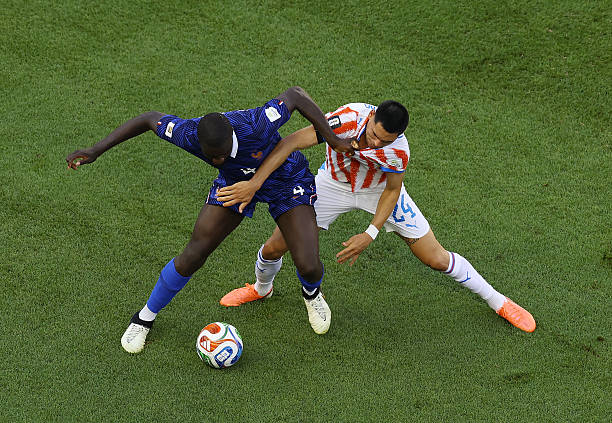
There was a time when watching Dayot Upamecano meant expecting the unexpected.
For 89 minutes, he could dominate one of Europe’s most dangerous strikers, step confidently into midfield to win possession, glide through pressure with the ball at his feet, and look every bit like one of the world’s elite center-backs.
Then, in a single moment, everything could unravel.
A mistimed tackle. A careless pass. One lapse in concentration that erased an otherwise flawless performance.
For years, that contradiction defined him.
At the 2026 FIFA World Cup, it no longer does.
Instead, Upamecano has quietly become the foundation of France’s tournament.
The headlines naturally belong to Kylian Mbappé and Michael Olise, but the balance of Didier Deschamps’ side increasingly depends on the man wearing No. 4. Every aggressive press, every high defensive line, and every calculated risk France takes begins with the confidence that its center-back will clean up whatever is left behind.
Upamecano hasn’t become a different player.
He’s still explosive over the first few yards. Still one of the fastest central defenders in international football. Still eager to attack an opponent instead of waiting for the game to come to him.
The difference is his judgment.
Earlier in his career, he often defended the next action before fully understanding the current one. Today, he waits just a fraction longer. That half-second changes everything.
Rather than diving into challenges, he shapes them, steering attackers into areas where France can overwhelm them with numbers and recover possession on its own terms.
Against Senegal, France looked unusually vulnerable in the opening stages.
The midfield struggled to control transitions. The fullbacks were stretched. Gaps began to appear between the lines.
Upamecano became the solution.
Time and again, he stepped out at precisely the right moment to intercept vertical passes before they ever reached the striker. When Senegal tried to isolate its forwards in one-on-one situations, he trusted his recovery speed instead of retreating toward his own penalty area.
There was nothing flashy about it.
Just efficient, economical, remarkably composed defending.
Perhaps the clearest sign of his evolution comes after France wins the ball back.
There was a period when Upamecano’s first instinct was caution: recover possession, find the nearest midfielder, and reset the play.
That version of him no longer exists.
Under Vincent Kompany at Bayern Munich, Upamecano has evolved from someone who simply starts attacks into someone who actively creates them.
His passing is more ambitious without becoming reckless. He recognizes when to break a press with a driven vertical ball and when to carry possession himself, forcing opponents out of their defensive shape.
Against Iraq, that side of his game became impossible to ignore.
Several of France’s cleanest attacking moves began not in midfield but with Upamecano stepping confidently into space, committing an opponent, and opening passing lanes before releasing the ball.
Those sequences rarely make highlight packages.
They change matches anyway.
His partnership with William Saliba has also reached another level.
Great center-back pairings aren’t built solely on talent.
They’re built on instinct.
France now has exactly that.
When Upamecano attacks the ball, Saliba instinctively drops a few yards to cover the space behind him. When Saliba follows a striker into the channels, Upamecano naturally slides inside to protect the center.
Neither movement draws attention.
Both happen almost without thought.
Their qualities complement one another perfectly.
Saliba glides across the field, reading danger before it develops. Upamecano prefers confrontation. He wants to impose himself physically and end attacks before they truly begin.
Together, they’ve given France the confidence to defend much higher up the field than they otherwise could.
That partnership will face its biggest test against Erling Haaland.
Few strikers ask more questions of defenders.
His runs behind the back line demand pace. His physicality demands strength. His finishing punishes even the smallest positional mistake.
Few defenders possess every tool needed to contain him.
Upamecano is one of them.
Not simply because he can match Haaland athletically, but because his decision-making has finally caught up to his extraordinary physical gifts.
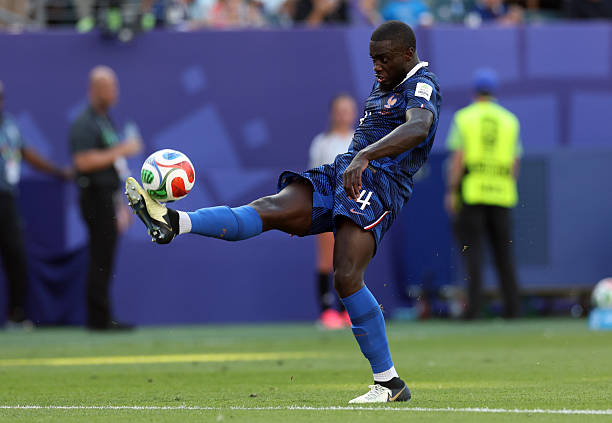
He now understands when to engage.
More importantly, he understands when not to.
That patience may be the defining characteristic of his World Cup.
For years, Upamecano was remembered for his mistakes because they interrupted performances that were otherwise exceptional.
Now, those mistakes have almost disappeared.
What’s left is a defender playing with authority, composure, and the complete trust of everyone around him.
He no longer looks like France’s most gifted athlete in defense.
He looks like its organizer.
Its communicator.
Its emotional anchor.
It’s tempting to call this tournament Upamecano’s breakthrough.
The reality is more nuanced.
This isn’t the arrival of a new defender.
It’s the completion of one.
For the first time in his career, Dayot Upamecano isn’t relying on his extraordinary athleticism to convince the world he belongs among football’s elite.
He’s relying on his understanding of the game.
And that may be the most dangerous version of him yet.