

This Monday, August 31, is far from an ordinary day for the soccer world. Lionel Messi has announced the end of his international career with Argentina. In this article, we take a look back at the first part of La Pulga’s career. Forgotten by trophies, this first chapter of his career may now seem distant, yet at one point, everything could have come to an end.
A complicated relationship with his own country
Long before the two finals lost to Chile, Messi already occupied a unique place in Argentine soccer. He was both the greatest talent of his generation and the player who struggled the most to be fully embraced by his own country. In June 2015, the Spanish newspaper El País described the relationship between Messi and Argentina as an especially complicated one. The term “pecho frío,” one of the harshest insults in Argentine soccer, was regularly associated with him.
The paradox was enormous. At Barcelona, Messi was already considered one of the greatest players in history. In Argentina, his status remained dependent on what he achieved with the national team. His club performances were not enough. He had to win with La Albiceleste, and above all, he had to win major competitions.
Behind this expectation was also the shadow of Maradona. Messi was constantly compared to the 1986 World Cup champion, who represented far more than simply a former player: he was a figure of Argentine soccer identity. Part of the country believed that a true heir to Maradona had to be capable of carrying his national team in decisive moments.
That is precisely what made Messi’s situation so unique. It was not enough for him to be excellent. He also had to show passion in the way people expected, be demonstrative, charismatic and capable of turning his individual performances into collective trophies. Every failure then became another piece of evidence for those who believed he had never truly succeeded with Argentina.
The criticism even went as far as questioning his relationship with the national jersey. The fact that he grew up in Spain after leaving Rosario at a very young age fueled this perception: for some, Messi had become a massive soccer star, but not the emotional representative of Argentina that his talent should have produced.
This divide became particularly visible during the 2015 Copa América. Messi arrived in Chile with another opportunity to put an end to the debate. Argentina reached the final but lost on penalties to the host nation. And once again, a collective defeat turned into an individual trial.
2015 after the final of 2014 : questioning Messi
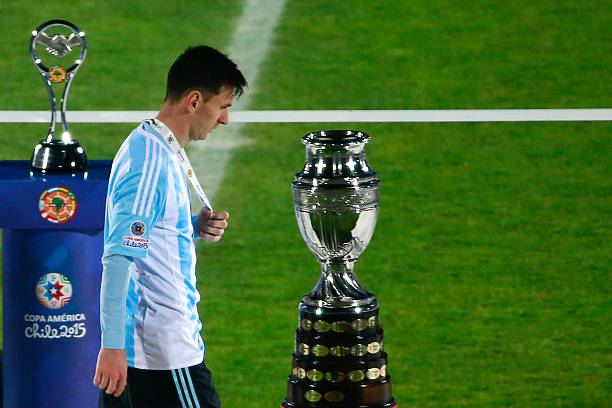
The Santiago final was a turning point. Argentina had just lost another international final, and Messi was gradually becoming the symbol of a generation incapable of winning a major trophy. Yet his responsibility for the defeat was far from obvious.
That did not stop the criticism from raining down on him. A few days after the final, some media outlets went as far as directly questioning Messi’s legitimacy to continue representing the national team. The headline of an article published by Los Andes brutally summed up the atmosphere: “Ni un minuto más de Messi.” The newspaper presented the issue in almost existential terms: did Argentina still deserve to have the best player in the world continue wearing its jersey?
The intensity of these attacks even provoked reactions from the player’s inner circle. In July 2015, his brother Matías Messi publicly lashed out at the people he considered “mediocre” for criticizing his brother. The controversy showed just how far the issue had gone beyond the field. Messi was no longer judged solely on his performances: his relationship with Argentina, his personality and even his identity were constantly being questioned.
Other voices nevertheless tried to defend the No. 10. Former Argentina international Ariel Ortega notably attacked those who called Messi “pecho frío.” The expression had become a symbol of a divide: on one side, those who believed Messi did not show enough character with Argentina; on the other, those who felt it was absurd to accuse a player of his stature of not loving his country enough.
Perhaps the most revealing aspect was that this criticism did not disappear despite Messi’s individual successes. A few weeks after the final, he was still receiving individual awards for his exceptional performances with Barcelona. But those trophies were not enough to erase Argentina’s frustration. Los Andes even referred to a kind of “Argentine cannibalism” directed at Messi and Juan Román Riquelme: two players adored around the world but regularly accused in their own country of being too cold.
Messi therefore found himself in an almost impossible situation. If he won with Barcelona, it did not count toward repairing his relationship with Argentina. If he lost with the national team, his status as the best player in the world was used against him. Every lost final became another piece of evidence for his critics.
And when he reached another final in 2016, the pressure had therefore become immense.
2016 : The weight of failure until the breaking point
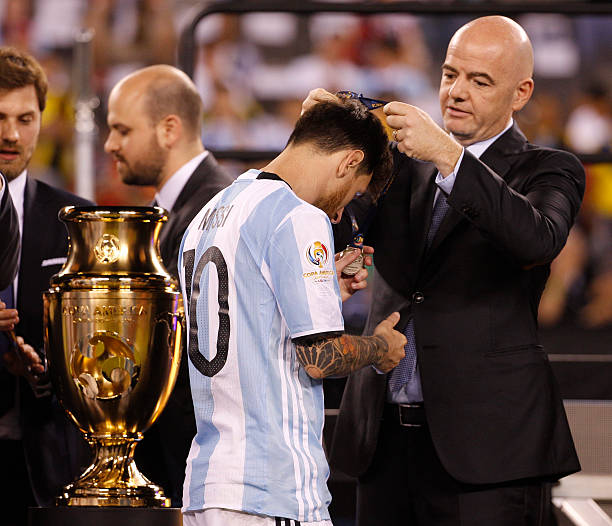
One year after the 2015 final, history repeated itself. Argentina faced Chile again in the final of the Copa América Centenario. For Messi, the stakes went far beyond those of a simple tournament. It was his fourth lost final with the national team, following the 2007 Copa América, the 2014 World Cup and the 2015 Copa América.
In the days leading up to the final, the criticism was still there. Diego Maradona himself questioned his leadership, believing that Messi did not have enough personality to carry a team. The debate surrounding his character therefore remained intact as Argentina prepared to play yet another final.
Then came the game.
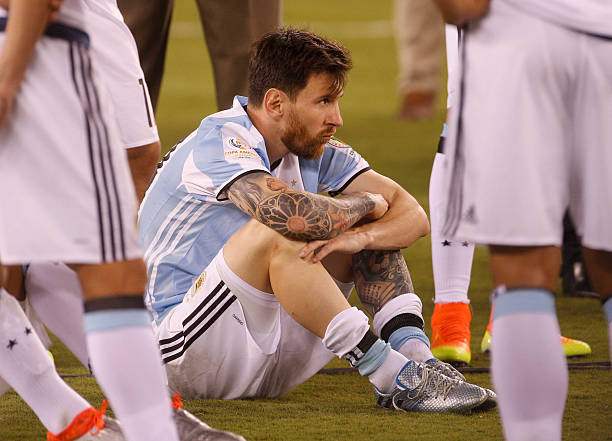
After 120 scoreless minutes, the title was decided on penalties. Messi was the first Argentine to take a kick and missed his attempt. Chile eventually won the shootout 4-2. The image of Messi, eyes filled with tears and alone after the defeat, immediately became the symbol of an entire generation’s frustration.
But this time, something broke.
A few minutes after the game, Messi announced that he was stepping away from the national team. He explained that he had tried several times to become a champion with Argentina without ever managing to do so, and that he now believed his decision was best for both himself and everyone else.
What was striking was that Messi appeared to have internalized some of the criticism directed at him for years. The problem was no longer simply that Argentina was losing: he eventually came to feel that he was the one who was incapable of winning with Argentina. Jonathan Wilson, writing in The Guardian, described a Messi who seemed almost to believe that he was the reason this exceptional generation was unable to win a major trophy.
The country’s reaction was immediately spectacular. For some Argentines, his departure was experienced as another disappointment. For others, on the contrary, it was a moment of realization: perhaps the problem had never been Messi.
The Guardian described a divided Argentina. Some supporters still blamed the player for failing to deliver a trophy to his country; others condemned the injustice of placing the responsibility for several collective failures on a single player. The newspaper also highlighted the fact that Messi had sometimes been booed in Argentina despite his global status, and that he was regularly credited with excessive influence over managers’ decisions or team selections without any real evidence.
That was the great paradox of Messi’s relationship with Argentina: he was so important that he was even blamed for problems that were beyond his control.
His departure ultimately sparked a popular movement. The slogan “No te vayas, Lio” flooded social media. A few weeks later, Messi reversed his decision. He explained that he loved Argentina and its jersey too much to permanently walk away from the national team.
This sequence perfectly summed up the relationship between Messi and his country. He had been idolized like no other player, but he had also been criticized like few stars ever were. He was expected to be the best player in the world, but also the new Maradona, the leader, the national symbol and the man responsible for ending more than two decades of frustration.
In 2016, Messi was therefore not simply a player who had just lost a final. He had become the focal point of all the frustrations surrounding Argentine soccer. And that pressure, built over more than a decade, had ultimately led him to believe that perhaps he was no longer meant to play for the national team.
 Argentina
 Lionel Messi