

For a long time, the No. 9 represented a relatively recognizable figure in soccer. Positioned at the tip of the attack, the striker was expected to occupy center backs, play with his back to goal, attack the space behind the defense and, above all, finish chances. But as tactics have evolved, this definition has gradually expanded. The development of the false 9, in particular, has completely changed the way the center-forward role is understood. Rather than constantly looking to get closer to the opponent’s goal, the striker can now move away from it to participate in the buildup.
The principle may seem paradoxical: an attacker whose job is to score can have as his primary task leaving the area where he is traditionally expected to be.
A no9 who refuses to stay in his place


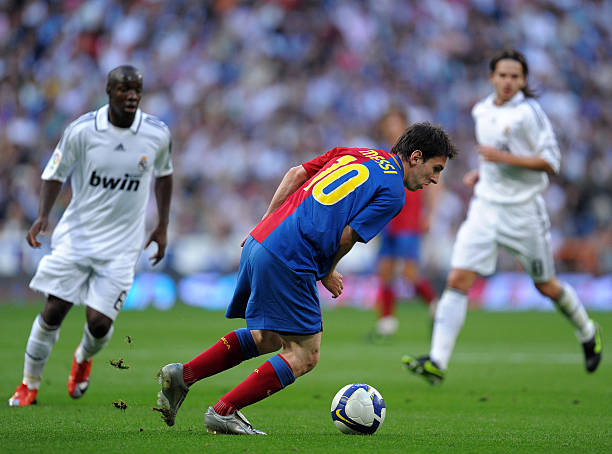
The false 9 is based on a simple idea: creating uncertainty for the opposition. Unlike a traditional center-forward, he does not constantly look to remain level with the defensive line. Instead, he regularly drops deeper to receive the ball in the spaces between the midfield and defense.
This movement can have several consequences. If a center back decides to follow him, he temporarily abandons his position and creates space in the defensive line. That space can then be attacked by a winger, an attacking midfielder or another forward making a run from a deeper position. On the other hand, if the defender refuses to leave his zone, the false 9 can receive freely between the lines and turn to face the play. In both cases, the defense is forced to make a potentially dangerous decision.
The role therefore requires a particular kind of intelligence. The player must know when to drop, where to position himself and, above all, when to make his run back toward the box. Once he has dropped into midfield, he cannot simply remain far from goal: he must be able to reappear in the box at the right moment. His game therefore relies as much on his off-ball movement as it does on his technical ability.
The role also requires an excellent ability to receive the ball under pressure. The false 9 must scan his surroundings before even receiving the ball, control it in the right direction, turn quickly and be able to beat an opponent or find a vertical pass. Dribbling, vision, passing ability and the capacity to retain possession then become almost as important as finishing.
The idea, however, did not originate with modern soccer. Forms of a “dropping No. 9” already existed in the 20th century, notably with Matthias Sindelar in Austria and Nándor Hidegkuti with Hungary in the 1950s. Hidegkuti caused England enormous problems during Hungary’s famous 6-3 victory at Wembley in 1953: if he was followed, he opened up space behind him; if he was left unmarked, he could contribute to the buildup.
But it would be another generation that transformed the idea into a global tactical weapon.
Messi Guardiola and the false 9 revolution
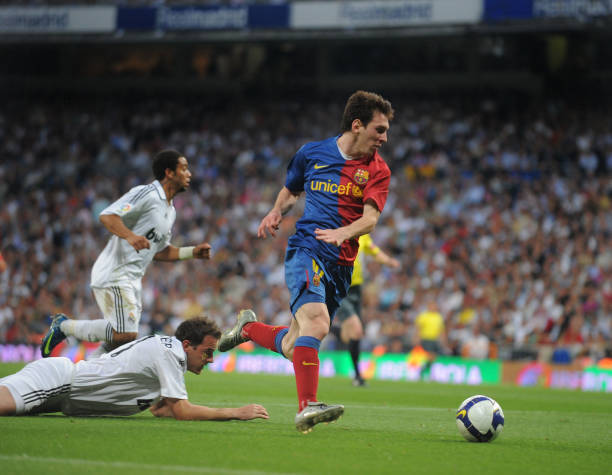
The modern false 9 is inseparable from Lionel Messi and Pep Guardiola. In 2009, during Barcelona’s famous 6-2 victory over Real Madrid at the Santiago Bernabéu, Guardiola moved Messi into a central position, with Samuel Eto’o and Thierry Henry able to attack the spaces opened up on the flanks. The change appeared simple on paper, but it completely disrupted Real Madrid’s defensive reference points.
Messi possessed the ideal qualities to exploit this role. His ability to receive between the lines, immediately turn and beat multiple opponents allowed Barça to transform a simple drop into a genuine attacking move. When a defender stepped out to him, spaces appeared behind. When the defender stayed back, Messi could drive forward with the ball and attack the defense at speed.
This setup also allowed Barcelona to create numerical advantages in midfield. By dropping deeper to participate in the buildup, Messi added an extra player to an area already occupied by Xavi, Andrés Iniesta or Sergio Busquets. Defenders were then faced with a constant dilemma: should they defend their zone or follow an attacker who was now behaving like an attacking midfielder?
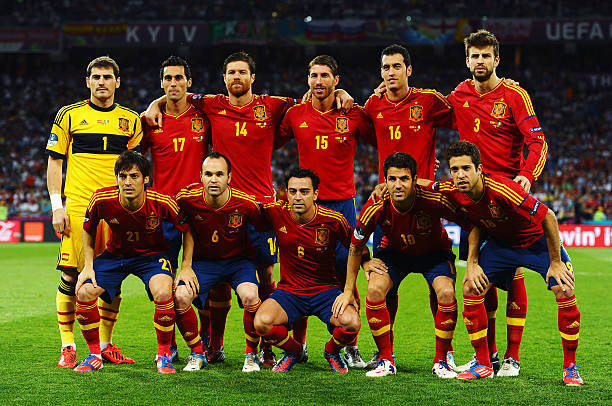
The phenomenon quickly extended beyond Messi’s individual case. Cesc Fàbregas was used as a false 9 by Vicente del Bosque’s Spain at Euro 2012. Roberto Firmino then became a reference point for the role at Liverpool under Jürgen Klopp. But Firmino’s use of the position added another dimension: his importance was not limited to his ability to drop deep and create space for Mohamed Salah and Sadio Mané. He also played a major role in pressing and counter-pressing.
The false 9 thus became much more than a creative forward. He could be his team’s first defender, the player who triggered the press, the one who created a numerical advantage in midfield and the one who opened up space for his teammates.
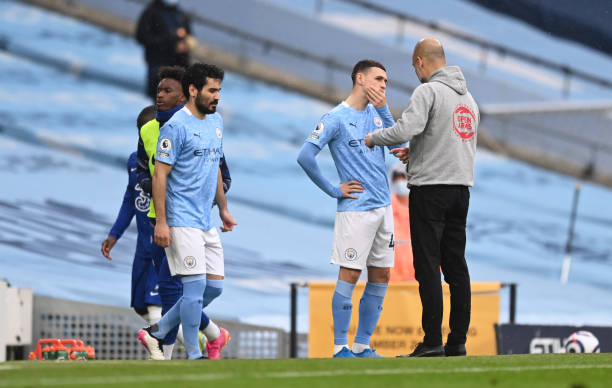
Manchester City pushed this evolution even further under Guardiola. In 2020-21, the absence or limited availability of certain center forwards allowed the Catalan coach to regularly use Kevin De Bruyne, Bernardo Silva, Phil Foden or Riyad Mahrez in the role. The false 9 was no longer necessarily even a forward by trade: midfielders could occupy the position and operate within an extremely fluid system in which responsibilities constantly changed depending on the phase of play.
At City, De Bruyne and Bernardo Silva could notably alternate between a false 9 position and that of an additional midfielder. The system then became particularly difficult for opponents to read, since the player expected to be the focal point of the attack could suddenly find himself at the heart of the game.
The false 9 therefore became one of the most advanced expressions of positional play: players are no longer defined solely by their starting position, but by the spaces they occupy and those they create for their teammates.
A powerful tactical wheapon but not a universal one
The success of the false 9 does not mean that the traditional No. 9 has become obsolete. The system has its own limitations. The first concerns precisely what makes it unique: by dropping deeper, the center-forward temporarily abandons the space behind the defense. The opposing defense can then push higher because it does not necessarily have to worry about an attacker constantly positioned behind its line. The aerial threat from crosses can also decrease.
The false 9 therefore depends heavily on the players around him. For the spaces he creates to be exploited, the wingers, midfielders or fullbacks must quickly attack the areas that have been opened up. Without movement around him, the false 9 may simply add another player in midfield without creating any genuine threat in front of goal.
The player’s individual quality is also crucial. Not every forward is capable of receiving with his back to goal, turning under pressure, beating an opponent, finding a vertical pass and then making another run into the box. Without these qualities, dropping deep loses much of its value.
Certain defensive structures can also limit his influence. A back three, for example, provides greater security when dealing with a dropping forward, since one defender can potentially step out without immediately creating as significant a gap through the middle.
This is precisely what makes contemporary uses of the role particularly interesting. The false 9 is no longer necessarily a lightweight, technical player with a profile similar to Messi. Mikel Merino provides a striking example at Arsenal. A midfielder by trade, the Spaniard was used as a center forward in a context marked by injuries. His physical profile, ability to compete in duels and intelligence in his movement allowed him to perform a different version of the traditional false 9 role.
During Arsenal’s trip to Tottenham in November 2025, Merino was notably used as a false 9 and regularly dropped in front of the center backs to participate in the buildup. This usage shows that the role can now be adapted to very different player profiles: it is no longer necessarily about replicating Messi, but about using the center-forward’s movement to disrupt the opposition.
Ultimately, the false 9 represents a major evolution in the way the center-forward position is understood. Its objective is no longer simply to be the player who finishes moves, but to contribute to their creation. He can be a playmaker, a target man, a link-up player, a pressing trigger or even an additional midfielder.
And perhaps that is its greatest revolution: modern soccer no longer necessarily asks the No. 9 to constantly be in the box. It asks him to understand when he needs to be there.