

There are footballers whose influence extends far beyond individual statistics. N’Golo Kanté undoubtedly belongs in that category. Quiet, humble, and rarely drawn to the media spotlight, the French midfielder nevertheless left his mark on an entire generation through his ability to transform a team’s balance. From Leicester to Chelsea, with the French national team along the way, his career reads like a succession of sporting miracles. In just a few years, he went from being a relatively unknown player competing in the lower divisions of French football to becoming a Premier League champion, a World Cup winner, and a Champions League winner. An extraordinary journey that made him one of the most influential midfielders of the 2010s.
Born on March 29, 1991, in Paris, N’Golo Kanté did not follow the traditional path of a future football superstar. After developing at JS Suresnes, he joined Boulogne’s youth setup before gradually making his way into professional football. His small stature, unassuming physical presence, and lack of pedigree at major youth academies did not immediately work in his favor. Nevertheless, his ball-winning ability, stamina, and positional intelligence quickly attracted attention. After helping Boulogne earn promotion to Ligue 2, he joined Caen in 2013. In Normandy, he took another step forward and played a key role in the club’s promotion to Ligue 1 during the 2013-14 season.
His time at Caen proved to be a defining stage in his development. Kanté was already standing out for his ability to make countless defensive interventions, cover enormous distances, and win possession in areas sometimes far removed from his starting position. He possessed that rare ability to make it seem as though he was everywhere at once. His game relied less on physical strength than on anticipation, reading passing lanes, and relentless activity. As major clubs began taking an interest in him, Leicester City decided to take a chance on the still relatively unknown midfielder in the summer of 2015.
Joining the Foxes would change his career, but also the history of English football. Under Claudio Ranieri, Kanté quickly became an indispensable part of Leicester’s setup. Playing alongside Danny Drinkwater in midfield, among others, he became the engine of a team that would pull off one of the greatest upsets in modern football history. Leicester won the Premier League in 2016, capping a season in which the club had started with relatively modest ambitions. His ability to win possession, cut off passing lanes, and quickly launch attacking transitions perfectly suited Ranieri’s direct and vertical style of football.
Kanté came to embody a new form of midfield dominance. While some players impose their presence through technical ability or physical power, the Frenchman did so through movement. He compensated for defensive imbalances, closed down spaces, and allowed his teammates to take greater attacking risks. His partnership with Drinkwater was particularly effective: while the Englishman handled part of the initial buildup and distribution, Kanté constantly covered ground to protect spaces and recover second balls. His work was sometimes invisible on television, but his importance became obvious whenever he was missing from the team’s collective structure.
From Caen to Premier League : Kanté redefined his role
In the summer of 2016, Chelsea decided to sign N’Golo Kanté for approximately £32 million. It already looked like a smart piece of business after his previous season, but it would quickly become one of the most profitable investments in the recent history of the London club. Arriving at a team undergoing reconstruction after a disastrous 2015-16 campaign, he found a favorable environment under Antonio Conte. The Italian manager immediately understood that he had a player capable of taking his tactical system to another level.
In Conte’s 3-4-3 formation, Kanté played alongside Nemanja Matić in a double pivot. The two players complemented each other perfectly. The Serbian provided physical presence and the ability to organize the buildup, while the Frenchman covered an extraordinary amount of ground. His ability to compete in duels, anticipate opposition passes, and drive forward after winning possession allowed Chelsea to defend with tremendous security. But his influence was not limited to defensive work: he also contributed to ball progression and the construction of attacking transitions.
The 2016-17 season confirmed that Kanté had become much more than a specialist ball-winner. His off-ball movement allowed him to compensate for his teammates’ positioning, while his mobility made it easier for Chelsea to play out of pressure. He was not simply a player tasked with chasing the ball: he knew how to identify spaces before his opponents and intervene at precisely the right moment. Chelsea won the league with 93 points, and Kanté became the first player in history to win consecutive Premier League titles with two different clubs. After Leicester, he achieved the same feat with the Blues.
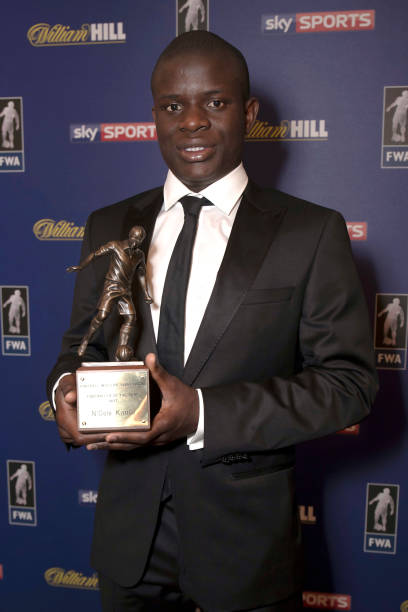
His season was also rewarded with individual recognition. In April 2017, he received the PFA Players’ Player of the Year award. It was a particularly symbolic distinction for a player whose influence was built around qualities that were sometimes difficult to quantify. He was also named Premier League Player of the Season by the Football Writers’ Association. His status had permanently changed: Kanté was no longer just an exceptional defensive midfielder, but one of the world’s leading players in his position.
Under Maurizio Sarri, who arrived at Chelsea in 2018, his role evolved once again. The Italian manager favored a possession-based style of football and placed Jorginho at the heart of his system. Kanté was subsequently used more often as a box-to-box midfielder, with greater attacking freedom. His positioning sparked debate, with some observers believing he was being moved away from the areas where he was most influential. Nevertheless, this new role revealed another dimension of his game. He pushed forward more frequently into the final third, made more runs into the penalty area, and became more directly involved in attacking moves. His ability to adapt to different responsibilities highlighted the versatility of his profile.
The year 2018 represented another peak in his career. After winning the Premier League with Leicester and then Chelsea, Kanté became a World Cup winner with France in Russia. Alongside Paul Pogba and Blaise Matuidi, he formed an exceptionally balanced midfield in Didier Deschamps’ system. His defensive coverage allowed Pogba to push forward and become more involved in the attacking buildup. Against opponents such as Argentina, Uruguay, and Belgium, he helped protect France’s overall balance and limit the spaces available to opposing players.
His performance against Belgium in the World Cup semifinal particularly highlighted his importance to France’s campaign. Tasked with tracking Kevin De Bruyne’s movements and limiting the influence of the Belgian midfield, he contributed to the collective control that allowed Les Bleus to secure their place in the final. Although his performance against Croatia in the final was more complicated, Kanté left Russia with the most prestigious trophy in international football. At just 27 years old, his trophy cabinet was already extraordinary.
Thomas Tuchel’s arrival at Chelsea in January 2021 would nevertheless provide another demonstration of Kanté’s importance. In a team built around a three-man defense, the Frenchman returned to a position that allowed him to fully showcase his qualities. His mobility, positional intelligence, and ability to beat opponents in duels became essential weapons in the Blues’ European campaign. As the competition progressed, he reached another level.
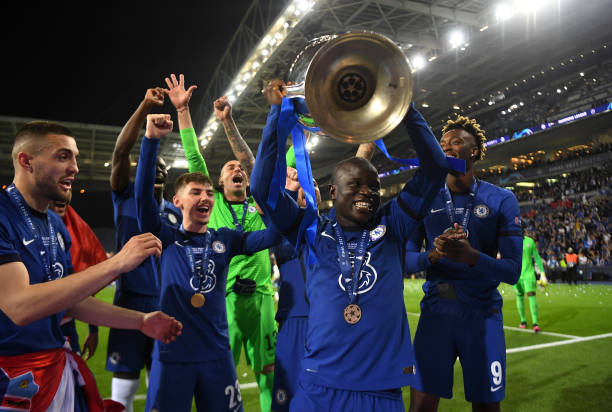
Against Real Madrid in the Champions League semifinal, he delivered two outstanding performances. His ability to win possession and drive into open spaces gradually allowed Chelsea to take control of the midfield battle. In the final against Manchester City, he produced another world-class display. Kevin De Bruyne, Phil Foden, and City’s other creative players struggled to find space through the middle. Kanté seemed to be constantly present in every passing lane, capable of intervening at precisely the right moment without necessarily relying on spectacular actions. Chelsea won 1-0 in Porto and claimed their second Champions League title.
This European campaign once again confirmed that his influence could not be reduced to the role of a ball-winner. Kanté could control the tempo of a game without dominating possession, disrupt opposition transitions, and give his teammates greater freedom. His reading of the game allowed him to compensate for collective imbalances with remarkable efficiency. The nickname “one-man midfield,” popularized in analyses of his European performances, perfectly captured the impression of watching a single player cover an extraordinary amount of space.
Unfortunately, the remainder of his career would be increasingly affected by injuries. His physical problems gradually limited his availability and prevented him from consistently returning to the level that had made him famous. Nevertheless, his legacy remains intact. N’Golo Kanté won two consecutive Premier League titles with two different clubs, a World Cup, a Champions League, and numerous individual awards. Above all, he demonstrated that a midfielder could dominate a game without necessarily being the most spectacular, technically gifted, or attacking player on the pitch.
Throughout the 2010s, football often celebrated playmakers, goalscorers, and players capable of changing a game with a moment of individual brilliance. Kanté reminded everyone that another form of genius existed: the ability to make teammates better, neutralize opposition strengths, and keep an entire team balanced. From Leicester to Chelsea, and through the highest levels of international football, the Frenchman left his mark on his era with remarkable simplicity. He never needed to demand the ball or the spotlight to become indispensable. He simply had to be everywhere his team needed him.