

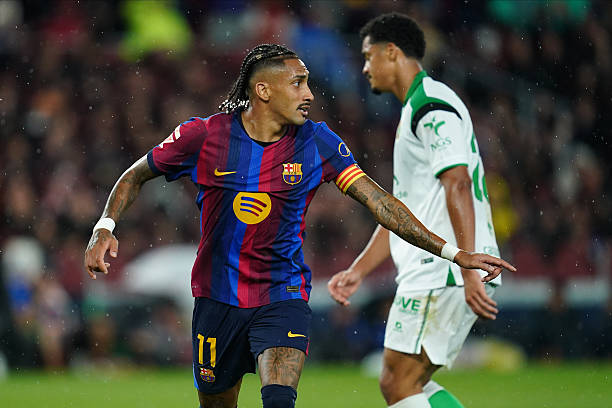
Long identified as a winger capable of making a difference on the flank, Raphinha is now reaching another level at FC Barcelona. Repositioned as a striker by Hansi Flick since the start of the season, the Brazilian has taken advantage of the club’s exodus of center forwards to occupy a role that was not considered natural for him. With Robert Lewandowski, Ferran Torres and Marcus Rashford leaving Catalonia during the summer, Barça found itself with a significantly reshaped attack, without immediately signing a true first-choice No. 9. The arrival of Gabriel Jesus, used as a complementary option, did not prevent Flick from trying another solution: moving Raphinha into the center. A decision that initially looked like a temporary fix quickly turned into a genuine tactical success. The Brazilian scored five goals in the first three rounds of La Liga, before continuing his spectacular run of form and reaching 12 league goals after just seven matchdays, as well as 14 goals in all competitions.
Not a false 9 a true
Contrary to the idea that Raphinha is simply a “false 9,” his current role actually relies on much more traditional center-forward characteristics. He attacks the box, makes repeated runs in behind, positions himself between the center backs and constantly looks to arrive in finishing areas. The difference lies more in the way he occupies those spaces. Raphinha does not remain permanently in the center waiting for the ball: he drops deep, moves around, combines with Lamine Yamal and the midfielders, then takes advantage of the spaces created by his movement to reappear in the penalty area. This mobility fits Flick’s style of soccer perfectly, with the German coach asking his attackers to press high, attack space quickly and make repeated off-ball runs. The Brazilian therefore retains some of his winger instincts while taking on the responsibilities of a center forward.
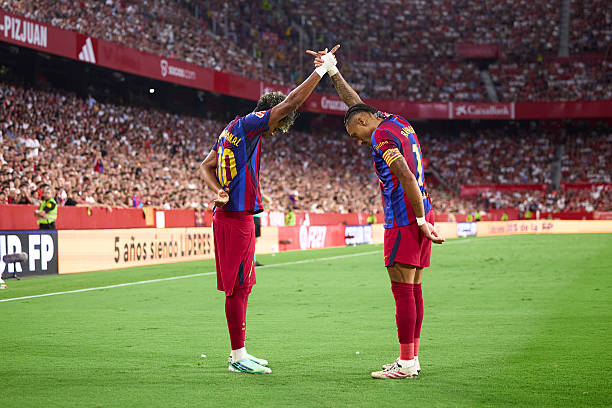
This positional change above all allows Barça to preserve what made Raphinha so effective when he played out wide: his work rate, aggression, runs and ability to attack space quickly. By moving him closer to goal, Flick gives him more opportunities to turn those qualities into finishing chances. His hat trick against Sevilla is the perfect illustration: one right-footed finish, one header and one left-footed strike, three goals scored in three different ways. A few days earlier, he had already scored a hat trick against Racing Santander. This versatility inside the box shows that he does not rely on a single type of action to be dangerous.
The most interesting aspect is that this positional change is part of a broader evolution in his status. Raphinha is no longer simply one attacking player among many in the Catalan squad. He has become Barça’s captain and one of the team’s main leaders. His journey makes this transformation even more significant. Having joined from Leeds in 2022 after growing up in a working-class neighborhood of Porto Alegre and taking a path far removed from Brazil’s most prestigious academies, he had to gradually establish himself in Europe. His first two seasons in Barcelona were marked by a certain inconsistency and questions over his place in the team. Flick’s arrival had already changed his status in 2024-25, with an exceptional season featuring 34 goals and 25 assists in 57 appearances, as well as a fifth-place finish in the Ballon d’Or.
From right to left and now focal point
Moving into the center therefore represents another stage in that transformation. Raphinha has not completely abandoned his winger identity: he retains his ability to leave his zone, accelerate and create openings. But he now consistently moves closer to goal and has become the main focal point of Barcelona’s attack. His ability to drop deep can draw a center back out of position, while his immediate runs in behind can then create space for Yamal or the other attacking players. Barça can therefore use its No. 9 not only as a finisher, but also as a player capable of disrupting the opposition’s defensive structure.
This evolution explains why Raphinha’s success goes beyond his statistics. His pressing, repeated runs and off-ball work fit the physical demands of Flick’s system. The Brazilian can start an attack in the heart of the field, contribute to its buildup and then finish the move inside the box just seconds later. His role is therefore hybrid in practice, but that does not mean he is a false 9: he is instead a mobile center forward capable of using his background as a winger to occupy the position differently.
Flick’s decision is even more significant because Barça was initially looking for a solution at center forward. The club had notably tried to sign Julián Álvarez during the summer, before ultimately keeping an attacking department in which Raphinha would become an unexpected answer. And while the Brazilian was not even included among the 30 Ballon d’Or nominees for 2026, his start to the season quickly reignited the debate surrounding his individual status. His exclusion from the list was notably explained by a previous season disrupted by injuries, despite the fact that he had finished fifth in the 2025 rankings.
Raphinha’s positional change ultimately says something broader about Flick’s Barcelona: rather than trying to replicate the profile of a traditional center forward, the German coach has transformed the characteristics of a player he already knew perfectly well. By moving Raphinha closer to goal, he has maximized his work rate and ability to attack the box while preserving his mobility. The Brazilian has therefore become a No. 9 without truly ceasing to be Raphinha. It is precisely this apparent contradiction that makes his positional change so effective.