

Long associated with the image of the tall striker tasked with receiving long balls and winning duels, the target man has a much broader role in modern soccer. Positioned at the top of the attack, he provides a reference point for his teammates and can help an entire team move up the field. His role is built around his ability to protect the ball with his back to goal, withstand pressure from defenders, lay the ball off to teammates, and create space around him. While the traditional profile relies heavily on physical strength and aerial ability, the tactical evolution of soccer has gradually transformed the target man into a much more complete forward, capable of contributing to buildup play, attacking space in behind, and moving into different areas of the field.
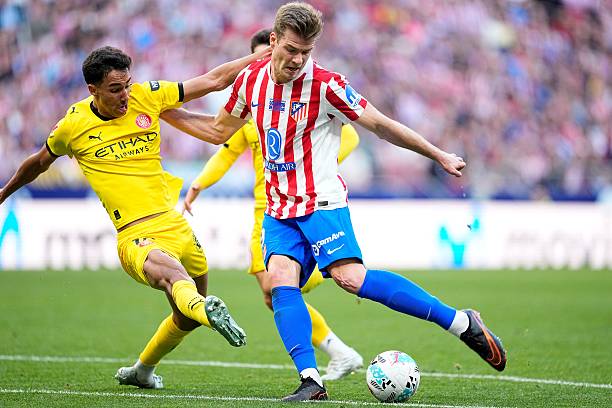
The target man’s first responsibility is to provide a direct outlet for his teammates. When the opposing defense applies heavy pressure, the ball can be played forward to the striker so he can control it and retain possession. With his back to goal, he must then use his body to shield the ball from the defender before quickly laying it off to a midfielder or winger. This ability to play as a reference point allows the team to escape pressure and turn a defensive situation into a possession phase in the opponent’s half. The target man therefore acts as a genuine link between midfield and attack.
This function is particularly important for teams that rely on direct play. A long pass toward the striker does not necessarily result in a loss of possession if he is capable of winning his duel, flicking the ball on, or holding onto it long enough for his teammates to move up the field. Headers, one-touch layoffs, and well-oriented first touches can become weapons for progressing quickly. The target man therefore does not necessarily need to keep the ball for long: a few seconds can be enough to move the team forward and allow the attacking players to push up the field.
A role that goes beyond aerial play
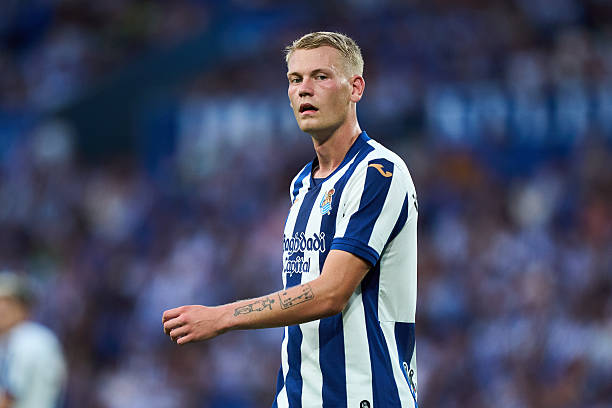
The physical dimension remains essential to the target man’s role. Against center backs, he must be able to use his size, balance, and strength to withstand physical challenges. Aerial ability is also important, both in open play and from set pieces. A target man can look to win a header for a teammate making a run behind him, attack a cross directly, or become a primary target on a corner or free kick. This ability to compete in the air explains why some attacking systems are built around the presence of a player capable of posing a constant threat inside the penalty area.
But reducing the target man to his size or strength would be a mistake. Modern profiles must also possess an excellent first touch, a certain level of passing ability, and a strong understanding of space. The examples of Robert Lewandowski and other forwards of this profile show how a target man can use his positioning to draw center backs toward him and create space for his teammates. By staying high up the pitch and playing with his back to goal, he can pin the defensive line and prevent defenders from easily stepping out onto the players arriving behind him.
Movement has therefore become just as important as the physical duel. A modern target man no longer necessarily has to remain in the center and wait for crosses. He can drop deeper to receive between the lines, move toward one side, or attack the space in behind. These movements force defenders to make decisions: follow the striker and leave space behind them, or maintain their position and give him more freedom. The target man then becomes a tool for disrupting the opponent’s defensive structure.
This evolution can be seen in the analysis of Alexander Sørloth and Orri Óskarsson in La Liga. Both strikers illustrate a target-man profile capable of combining physical strength, movement, and technical ability. Sørloth can vary his runs inside the penalty area to manipulate defenders’ positioning, while Óskarsson can drop deeper, withstand pressure, and quickly lay the ball off to a teammate before moving forward again. The target man is therefore no longer simply the player waiting for the ball: he can actively contribute to creating defensive imbalance.
This ability to pin defenders is also valuable for players operating behind him. When a center forward occupies both center backs, an attacking midfielder or winger can take advantage of the space created around him. The target man can therefore influence an attack without even touching the ball. By remaining between the center backs, making a run, or simply occupying a dangerous position, he can draw their attention and open up an area for a teammate. This can be seen with Lewandowski at Barcelona: his high positioning and ability to play with his back to goal can allow players such as Pedri or Dani Olmo to attack the spaces around the penalty area.
The target man also plays an important role during transitions. After winning the ball, a team can immediately look for its center forward to retain possession and allow the rest of the team to move up the field. In this context, his ability to withstand pressure becomes crucial. He must be able to receive the ball under pressure, protect it, and choose between a short layoff, a pass toward a teammate making a run, or holding onto the ball for longer. This function is particularly valuable against teams that press high, as the target man can become an emergency outlet when defenders and midfielders are trapped.
However, the role has its limitations. A team that relies excessively on its target man and long balls can become predictable. If the opponent manages to isolate the striker, cut off passes toward him, or win the second balls, a large part of the attacking plan can lose its effectiveness. Modern soccer therefore demands greater mobility and variety. The target man must now be able to contribute to the press, attack the space in behind, and move outside his usual area. Simply being tall and powerful is no longer enough at the highest level.
This is why the modern target man is gradually becoming a hybrid forward. Erling Haaland, for example, possesses some of the characteristics traditionally associated with the target man while also being capable of attacking space in behind with speed and contributing to the press. Harry Kane represents another evolution of the role: his ability to drop deeper and contribute to chance creation allows him to operate as a genuine link between midfield and attack. The target man can therefore be a target, a finisher, a passer, and a player who pins defenders.
Ultimately, the target man remains a role built around a simple idea: providing the team with a reference point in attacking areas. But the demands associated with the position have evolved considerably. The traditional target man primarily had to win duels, hold up the ball, and finish crosses. The modern target man must also know how to move, combine, press, attack space in behind, and create room for others. His importance is therefore not measured solely by the number of goals he scores, but also by his ability to make his team play and alter the behavior of the opposing defense.