

In Ballon d’Or history, some second-place finishes have endured in the public imagination as injustices. David Beckham’s runner-up finish in 1999 belongs to that category. The Manchester United midfielder finished behind Rivaldo, who won the award with 219 points to the Englishman’s 154. At first glance, the Brazilian’s victory was entirely reasonable. After an outstanding season with Barcelona, he won the Spanish league title and the Copa América with Brazil, cementing his status as one of the world’s best attacking players. But Beckham’s 1999 campaign carried a special significance. At the heart of Sir Alex Ferguson’s Manchester United team, he helped secure a historic treble consisting of the Premier League, the FA Cup, and the Champions League. His season embodied a team’s ability to overcome adversity, as well as the importance of a player whose influence extended far beyond individual statistics. The debate is therefore not about denying Rivaldo’s quality, but about asking whether Beckham’s team achievements, consistency, and importance in decisive moments deserved greater recognition.
To understand the Englishman’s case, it is necessary to revisit Manchester United’s European campaign. Long regarded as a serious but inconsistent contender, the Manchester club finished the 1998-99 season by winning all three major competitions in which it competed. Beckham played a crucial role in that success through his crossing ability, technical precision, and threat from set pieces. In a team where Roy Keane and Paul Scholes handled much of the work in midfield, he provided a constant threat from the right flank while contributing defensively and working for the collective. His contribution was not limited to pinpoint crosses. He could make repeated runs, cover significant distances, and maintain a high technical standard under pressure. His performance in the Champions League semifinal second leg against Juventus in Turin was particularly impressive. Trailing during the game, Manchester United fought back to win 3-2 and secure a place in the final. The Guardian’s match report highlighted the extent of Beckham’s work rate, noting how he appeared to cover virtually every area of the field.
The symbolism of United’s treble
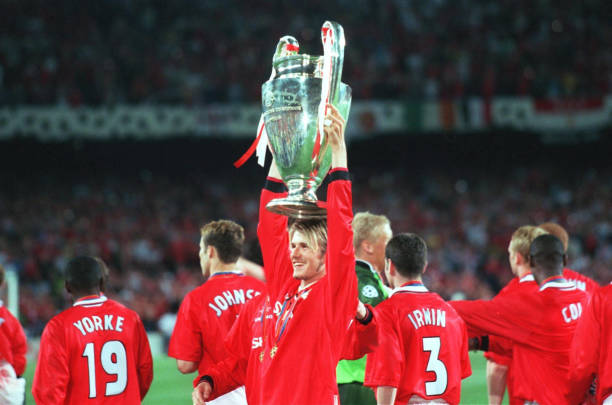
However, it was the Champions League final against Bayern Munich that best captured the uniqueness of Beckham’s season. On May 26, 1999, in Barcelona, Manchester United trailed 1-0 and struggled to find a breakthrough. Repositioned in midfield, Beckham helped keep his team in the game and supplied its late attacking moves. In stoppage time, his set pieces became decisive. Following a corner delivered by the Englishman, the ball fell into the penalty area and allowed Teddy Sheringham to equalize. Moments later, another Beckham corner created a chaotic situation that Ole Gunnar Solskjær capitalized on to score the winner. Manchester United prevailed 2-1 and made history. Beckham did not score the decisive goal himself, but he directly contributed to both moves that turned the final around. The performance reinforced his reputation as a player who could deliver when the pressure was at its highest. It also gave his Ballon d’Or candidacy an almost cinematic quality: the story of a player who, at the end of an exceptional season, had played a central role in one of the greatest achievements in European soccer history.
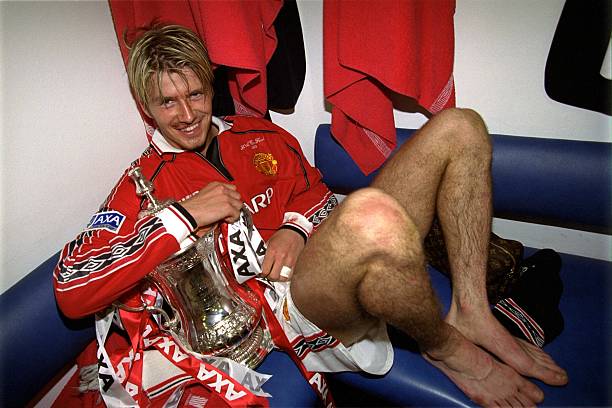
Beyond that final, Beckham embodied the consistency of a team that won the Premier League after a tightly contested title race before adding the FA Cup and Champions League. His influence was particularly remarkable because his role was not built around finishing chances. He was a creator, a crossing specialist, and a set-piece expert, but also a link player capable of giving direction to attacks. His right foot was a strategic weapon, allowing Manchester United to turn ordinary attacking situations into clear-cut chances and making every corner a potential scoring opportunity. This ability to create decisive moments without necessarily appearing on the scoresheet makes his performances more difficult to evaluate than those of a striker whose goals serve as the primary measure of success. In a season when Manchester United won the biggest trophies available, it was entirely reasonable to consider Beckham one of the principal architects of that achievement.
The case for Rivaldo, however, remains compelling. The Brazilian ended the year as both a Spanish league champion with Barcelona and a Copa América winner with his national team. His creativity, dribbling, left-footed shooting, and ability to change the course of a game made him an exceptional attacking player. The Ballon d’Or also rewards individual excellence, not just collective achievements. Rivaldo ultimately finished 65 points ahead of Beckham, while Andriy Shevchenko came third with 64 points. In its report on the result, The Guardian noted that the Brazilian had been rewarded for his contributions to the successes of both Barcelona and Brazil. It would therefore be excessive to portray his victory as an obvious mistake. The real debate concerns how to rank two outstanding seasons: one built around individual dominance and international success, the other defined by an unprecedented collective achievement at club level.
Beckham also possessed a media advantage that might have worked in his favor, but his celebrity sometimes blurred the analysis of his performances. His marriage to Victoria Adams, his appearance, and his worldwide fame made him a celebrity far beyond the soccer field. That exposure helped transform the English midfielder into a cultural icon, but it also fueled the perception that his popularity could be confused with his sporting value. His second-place finish in the Ballon d’Or, however, cannot be understood without considering his performances on the field. The Manchester United player was not simply a media star. He was an essential part of a team that had just accomplished something extraordinarily rare. Distinguishing his celebrity from his soccer ability is essential to defending his candidacy without falling into the opposite trap of suggesting that his public image earned him undeserved recognition.
In retrospect, David Beckham deserved the 1999 Ballon d’Or in the sense that his victory would have been entirely defensible. His season brought together several criteria traditionally valued by the award: a decisive contribution to his club’s success, remarkable consistency, significant tactical influence, and outstanding performances in the biggest games. But Rivaldo also had an impressive sporting case, and his victory remains legitimate. What makes Beckham’s second-place finish so frustrating for his admirers is not the idea that the Brazilian did not deserve to win, but rather the feeling that the historic scale of Manchester United’s treble was not given sufficient weight. In 1999, Beckham was one of the faces of a team that entered the history books. The Ballon d’Or eluded him, but his role in that extraordinary season permanently secured his place among the great players of his era.