

With the Champions League at stake, Paris Saint-Germain enters this clash with the ambition of imposing control over the game while maximizing its major attacking strengths.
Barcola and Doué : speed as weapon
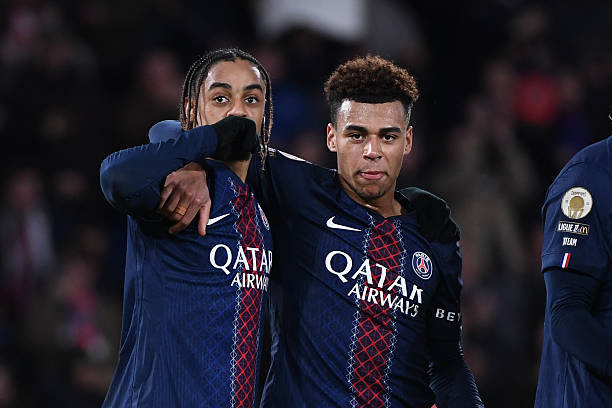
Bradley Barcola and Désiré Doué represent two key elements in PSG’s offensive transitions. Barcola, in particular, is one of the fastest players in the Paris squad — capable of running in behind defensive lines or creating imbalances in open space. Statistically, his role has been significant in recent months, with sharp runs and a real ability to create chances — even if he can sometimes lack consistency in front of goal.
That pace is a strategic asset for the Parisians: when they combine aggressive ball recoveries with quick overlapping runs, they become extremely dangerous in transition. It’s exactly this kind of attack — rapid transition combined with pure speed — that could trouble a Chelsea defensive line that has occasionally been exposed.
The pivotal role of Vitinha
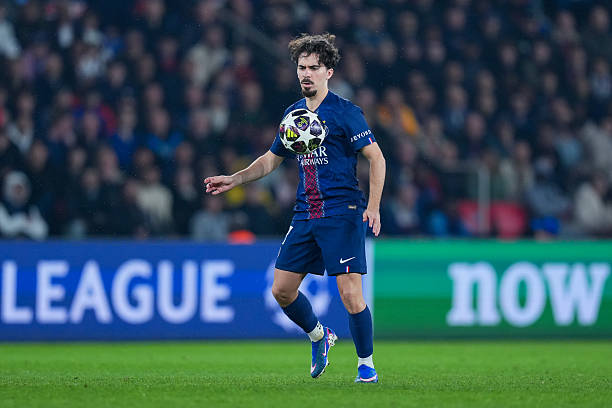
At the heart of PSG’s collective system, Vitinha plays a crucial role in organizing the team’s play. The Portuguese midfielder often acts as the architect of PSG’s possession and transition game: he simplifies ball circulation, organizes forward progression, and serves as the link between ball recovery and attacking phases. That role becomes even more critical in Champions League matches, where the smallest imbalance can prove decisive.
It is this ability to manage tempo — slowing the game down or accelerating it when necessary — that allows Paris to control the rhythm of the match while also facilitating the involvement of their attacking creators.
Having Safonov performing well in major European clashes — with sharp reflex saves, aggressive positioning, and strong reading of crosses — could prove to be a valuable asset for a PSG side preparing to face Chelsea over two legs.
Let’s now turn to Chelsea to understand why the Blues have been so inconsistent this season.
A costly problem of indiscipline
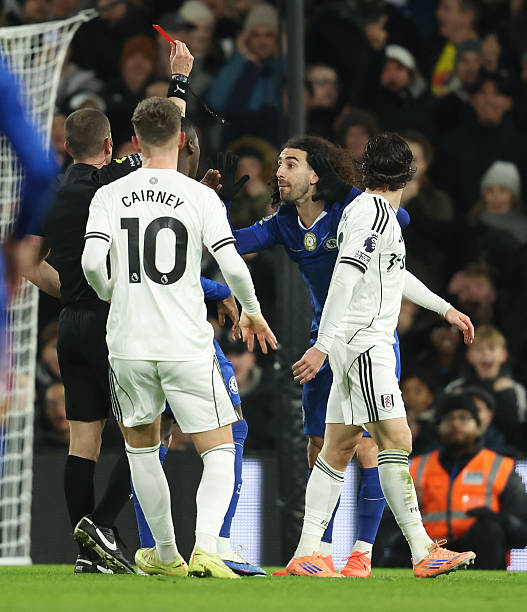
Chelsea’s Achilles’ heel this season has been their discipline. The Blues have accumulated nine red cards in the 2025–2026 season across all competitions. Among the players sent off are Sanchez, Chalobah, João Pedro, Gusto, Delap, Caicedo, Cucurella, Fofana, and Neto.
This statistic is more than just a number — it has real consequences for the team’s ability to execute its game plan over 90 minutes. Many of these dismissals come from critical situations: late tackles, tactical fouls to stop counterattacks, or unnecessary duels lost in dangerous areas. All of this undermines the team’s collective efficiency.
Head coach Liam Rosenior himself has acknowledged that this issue must be addressed if the club wants to achieve its ambitions.
This tendency toward red cards could be especially costly against a PSG side capable of exploiting numerical advantages, as seen in previous European matchups.
Rosenior : build a defensive block
Despite these challenges, Liam Rosenior has managed to bring more defensive structure to Chelsea since taking charge. Tactical analysis shows that the English coach has demonstrated a real capacity to adapt his defensive plans depending on the opponent.
For example, he has deployed a back five in high-stakes matches, such as against Arsenal in the FA Cup semifinal, while also using compact defensive lines to limit space between the lines.
This tactical flexibility has become one of Chelsea’s strengths. Rosenior isn’t afraid to adjust his systems depending on the opponent — something that will be crucial against a PSG side built on fast transitions.
However, Chelsea’s defensive block still has weaknesses, particularly in managing space and maintaining concentration during key moments — vulnerabilities that PSG’s pacey attackers could exploit.
How much Palmer could impact the game
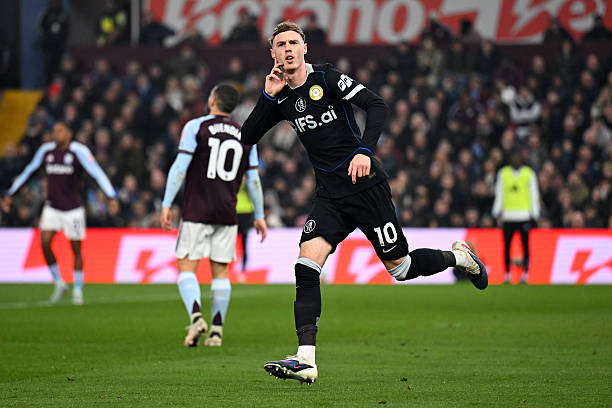
In attack, Chelsea relies on players capable of changing the course of a match — and Cole Palmer embodies that role perfectly.
Even if he hasn’t scored as frequently in certain big moments recently, Palmer remains a player capable of influencing the game through his dribbling ability, his creativity in tight spaces, and his long-range shooting.
His creativity in the final third, combined with the vertical style of play promoted by Rosenior, could make him the decisive factor in this European showdown.