

On May 16, 2005, Manchester United changed ownership. That day, a new page in the club’s history was written in the offices of the City of London, far away from the pitch at Old Trafford. After months of financial maneuvering, Malcolm Glazer and his family crossed the decisive 75 percent ownership threshold in Manchester United, giving them enough control to take the club private and remove it from the London Stock Exchange. For supporters, this was not simply the arrival of a new shareholder. It was the beginning of an especially contentious relationship between an American family and a section of Manchester’s fanbase, with financial, sporting and symbolic consequences that would be felt for nearly two decades.
The story, however, began long before that Monday in May. Malcolm Glazer, an American billionaire and owner of the Tampa Bay Buccaneers in the NFL, began buying shares in Manchester United in 2003. By the fall of 2004, his interest had become impossible to ignore. He became the club’s second-largest shareholder and made two informal takeover proposals, in October 2004 and then February 2005. Manchester United’s board rejected them, in part because of concerns about the level of debt Glazer planned to take on to finance the deal. Glazer did not give up. While his representatives gradually accumulated shares, opposition was organizing in the stands.
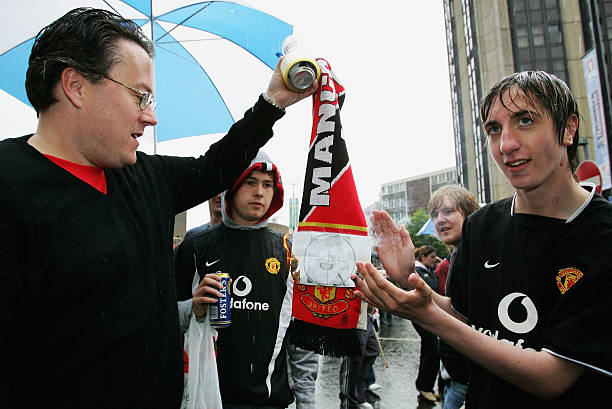
In Manchester, the idea of an American owner did not go down well. The issue was not simply his nationality: it was primarily the way he intended to finance his acquisition. Supporters were particularly concerned about potential ticket-price increases and the club becoming even more commercially focused. In February 2005, as discussions surrounding Glazer’s arrival intensified, hundreds of supporters demonstrated around Old Trafford. The Shareholders United movement attempted to pressure the board not to give Glazer access to the club’s accounts, a step considered necessary for banks to finance his takeover. The protests sometimes became extremely heated, to the point that police had to intervene and threats against Glazer and some club executives were reported.
The turning point came on May 12. That day, Glazer secured the support of two major Irish shareholders, horse-racing businessmen John Magnier and JP McManus. Their company, Cubic Expression, sold its 28.7 percent stake to Red Football, the vehicle created by Glazer to carry out his takeover. In exchange for 300 pence per share, the American immediately increased his stake to 56.9 percent and officially launched a takeover offer valuing Manchester United at £790.3 million, or approximately €1.16 billion at the time. He had therefore become the club’s majority shareholder.
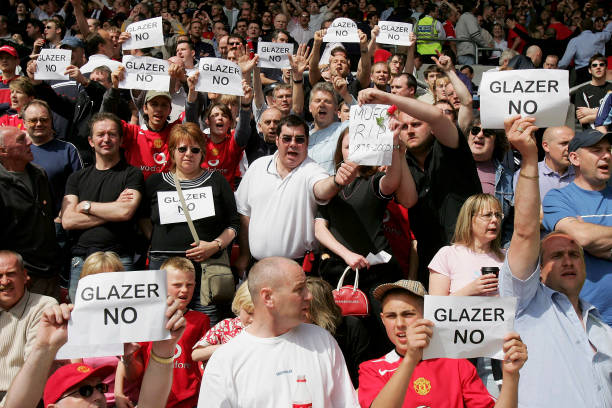
The day triggered an immediate reaction from supporters. While Glazer viewed the acquisition as a financial operation that would allow him to gradually take control of one of the world’s most powerful clubs, some fans saw it as a fundamental break with the past. Demonstrations took place around Old Trafford, and some supporters announced that they would not renew their season tickets. Nick Towle, then chairman of Shareholders United, summed up the feelings of part of the movement by saying that it was “no longer his club.” At the same time, the Glazer camp announced that Joel Glazer, one of Malcolm’s sons, would take an active role in running Manchester United.
May 16, 2005 : The day Manchester United changed forever

Four days after becoming the majority shareholder, Malcolm Glazer crossed the threshold that transformed his ownership advantage into genuine control. On May 16, he reached 75 percent ownership of Manchester United. His stake had already risen to 74.81 percent several days earlier, leaving him just a few hundred thousand shares short of the decisive threshold. Once the 75 percent mark was passed, Glazer could take Manchester United private and begin the process of removing it from the London Stock Exchange. It was therefore no longer simply a matter of owning a majority of the shares: the threshold gave him additional rights over the club’s structure and marked the true transfer of power.
Behind the takeover was a particularly complex financial operation. The acquisition of Manchester United was valued at around £790 million, but Glazer did not finance the entire deal with his personal fortune. His structure relied heavily on debt. Approximately £540 million was borrowed to finance the takeover, with part of that debt secured against the club’s assets, including Old Trafford. The structure included £265 million of debt secured against Manchester United’s assets, while another £275 million came from preference shares.
It was precisely this mechanism that would shape the Glazer family’s reputation among a section of the fanbase for years to come. Before their arrival, Manchester United was a publicly traded and extremely profitable company. After the takeover, some of the debt used to purchase the club was effectively placed onto the club itself. The Corporate Governance Institute estimates that the leveraged buyout left Manchester United with around £600 million in debt, along with significant annual financial obligations. The Glazers could theoretically have financed more of the acquisition with their own capital, but the structure ultimately placed a substantial portion of the financing burden on the club and its revenues.
For the supporters who had attempted to stop the takeover, crossing the 75 percent threshold therefore represented a defeat. They had tried to use their status as shareholders to prevent Glazer from reaching the thresholds required to take the club off the stock market. But the agreement with Magnier and McManus removed one of the main obstacles to the deal. Once Glazer passed 75 percent, the battle to prevent his arrival was essentially over. He still had to continue his offer in order to acquire almost all of the remaining shares: a few weeks later, his family would own 97.3 percent of the club and move closer to the 97.6 percent threshold required to compulsorily acquire the remaining shares.
May 16, 2005 therefore became a pivotal date in Manchester United’s history. On the field, the club was still managed by Sir Alex Ferguson and had just lost the FA Cup final to Arsenal on penalties. Off the field, its historic ownership structure was disappearing behind a new financial model. The contrast was striking: while Ferguson was already considering how he would strengthen his team, the club had just undergone a fundamental economic transformation.
The Glazer family would not simply keep Manchester United as a private investment. After Malcolm Glazer’s death in 2014, his children continued to control the club. But the financial model established in 2005 continued to have consequences. Dividends began being paid to the owners in 2015 and, according to the Corporate Governance Institute, reached approximately £90 million over the following four years. At the same time, debt and financial costs became recurring elements of the debate surrounding the club’s management.
That is why the memory of May 2005 extends far beyond the simple question of who owned Manchester United. For a section of supporters, the problem was not simply that an American had bought Manchester United. It was that the acquisition had been carried out through a highly leveraged financial structure and that the cost of that operation subsequently became associated with the club’s finances. The protests of 2005 therefore foreshadowed an opposition that would resurface repeatedly: during protests against the Glazers, during the Red Knights’ attempt to buy Manchester United in 2010, and again during the supporters’ mobilization against the Super League project in 2021.
Twenty-one years later, May 16, 2005 remains one of the most important days in Manchester United’s modern history. That day, Malcolm Glazer did not simply become one of the most powerful figures in English soccer: he transformed the club’s ownership structure. A £790 million acquisition, largely financed through debt, took Manchester United from a publicly traded company to a club controlled by an American family. To understand the distrust that developed between the Glazers and a section of Manchester’s supporters, you have to go back to that day: that is where the Glazer era truly began.
 Manchester United