

On Sunday, Manchester United and Manchester City will meet at Old Trafford for the 199th derby in their history. Kickoff is set for 11:30 a.m. ET and 8:30 a.m. PT. More than just a clash between two neighboring clubs, this fixture pits two identities, two histories and, for the past 15 years or so, two different visions of the balance of power in the city against each other. Because while Manchester was red for a long time, blue has gradually taken control.
A rivalry born before United and Liverpool dominance
Today, Manchester United and Manchester City represent two of the biggest powers in English soccer. Yet their rivalry was born long before the billions, European titles and Premier League era. Both clubs have humble origins and were shaped within the same industrial city.


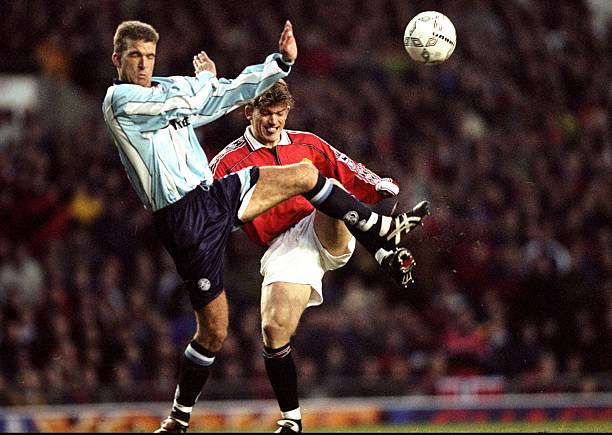
Manchester United was founded under the name Newton Heath LYR in 1878, around employees of the Lancashire and Yorkshire Railway’s carriage and wagon depot. Meanwhile, the club that would become Manchester City was created two years later under the name St Mark’s, in West Gorton. The two clubs quickly found themselves in the same footballing environment and first met in competitive action in 1891.
At the time, there was obviously no such strong divide between “Red” and “Blue.” But the derby gradually became a marker of local identity. In Manchester, soccer is not just about results: it is rooted in neighborhoods, families and generations.
The unique nature of this rivalry lies precisely in that proximity. The two clubs are not separated by any significant geographical boundary. They play in the same city and share a common history. Supporters can live in the same neighborhoods, work for the same companies or attend the same schools while choosing two opposing sides.
During the first few decades, City was by no means the little brother to United that one might imagine today. The balance of power fluctuated for a long time. Until World War II, City had actually finished above United in the league more often, with 28 higher finishes compared with 15 for the Red Devils across their first 43 seasons together in the Football League. At that point, both clubs had won three major trophies each.
The rivalry was also built around moments that became part of the collective memory. In 1974, the goal scored by Denis Law, a former Manchester United hero who had moved to neighbors City, remains one of the derby’s most famous images. His incredible backheel at Old Trafford came as United were fighting to avoid relegation and contributed to a scene that has since become legendary: supporters invaded the pitch after the goal, and the match was eventually abandoned. United would be relegated that season, although the result of the derby itself was not solely responsible for their relegation.
The derby, therefore, already had an incredibly rich history long before City became a financial and sporting powerhouse.
When Manchester became red
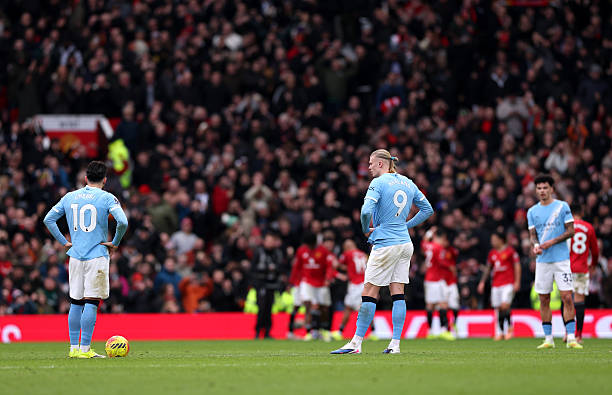
From the 1980s onward, the balance of power changed dramatically. Manchester United entered a period of dominance that would almost come to define the identity of modern English soccer.
Under Alex Ferguson, the Red Devils gradually became the undisputed benchmark in the country. Between 1980 and 2012, United finished above City in the standings in 31 of the 32 seasons. During that period, City only beat United twice in the league before the start of the 1990s: 1-0 in 1981 and 5-1 in 1989.
This dominance transformed the perception of the derby. United were no longer simply playing their neighbors: they were playing a team trying to exist in their shadow.
But soccer has a particular memory. The years of red dominance would ultimately make the reversal even more spectacular.
The shift truly began at the start of the 21st century. New investment allowed Manchester City to move into another dimension. The “noisy neighbors,” as Ferguson called them, no longer wanted simply to take part in the derby: they wanted to overturn the hierarchy of the city.
One of the first symbols of that ambition was Carlos Tevez. The Argentine, who had spent two seasons at Manchester United, joined City in 2009 after refusing to continue his career at Old Trafford. City immediately used his transfer as a media statement of intent by putting up a huge billboard in the city center featuring Tevez with the message “Welcome to Manchester.” Ferguson responded by describing City as a club with a “small mentality.”
A few months later, City reached the League Cup final after eliminating United in the semifinals. The blue club was beginning to show that it could now compete with its neighbor on the field.
Then came October 23, 2011.
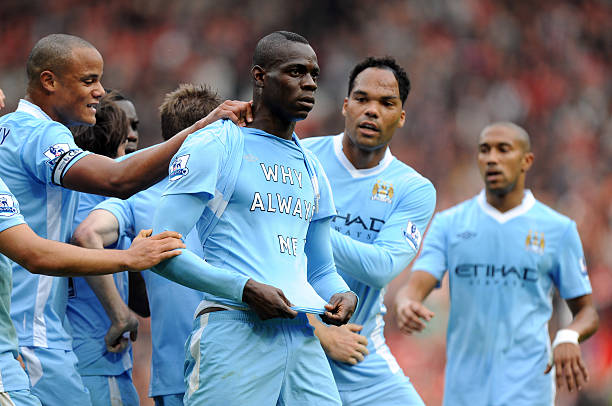
That day, Manchester City crushed Manchester United 6-1 at Old Trafford. Mario Balotelli unveiled his famous “Why Always Me?” celebration after scoring his first goal, and City produced one of the most humiliating results ever inflicted on the Red Devils at home. But more importantly, the victory took on historic significance: a few months later, City would win the Premier League on goal difference, ahead of United.
The derby was no longer just a historic rivalry. It had become a symbol of a changing balance of power.
Blue moon take control
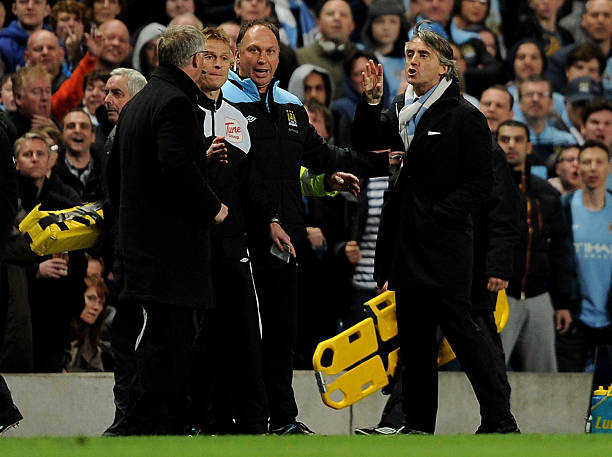
Since the beginning of the 2010s, Manchester City has gradually reversed the hierarchy.
The club that once sought to emerge from United’s shadow has become the one collecting trophies while its neighbor searches for a return to its former greatness. Pep Guardiola’s arrival in 2016 accelerated that transformation even further. City became a benchmark for possession-based soccer, winning league title after league title and establishing itself on the European stage as well.
The contrast is striking. While City has built a dynasty, United have gone through a succession of managers and sporting projects without managing to rediscover the consistency of the Ferguson era.
The rivalry remains unique, however, because the balance of power can change dramatically in a derby. Recent history has produced emphatic victories for both sides, late goals, provocative celebrations and scenes that go far beyond the sporting context. The derby has become a kind of permanent theater in which each generation has its own memories.
Sunday’s game fits precisely into this new era. City arrive in a position of strength built over the past several years, while United are looking to prove that the balance of power can shift once again. City have won eight Premier League titles in 14 years, compared with just one for United over the same period, which explains why some players from the blue side now claim the title of “kings of Manchester.”
But this recent dominance is not enough to erase history. Manchester United remain the club that represented the city at the highest level for so long, with a dominance that shaped several generations of supporters. City, meanwhile, now represent modern success and the overturning of a hierarchy that once seemed almost impossible to change.
That is what makes this derby so special: it is not simply about determining who is better today, but about deciding which identity should represent Manchester.
Red versus blue. Ferguson against Mancini, then Guardiola. Cantona against Kinkladze, Rooney against Agüero, followed by the new generations. One city, two clubs and more than a century of shared history.
And on Sunday, at Old Trafford, the 199th chapter of this rivalry will once again write a new page in the history of Manchester.