

Manchester United does not just have a results problem: its start to the season above all reveals a team struggling to impose its rhythm and produce football with enough intensity to control its games. After five Premier League matches, the difficulties seen in the draw against Fulham summed up the current limitations of Michael Carrick’s team. For large stretches of the game, United appeared to lack movement, speed in its passing and, above all, aggression when it came to winning the ball back. The problem is even more apparent because Manchester United is now looking to play in a style based more heavily on possession and control of the game. But keeping the ball is not enough when a team cannot accelerate, create openings or win it back quickly after losing it.
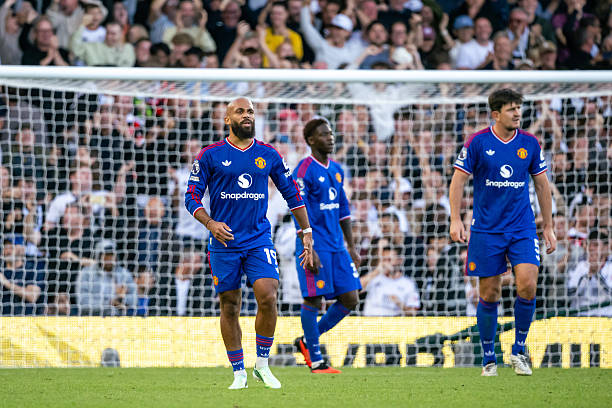
Against Fulham, United did indeed have more of the ball, but that possession often proved sterile. The players found themselves too far apart, runs lacked spontaneity and attacking sequences repeatedly lost their rhythm before even reaching the opposition penalty area. The lack of intensity has become one of the main symptoms of this team. Physical statistics published after the game notably show that United ranks among the league’s least effective teams when it comes to high-intensity running and sprints. At Craven Cottage, Fulham covered several more kilometers than Manchester United, highlighting a particularly noticeable difference in dynamism after halftime. Matheus Cunha himself acknowledged after the game that Fulham had brought more energy than his team at the start of the second half. Michael Carrick disputed the idea that his team had lacked energy, pointing in particular to its response during the final minutes, but that late spell is not enough to erase the difficulties observed during the rest of the match.
A team lacking rhythm, intensity and solutions

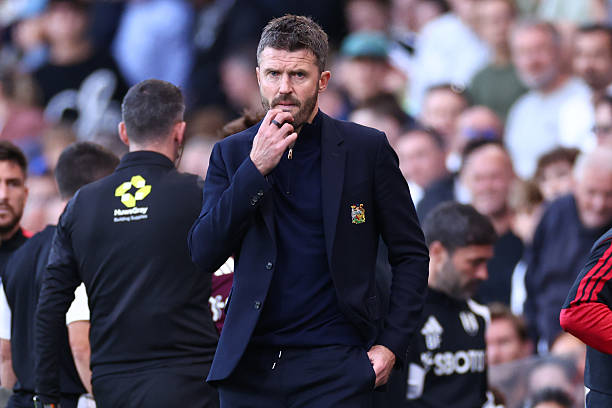
The problem is also tactical. The midfield trio of Youri Tielemans, Kobbie Mainoo and Bruno Fernandes possesses genuine technical quality, but it does not necessarily offer the athletic power required to produce repeated high-intensity runs and cover large distances without the ball. Tielemans can provide his passing quality and ability to dictate play, while Mainoo is capable of carrying the ball and resisting pressure, but United is still missing a true engine capable of constantly connecting the different areas of the pitch. The arrival of Carlos Baleba is supposed to bring a different dimension to the position, with a player capable of gaining ground, covering large distances and contributing to ball recovery while still being able to progress with the ball. This lack of power in midfield partly explains why Manchester United is often late to second balls and why its players are slow to make runs into the penalty area. A team that wants to dominate through possession must be able to react immediately after losing the ball. It must also constantly create movement to provide multiple options for the player in possession. United does not yet have that fluidity. When the ball moves slowly, opponents have time to reorganize and the spaces disappear. When United loses possession, the lack of high-intensity running then makes counter-pressing more difficult and gives the opposition more time to play out. The result is a vicious cycle: slow possession produces few chances, turnovers become dangerous and the team then has to defend for longer periods. This difficulty is also visible in the final third. Manchester United can produce promising spells, but it still lacks consistency and quality when it comes to turning territorial dominance into genuine chances. The absence of Benjamin Sesko, who is physically compromised, in particular deprives Carrick of a profile capable of threatening in behind more consistently and providing a focal point. Without a sufficiently dangerous attacking presence, opposing defenders can more easily narrow the space around Bruno Fernandes, Matheus Cunha and the attacking players. The problem, therefore, is not simply that United is missing a striker: the entire attacking chain is functioning intermittently. The fullbacks are still providing too little width and threat, the midfield is struggling to accelerate sequences and the attackers are sometimes forced to drop deep to participate in the buildup, leaving less presence in the penalty area. On top of that, a defense can become exposed when the team loses its compactness. Manchester United wants to control games more through the ball, but that approach requires a team capable of maintaining a high level of intensity in its movement and transitions. Without that, control becomes an illusion: the team has the ball without actually controlling the game. That is precisely what gives United this sense of slowness today. The problem is not necessarily a lack of individual talent, but the difficulty of making different qualities work together within the same system. United has players capable of passing, carrying the ball, creating and scoring, but the team is still lacking collective rhythm. As long as movement remains too limited, high-intensity runs are insufficient and the midfield cannot impose its tempo, Manchester United will continue to dominate certain phases without truly controlling its games. Michael Carrick’s task, therefore, is less about teaching his team how to have the ball than teaching it how to use possession to accelerate, win the ball higher up the pitch, attack space and maintain constant pressure. Without that evolution, United risks continuing to produce fragmented football, where good spells exist but remain too rare to turn possession into genuine dominance.
 Manchester United