

By defeating Arsenal in the Champions League final after an extremely tight and suffocating contest, Luis Enrique’s Paris Saint-Germain probably played its most difficult European match of the season. Accustomed to imposing its rhythm through ball possession, positional play and the ability to stretch opposing defensive blocks, PSG found itself facing an Arsenal side that arrived with a very clear plan: neutralize Paris’ creative circuits and turn the match into a tactical battle. This final never resembled the attacking showcases that PSG had accustomed Europe to. Instead, it became a contest of patience in which every inch of space had to be earned.
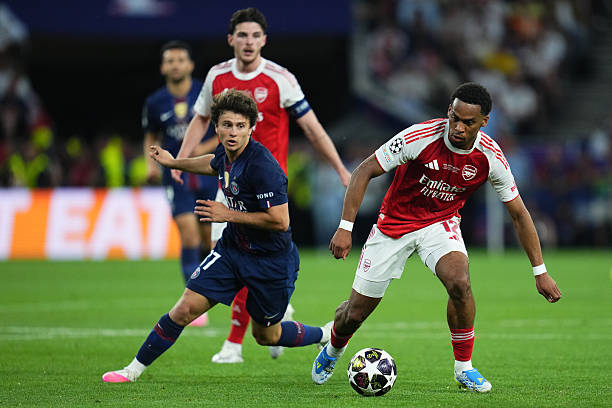
Arsenal deliberately surrendered the possession to block the middfield area
The first major takeaway from this final lies in the highly pragmatic approach chosen by Mikel Arteta. While his team is usually known for controlling matches through possession, Arsenal accepted giving the initiative to PSG for long stretches of the game. The objective was simple: prevent Paris from finding free players between the lines.
The London side organized itself in a very compact 4-4-2 shape without the ball. The distances between the lines were reduced to a minimum, preventing PSG’s midfielders from receiving in favorable conditions. Every time Vitinha or João Neves attempted to play forward, they immediately found themselves under pressure.
This choice largely explains PSG’s territorial dominance without true attacking dominance. The Parisians monopolized possession but struggled to create situations of imbalance through the middle. Arsenal specifically wanted to force PSG to play out wide and deliver crosses rather than combine in the half-spaces, the areas where Luis Enrique’s side is usually at its most dangerous.
This strategy also limited the impact of PSG’s attacking rotations. Dembélé’s movements into deeper areas, Kvaratskhelia’s positioning changes and the forward runs of the midfielders rarely created the disruptions they normally do.
Arsenal’s pressing focused heavily on PSG’s buildup phase. Beyond the compact defensive block, Arsenal alternated with periods of extremely aggressive pressing. Arteta had identified one of PSG’s greatest strengths: its ability to build from the back through technically gifted defenders and midfielders.
To disrupt that mechanism, Arsenal sought to close passing lanes into central areas rather than press recklessly. Kai Havertz played a key role in this setup. His work rate allowed him to direct PSG’s buildup toward predetermined areas before Arsenal’s midfielders moved in to trap the ball carrier.
The result was visible for much of the match. PSG was often forced to play longer balls or build attacks more slowly than usual. The fluid sequences that had allowed Paris to overwhelm Liverpool and Bayern Munich during its European run were far less frequent.
Arsenal was not necessarily trying to win the ball back immediately. The primary objective was to break PSG’s rhythm and prevent the French champions from establishing their positional play. This approach explains why PSG appeared unusually frustrated in possession.
Enrique choose to shift this battle on the wing
Faced with Arsenal’s central blockade, Luis Enrique gradually adjusted his approach. Realizing that space through the middle was virtually nonexistent, PSG sought to stretch the English side even further.
The full-backs positioned themselves very high up the pitch while the wingers occupied wider positions to force Arsenal to defend across the entire width of the field.
This adjustment did not immediately create clear-cut chances, but it gradually wore down Arsenal’s defensive block. The deeper Arsenal retreated, the more physically demanding its defensive movements became.
PSG then began generating more one-on-one situations on the flanks, particularly through Kvaratskhelia’s bursts of acceleration and Dembélé’s movements away from the defensive line.
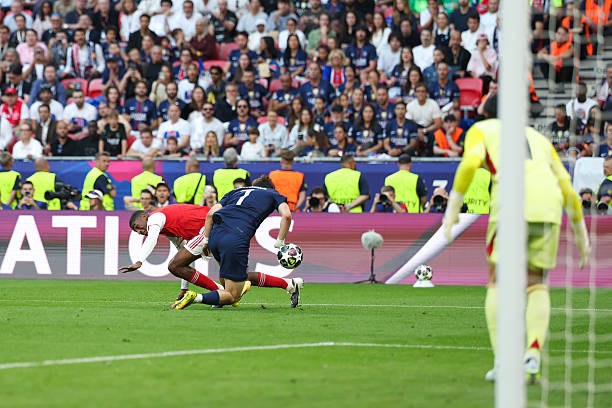
The turning point finally came when the Georgian initiated a one-two combination with Dembélé. Arsenal’s stretched defensive shape left an opening that Kvaratskhelia attacked immediately, and Mosquera had little choice but to bring him down.
Once Arsenal’s defenders were forced to defend more frequently inside their own penalty area, they became increasingly exposed to PSG’s technical quality and intricate combinations. Paris had not found a breakthrough through structured positional attacks, but it had succeeded in establishing constant territorial pressure that ultimately produced the equalizing penalty.
This sequence perfectly summarizes the logic of the match: PSG did not dominate through a flood of chances but through its ability to keep Arsenal pinned back for extended periods.
Two different vision of how to creat a team
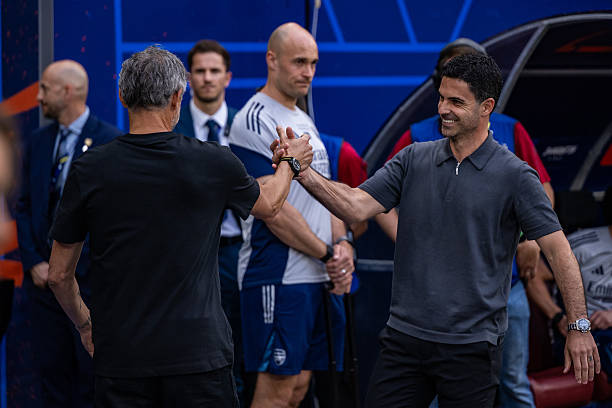
Beyond the result itself, this final primarily illustrated two different conceptions of elite-level football.
On one side, Luis Enrique’s PSG sought to control the match through possession, positional rotations and the creation of technical superiorities. On the other, Arsenal accepted a more reactive role, relying on collective discipline, transitions and the maximum reduction of available space.
Arteta’s approach was entirely consistent with the strengths of his squad. Arsenal possesses arguably one of the best defensive structures in Europe and demonstrated throughout the competition its ability to suffer without breaking.
PSG, meanwhile, confirmed another essential quality of great champions: the ability to win even when the original game plan does not function perfectly. Unlike some previous versions of the Parisian club, this team did not panic when technical superiority alone was no longer enough.
The match ultimately turned on fine margins, as so often happens in major European finals. But tactically, it will be remembered both as one of the most complete demonstrations of Mikel Arteta’s coaching work and as proof that Luis Enrique’s PSG can now adapt to any context.
More than an attacking showcase, this final was a strategic battle. And it is precisely because Arsenal made the match so uncomfortable that PSG’s triumph appears even more impressive today.
 Arsenal
 Paris Saint Germain
 Bukayo Saka
 Kai Havertz
 Khvicha Kvaratskhelia
 Ousmane Dembélé