

For years, Brazil waited for its next great superstar. The player who would inherit Neymar’s mantle and finally return the Seleção to the summit of world soccer.
By this World Cup, there was no longer any doubt. This was Vinícius Júnior’s team. At 26 years old, the Real Madrid winger arrived in North America with a completely new status. Carlo Ancelotti had built Brazil around him, Neymar himself acknowledged that “this is now Vinícius’ team,” and virtually every attacking move flowed through the No. 7. Throughout the group stage, Vinícius delivered. But once the knockout rounds began, Brazil’s overwhelming dependence on its superstar became impossible to ignore. Against a perfectly organized Norway, the Brazilian dream came crashing down.
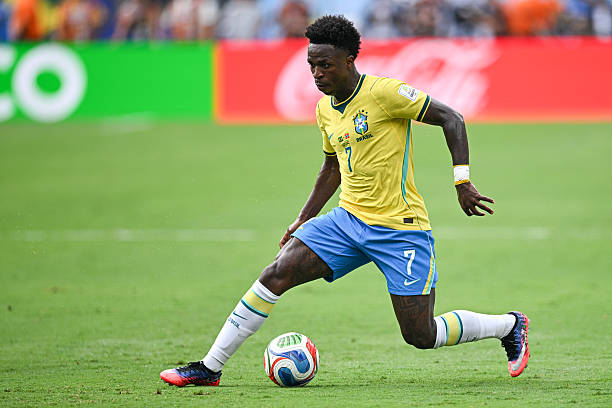
The main man of Seleçao
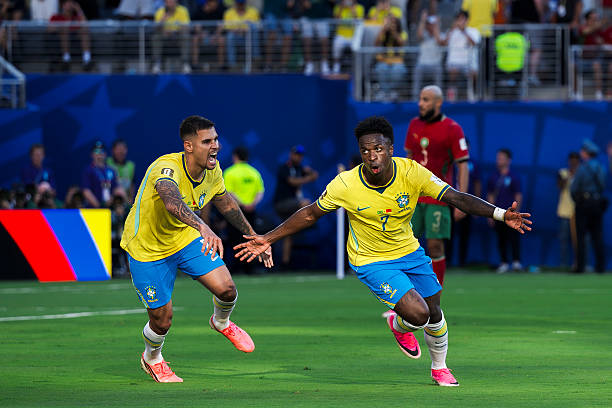
The 2026 World Cup was supposed to mark the beginning of a new generation. After spending years in Neymar’s shadow, Vinícius had finally become the face of Brazilian soccer. Carlo Ancelotti, who knew him better than anyone after coaching him for years at Real Madrid, made a clear tactical decision: Build the entire attacking system around his winger. Given greater freedom to roam and more responsibility as the team’s primary creator, Vinícius was no longer simply an electrifying dribbler. He had become the technical leader of a national team undergoing a major rebuild. Even Neymar, returning to the squad after a lengthy absence, embraced that transition. Brazil now belonged to Vinícius. On the field, the Real Madrid star quickly justified those expectations.
From the opening matches, he repeatedly attacked defenders with explosive pace, relentless runs in behind, and devastating one-on-one ability. More mature in his decision-making and more clinical in front of goal, he made decisive contributions almost every time he stepped onto the field. His masterpiece came against Scotland. Scoring twice in Brazil’s 3-0 victory, Vinícius secured qualification while ensuring that Ancelotti’s team finished atop its group. He completed the group stage with four goals, becoming the first Brazilian since Ronaldo and Rivaldo in 2002 to score in all three World Cup group-stage matches.
His soccer captivated audiences.
His dribbling, acceleration, and creativity evoked memories of Brazil’s great attacking artists of previous generations.
More than ever, he embodied jogo bonito. Yet beneath those impressive statistics lay a more troubling reality.
Brazil played almost exclusively through Vinícius. Every transition looked for him. Every counterattack was directed toward his side of the field. Whenever he received the ball, his teammates often appeared content to wait for him to create something extraordinary.
That dependence became one of the Seleção’s greatest weaknesses.
When Vinícius was unstoppable, Brazil looked almost unbeatable—as demonstrated by its dominant second-half performance against Japan. When he was contained, the entire attack ground to a halt.
Norway found the key to keep him silent
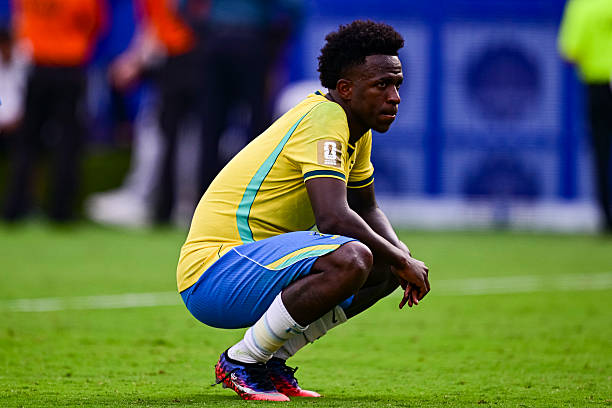
In the Round of 16, Ståle Solbakken’s Norway had already identified the problem. Before kickoff, the Norwegian head coach described Vinícius as “a physical phenomenon” capable of deciding any match on his own. His solution was equally straightforward.
Double-team him. Triple-team him whenever necessary. The plan was executed flawlessly. Every time Vinícius touched the ball, defenders immediately surrounded him. The space disappeared. Passing options became increasingly scarce. Brazil continued enjoying possession but lost all of its attacking spontaneity. The Seleção simply could not find another solution. Vinícius never stopped trying. He created several chances.
He beat defenders repeatedly. He even produced a superb opportunity for Endrick, who failed to convert. But this time, no one else stepped up beside him. Meanwhile, Erling Haaland punished every Brazilian defensive mistake, aided brilliantly by the relentless work of Andreas Schjelderup and Oscar Bobb, whose energy and attacking aggression provided exactly what Brazil’s other forwards lacked.
Disciplined, organized, and ruthlessly efficient, Norway eliminated one of the tournament favorites while producing one of the biggest upsets of the World Cup.
The contrast was impossible to miss. On one side stood a brilliant but isolated Vinícius. On the other stood a Norwegian team functioning as a perfectly synchronized collective.
A World Cup defined by contradiction
Individually, Vinícius leaves this World Cup with his reputation enhanced. Four goals. Several world-class performances. Spectacular dribbling displays.
And further confirmation that he belongs among the very best players in global soccer.
Collectively, however, the tournament was an undeniable failure. Brazil, already facing questions over Carlo Ancelotti’s controversial decisions—including leaving João Pedro out of the squad and relying on a physically limited Neymar—crashed out as early as the Round of 16. The elimination served as another reminder that even a national team blessed with an extraordinary player cannot survive if it depends almost entirely on him. This World Cup will therefore be remembered as the tournament of Vinícius Júnior’s individual coronation. But it will also be remembered as the tournament in which Brazil discovered the limits of a team built around one man alone. Because when there is only one captain steering the ship, all it takes is one opponent finding the right tactical solution to sink the entire vessel.
 Brazil
 Neymar
 Vinicius Jr