

If Rodri’s move to Barcelona were to become a reality, it would not simply be a marquee signing. More importantly, it could address one of the few imbalances in Hansi Flick’s Barcelona: the absence of a true defensive midfielder capable of controlling the first phase of buildup, protecting the defense, and giving the team’s creators more freedom. While the Catalan midfield already includes Pedri, Frenkie de Jong, Gavi, and Dani Olmo or Fermin in advanced role, Rodri would bring a different profile, one focused more on control and security. His experience under Pep Guardiola at Manchester City, as well as his role as a leader for Spain, makes him particularly compatible with a team that wants to dominate possession while applying extremely aggressive pressure after losing the ball.
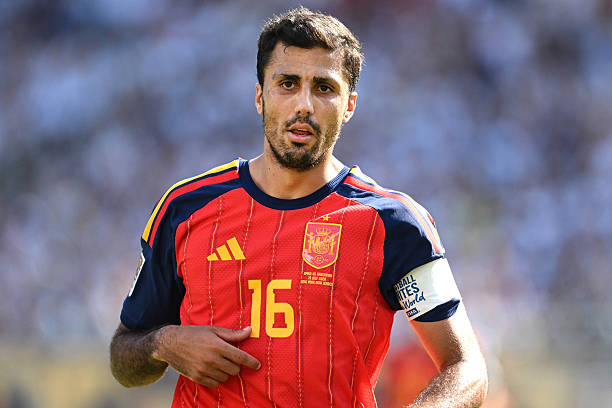
The 6 Barcelona has been missing !
Since Sergio Busquets’ departure, Barcelona have never truly found a player capable of consistently occupying the holding midfield role with the same level of control. Frenkie de Jong can play in front of the defense, but his tendency to carry the ball and push forward regularly takes him away from that area. Eric Garcia has also been used in midfield by Flick, without ever being considered a definitive solution.
Rodri could therefore solve this problem immediately. In a 4-2-3-1, the 2024 Ballon d’Or winner could be positioned as the deepest midfielder, responsible for dropping toward the center backs to receive the ball and organize the first phase of buildup. His technical quality would allow him to withstand opposing pressure, while his reading of the game would enable him to quickly stop transitions.
This is precisely one of the aspects that could appeal to Flick. Barcelona play with an extremely high defensive line and look to win the ball back immediately after losing it. This system requires a player capable of controlling the space in front of the defenders when the first line of pressure is broken. Rodri possesses exactly that ability to win duels, anticipate transitions, and keep his team in a high position.
His role, therefore, would not simply be to “replace” De Jong. It would change the distribution of responsibilities. Where the Dutchman likes to break lines by carrying the ball, Rodri could remain further behind the play and allow the other midfielders to take greater risks.
Freeing Pedri
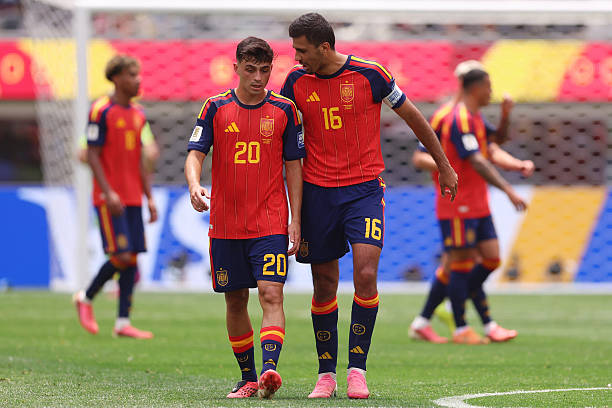
One of the biggest beneficiaries of Rodri’s arrival could be Pedri. The Spanish midfielder has become one of the main controllers of Flick’s Barcelona, capable of moving between the lines, dictating the tempo, and contributing to the counter-press. But his influence could increase even further with a player like Rodri behind him.
In this setup, Rodri would become the team’s first launch point while Pedri would operate higher up the field, with more freedom to participate in attacking combinations. This is already a possibility raised in analyses surrounding the potential transfer: Rodri would allow Pedri to move away from the first line of buildup and focus more heavily on creation.
Barcelona could then have an especially complementary structure: Rodri to secure possession and dictate play, Pedri to accelerate and connect the lines, and a third midfielder—Dani Olmo, Gavi, or Fermín López depending on Flick’s choices—to provide more presence between the lines.
This structure also fits Barcelona’s identity under Flick. Despite being labeled a 4-2-3-1, Barcelona regularly transform into a 4-3-3 in possession depending on their players’ movements. The team looks to create overloads through the middle, build short combinations, and move the opposing block before attacking the spaces that open up.
Rodri could become the fixed point of this structure. His ability to play short passes as well as switch the play would allow the center backs to find the midfielders more easily while giving the fullbacks greater freedom to push forward without completely compromising the team’s balance.
This is also where his time under Guardiola becomes particularly relevant. Rodri was tactically developed within a footballing philosophy where controlling space and dominating possession are essential. Barcelona could therefore offer him an especially natural environment, continuing the style of soccer he experienced at Manchester City.
A more balanced Barcelona
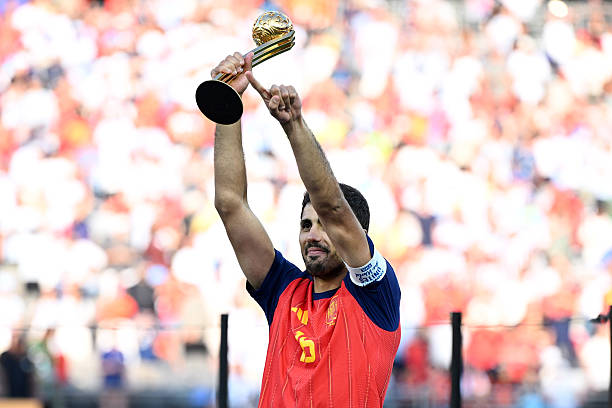
The main challenge would ultimately be finding the right balance between Flick’s philosophy and Rodri’s qualities. The German coach is not simply looking to control games through possession: his Barcelona also want to play extremely high, press intensely, and quickly win the ball back in the opponent’s half.
Rodri could make that level of risk more sustainable.
In a 4-3-3, for example, he could operate as the lone holding midfielder, with Pedri as the left No. 8 and Gavi on the right. This setup would partly replicate the role he knows with Spain and the one he used for years under Guardiola at Manchester City. Sports Illustrated has specifically considered this possibility, with Rodri acting as the anchor and two more creative midfielders playing ahead of him.
Another option would be to maintain Flick’s 4-2-3-1. Rodri could then be paired with Pedri or De Jong in the double pivot, with a No. 10 positioned ahead of them. In this setup, Rodri would have greater defensive responsibilities while his partner could make more forward runs.
The choice between the two systems would depend largely on Flick’s preferences. The 4-2-3-1 would allow Barcelona to maintain the structure that has brought the German coach success, while the 4-3-3 would give the team an organization closer to its traditional identity and allow Rodri to fully embrace his role as a holding midfielder.
His arrival could therefore give Flick additional tactical flexibility.
More importantly, Rodri would not simply be a player tasked with defending. His contribution during buildup could allow Barcelona to better control the moments when their press is beaten. With a player capable of slowing down a transition, winning a duel, or simply keeping possession under pressure, Barcelona could take greater risks with their defenders and attacking players.
That may ultimately be Rodri’s true value: he would not transform Flick’s Barcelona into a different team, but he could allow them to take their principles even further.
A holding midfielder capable of defending, building, directing play, and controlling the tempo would give Pedri more freedom, secure the fullbacks’ forward runs, and strengthen the counter-press.
Rodri would therefore be more than just another piece in Barcelona’s midfield. He could be the piece that finally allows Flick to bring control, creativity, and aggression together within the same structure.
 Rodri
Rodri