

A hire that signaled ambition
When U.S. Soccer named Mauricio Pochettino head coach on September 10, 2024, the message was unmistakable. The federation had chased one of the most respected managers in the sport, a man who had stood on the touchline for Tottenham, Paris Saint-Germain and Chelsea, and convinced him to take charge of a national team that had lost its way. The Americans were set to host a World Cup on home soil in less than two years, and they needed someone capable of carrying that weight. Pochettino accepted, promising to build something the country could be proud of.
The honeymoon did not last long.
The painful early months
Pochettino later admitted he was naive about what he was walking into. The complacency around the program hit him, in his words, like a big punch. His debut on October 12, 2024 brought a tidy 2-0 win over Panama, but the deeper problems surfaced fast. The U.S. limped to a fourth place finish at the 2025 Concacaf Nations League Final Four in March, losing to Panama and Canada in a humbling pair of results that put his methods under the microscope.
Then came the Gold Cup. The U.S. reached the final, only to fall to Mexico in front of a stadium drowning in green shirts. Pochettino framed the defeat as a necessary blow, a moment of clarity for players who needed to understand that talent on its own would carry them nowhere.
- Record before the 2025 Gold Cup run: 2 wins, 4 losses
Building a new player pool
Rather than reach for familiar names, Pochettino went hunting. He handed debuts and real responsibility to players few casual fans could have picked out of a lineup. Defender Alex Freeman, midfielder Sebastian Berhalter, full back Max Arfsten and goalkeeper Matt Freese all became fixtures. Freese started every match of the Gold Cup run and conceded just one goal in the group stage, tying a USMNT record for appearances by a goalkeeper in his debut year. Sergino Dest fought his way back into camp after a ruptured ACL. The churn was deliberate. Pochettino wanted competition, depth, and a group that earned its place rather than inherited it.
The point was never to reward reputation. It was to find players who fit the way he wanted to play: aggressive on the press, quick to win the ball back, comfortable defending high up the field.
- Players capped by the USMNT in 2025: 56
The turnaround
The second half of 2025 looked like a different team wearing the same shirt. The U.S. closed the year on an unbeaten run of five matches against opponents ranked inside the FIFA top 40, the first time the program had managed that since 2013. Every one of those teams was already bound for the World Cup. Three of them arrived carrying unbeaten streaks, and the U.S. snapped all three.
The signature night came in Tampa on November 18, when the Americans took Uruguay apart 5-1. It was the largest margin the U.S. had ever produced against a South American side, and it tied the record for the biggest win over a team ranked in the top 15. Alex Freeman, Sebastian Berhalter and Tanner Tessmann all opened their international scoring accounts in a single first half, the kind of detail that tells you a young group is starting to believe.
- Record across the final 12 matches of 2025: 8 wins, 2 losses, 2 draws
A culture, not just a system
Pochettino’s bet was always about more than tactics. Veterans spoke about a coach who pulled players aside one by one, who insisted on close connections and constant communication. The walls of the team hotel carried his mantras: Believe, Work, Compete, and the simple challenge of Why not U.S. The slogans could have read like marketing, but the dressing room appeared to buy in completely.
The connection reached the stands too. Pochettino noted how the fans, once outnumbered by visiting supporters at the Gold Cup final, began to show up in force. Being serenaded in Seattle with Take Me Home, Country Roads moved him enough that he started learning the words. He called that bond between team and supporters the most important legacy he could leave.
A wobble before the storm
Confidence is fragile, and the spring of 2026 tested it hard. The U.S. lost 5-2 to Belgium on March 28 and 2-0 to Portugal three days later, results that reminded everyone how thin the margin can be against elite European opposition. The critics circled again. Pochettino held his nerve, insisting the team was building toward the only peak that mattered, the one in June.
The World Cup arrives
The payoff came on home soil. The U.S. opened Group D with a commanding 4-1 win over Paraguay, then ground out a 2-0 victory over Australia in Seattle to lock up a place in the knockout round with a game to spare. A 3-2 loss to an already eliminated Turkey in the finale, with Pochettino resting nine starters and protecting players on yellow cards, did nothing to dampen the achievement.
The Americans won Group D outright with six points, their best group stage showing in the modern era. Only twice before, in 1930 and 2002, had the U.S. won two matches in a single World Cup.
- Group matches won at a single World Cup: only the 1930 and 2002 sides had managed two before this team
What comes next
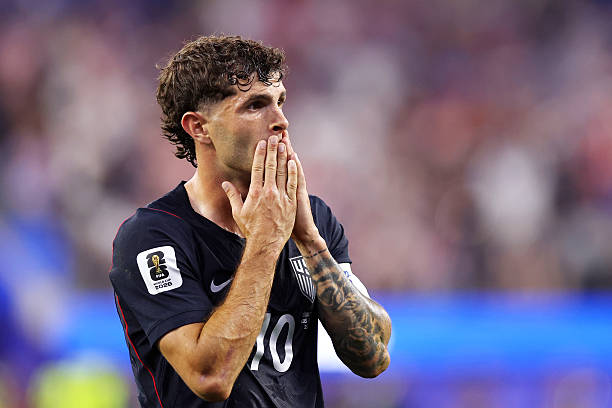
The transformation is real, but the test that defines it is still in front of him. The U.S. meets Bosnia and Herzegovina in Santa Clara on July 1 in the round of 32, with Christian Pulisic fit again after the calf problem that limited him in the group stage. The Americans have won only one knockout match in their entire World Cup history, the 2-0 defeat of Mexico in 2002. Erasing that ceiling is the chapter Pochettino wants to write next.
Twelve months ago this was a program searching for an identity, lurching from one humbling result to the next. Today it wins its group at a World Cup, plays with belief, and carries itself like a team that belongs. Whatever happens against Bosnia, the rebuild has already changed the conversation around U.S. soccer, and that may be the truest measure of what Pochettino has done.
 United States
 Christian Pulišić
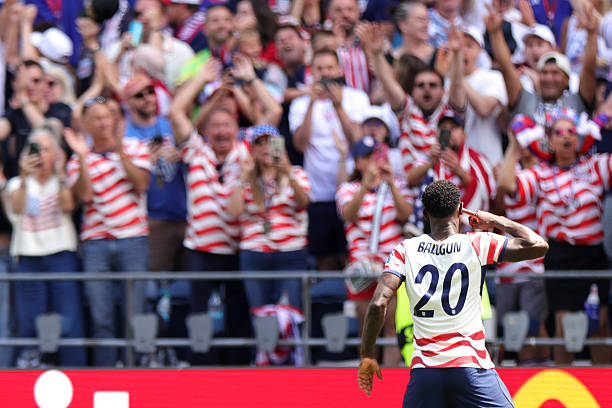
 Folarin Balogun