

For 75 minutes, Thomas Tuchel appeared to have found the perfect formula.
England had smothered Argentina, neutralized Lionel Messi for long stretches of the match, taken the lead through Anthony Gordon, and looked to be closing in on its first World Cup Final since 1966.
Then, in the space of a few minutes, everything collapsed.
Argentina completed a dramatic 2-1 comeback victory thanks to goals from Enzo Fernández in the 86th minute and Lautaro Martínez deep into stoppage time. More than just another comeback, the match will be remembered as a striking example of how a series of coaching decisions completely altered the course of a World Cup semifinal.
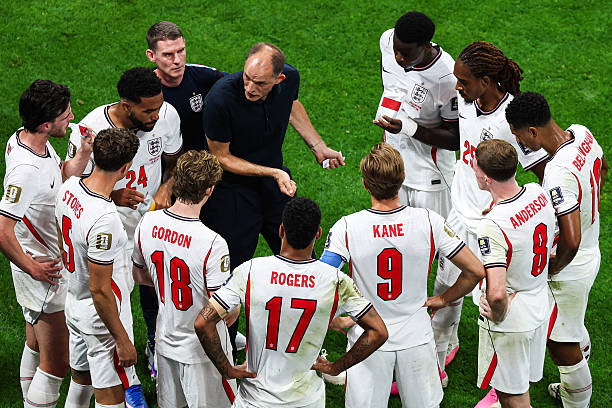
The turning point : England stopped playing
The irony is difficult to ignore.

For years, tactical analysts have repeated the same principle: when a team takes a one-goal lead, its first instinct is often… the worst possible decision.
To retreat.
Modern tactical research consistently shows that protecting a lead does not mean surrendering possession. Quite the opposite. Teams that continue pressing high and controlling the ball generally concede fewer dangerous opportunities. By voluntarily giving the initiative away, they instead invite more crosses, more set pieces, and more chaotic situations inside their own penalty area.
That is exactly what England did.
In the 83rd minute, Tuchel made a decision that immediately surprised many observers. He withdrew key players—including Declan Rice and Reece James—and switched to a back five in an attempt to protect his advantage.
On paper, the move seemed logical.
Pack the penalty area.
Close the spaces.
Protect the lead.
In reality, the substitution produced the exact opposite effect.
Rather than stabilizing England’s defensive structure, it sent a very clear psychological message:
“We’re going to absorb pressure.”
Argentina immediately understood that it now controlled the ball, the territory, and the tempo of the match.
England, meanwhile, stopped trying to attack.
Its only objective became survival.
Defending deeper does not necessarily mean defending better.
In modern soccer, defending is no longer simply about putting more defenders on the field.
An excessively deep defensive block creates several predictable consequences:
- more crosses into the box;
- more corner kicks;
- more second-ball situations;
- greater mental fatigue;
- and almost no ability to play out from the back.
The longer a team absorbs sustained pressure, the greater the statistical probability that it will eventually concede a clear scoring opportunity.
Argentina laid siege to England’s penalty area.
Wave after wave of attacks followed.
Messi began finding far more space between the lines.
Alexis Mac Allister started receiving the ball in dangerous pockets.
Enzo Fernández was able to make late runs into the box without being closely tracked.
The equalizer increasingly felt inevitable.
The statistics told the same story
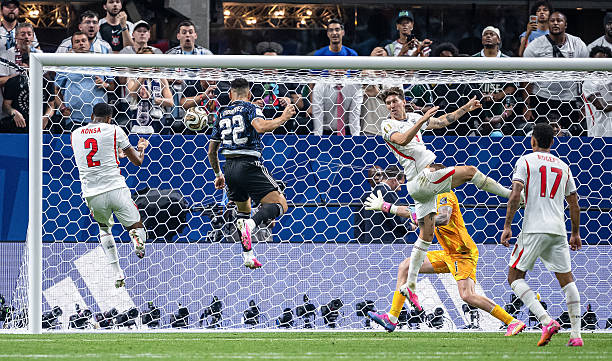
After Anthony Gordon opened the scoring, England virtually disappeared as an attacking force.
According to postgame statistics, the Three Lions enjoyed only around 12 percent possession between Gordon’s goal and Argentina’s eventual winner.
They could no longer keep the ball.
Every clearance simply handed possession straight back to Argentina.
Every attempted outlet pass ended in another turnover.
At this level, gifting that much initiative to the reigning world champions is usually nothing more than delaying the inevitable. What made Tuchel’s coaching decisions even more questionable was that Argentina had not truly been dominating before England changed its tactical approach.
Lionel Scaloni’s side had struggled to find space.
England defended aggressively.
Its high press consistently disrupted Argentina’s buildup.
By completely changing his team’s shape, Tuchel effectively solved many of his opponent’s problems.
Argentina no longer had to break through England’s pressure.
Instead, it simply monopolized possession.
Then came the quickly taken corner.
Enzo Fernández’s thunderous strike.
And finally, Messi’s cross that Lautaro Martínez converted in stoppage time.
The Mexico precedent that misled Tuchel
After the match, Thomas Tuchel explained that his decision had been inspired by England’s Round of 16 victory over Mexico, where switching to a back five had successfully preserved a lead despite playing with ten men.
But what works in one situation does not necessarily work in another.
Mexico was not Argentina.
The Albiceleste arguably possessed the tournament’s most complete collection of players for attacking a low defensive block.
Messi could create.
Mac Allister could accelerate attacks.
Enzo Fernández could arrive late into dangerous spaces.
Lautaro Martínez could punish even the smallest defensive mistake.
By trying to repeat a formula that had previously succeeded, Tuchel failed to account for the unique qualities of his opponent.
Following the match, the German manager did not attempt to avoid responsibility.
“Of course the responsibility is on the coach. If it doesn’t work, it’s easy to say it was the wrong decision.”
Tuchel admitted that England had become “too passive” after the substitutions while insisting that his intention had simply been to close the spaces Argentina was beginning to exploit.
Harry Kane reached much the same conclusion.
“Once we went ahead, England simply tried to hold on, and that’s not enough at this level.”
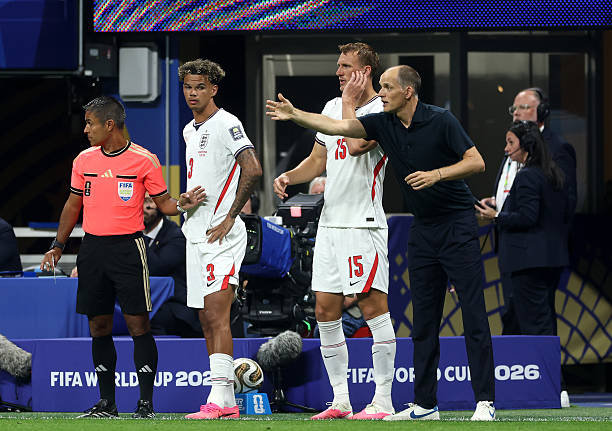
For years, Gareth Southgate was criticized for being overly cautious in major tournaments. Thomas Tuchel had been hired precisely to change that reputation.
Ironically, one of the tournament’s most conservative tactical decisions ultimately led to England’s elimination. England had been the better team. It controlled the match. It controlled its opponent. Then it voluntarily abandoned the very qualities that had made it superior. Against an Argentina side accustomed to the pressure of the biggest occasions, surrendering just a few yards of territory was enough to completely shift the balance of power. In major tournaments, championships are sometimes won because of a brilliant substitution.
But they can just as easily be lost because of one that sends a message of fear. And in Atlanta, the true turning point of this World Cup semifinal may not have been Enzo Fernández’s equalizer. It began the moment Thomas Tuchel decided that his team should stop trying to win—and start trying not to lose.
 Argentina
 England
 Lionel Messi