

Some football rivalries are built on geography. Others emerge from decades of sporting competition.
Argentina versus England is different. It is a rivalry shaped by empire, war, politics, revenge and some of the most unforgettable moments ever witnessed on a football pitch. Every meeting between the two nations carries a weight that extends far beyond ninety minutes and Wednesday it’s a new page of history that would be writing for the second semi final of World Cup 2026. Diego Maradona’s “Hand of God”, David Beckham’s infamous red card, Michael Owen’s wonder goal, David Beckham’s redemption in 2002 and even modern refereeing appointments all remain tied to a relationship unlike any other in international football.
More than four decades after the Falklands War, every Argentina-England encounter still feels like history revisited.
The origins : from UK influence to political conflict
Ironically, England helped create Argentine football. During the late nineteenth century, British railway workers, merchants and engineers introduced the sport to Argentina. Clubs such as Alumni, Belgrano Athletic and countless schools founded by British immigrants laid the foundations for what would become one of football’s greatest nations. By the early twentieth century, however, Argentina had transformed football into something uniquely its own. The game spread from elite British communities into working-class neighborhoods, becoming a central part of Argentine identity. Relations between the two countries remained relatively cordial until 1982. Everything changed with the Falklands War. Known as the Islas Malvinas in Argentina, the Falkland Islands had long been claimed by Buenos Aires despite British control since the nineteenth century. In April 1982, Argentina’s military dictatorship invaded the islands hoping to unite the country behind a patriotic cause. Britain, led by Prime Minister Margaret Thatcher, responded militarily. The conflict lasted just over two months. More than 900 soldiers died before Argentina surrendered in June 1982. For Argentina, the defeat became a national trauma. For Britain, it was a military victory that strengthened Thatcher politically.
Although diplomatic relations eventually normalized, public memory never disappeared. Football soon became the arena where those emotions would resurface.
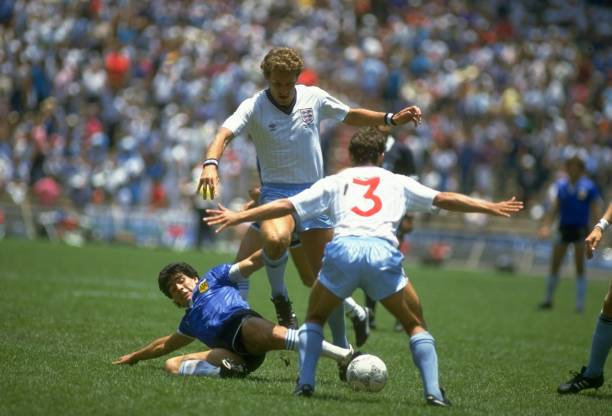
Mexico 1986 : the match that changed everything

Only four years after the war, Argentina and England met in the World Cup quarter-finals. The political context was impossible to ignore. For many Argentinians, defeating England represented an opportunity for symbolic revenge.
No player embodied that sentiment more than Diego Maradona.
Six minutes into the second half came one of football’s greatest controversies.
Maradona jumped alongside goalkeeper Peter Shilton and punched the ball into the net with his left hand. Tunisian referee Ali Bin Nasser allowed the goal despite furious English protests. Maradona later described it as being scored “a little with the head of Maradona and a little with the hand of God.”
Four minutes later, he produced perhaps the greatest goal in World Cup history. Picking the ball up inside his own half, Maradona dribbled past five English players before beating Shilton. FIFA would later name it the “Goal of the Century.” The contrast between the two goals perfectly encapsulated Maradona himself: genius and controversy existing side by side.
Years later, Maradona admitted that beating England carried special significance because of the Falklands War. Many Argentinians viewed the victory not simply as a football result, but as a form of symbolic national redemption.
England, meanwhile, saw injustice.
The resentment endured for generations.
France 1998 : when Simeone made Beckham England’s villain

Twelve years later, another World Cup classic deepened the rivalry.
Argentina and England met in Saint-Étienne in the Round of 16. The game featured everything. A penalty from Gabriel Batistuta. An equalizer from Alan Shearer. Michael Owen announcing himself to the world with one of the greatest goals ever scored by an English player. A brilliant Javier Zanetti free-kick routine. Then came the incident everyone remembers. Shortly after halftime, David Beckham kicked out at Diego Simeone after being fouled.
Danish referee Kim Milton Nielsen immediately showed a red card.
Reduced to ten men for almost an hour, England defended heroically before losing on penalties.
Back home, Beckham became public enemy number one.

He was abused by supporters, ridiculed in newspapers and blamed almost single-handedly for England’s elimination. Effigies were hung in the streets. Hostile chants followed him throughout the next Premier League season. The psychological burden became enormous. Only years later would Beckham fully rebuild his relationship with English supporters.
2002 : England kill Argentina’s big hopes

The next World Cup meeting offered Beckham his chance for redemption. England and Argentina faced each other in Sapporo during the group stage. The context could hardly have been more different.
England sought revenge for 1998.
Beckham sought personal redemption. Argentina, one of the tournament favorites, needed victory to qualify for the next round.
But just before halftime, after a very bad half time, Mauricio Pochettino fouled Michael Owen inside the penalty area. The same Owen who hit the post just a few time before Beckham converted.
England defended brilliantly throughout the second half to secure a famous 1-0 victory. The result proved decisive. England reached the knockout stage.
Argentina will be eliminate during the group phase in one of the biggest disappointments of the 2002 World Cup. For Beckham, the goal completed one of football’s greatest redemption arcs. The man once blamed for England’s downfall had finally delivered revenge against Argentina.
Why the rivalry still maters
Few players today experienced the Falklands War. Most were not even born when Maradona scored his famous goals. Yet the rivalry continues. Former England international Phil Neville recently explained that matches against Argentina still carry a unique emotional significance because of their shared history. Even FIFA remains aware of its sensitivity.
Ahead of the 2026 World Cup, refereeing authorities confirmed that English referees would not officiate Argentina matches, following the long-standing principle of avoiding officials from countries with historical or sporting conflicts whenever possible.
The decision illustrates how the rivalry continues to influence football governance decades later.
Respect has replaced hatred—but history remains. Modern Argentina and England rarely display the hostility seen during previous generations.
Players regularly compete together in the Premier League like Enzo Fernandez at Chelsea, Emiliano Martinez at Aston Villa or Lisandro Martinez at Manchester United. Supporters interact daily on social media. Managers praise opponents far more than they insult them.
Nevertheless, every World Cup draw inevitably raises the same question.