
PS: This article was written before the game against Hull City, which once again showed the extent of the defensive work still required at Chelsea.
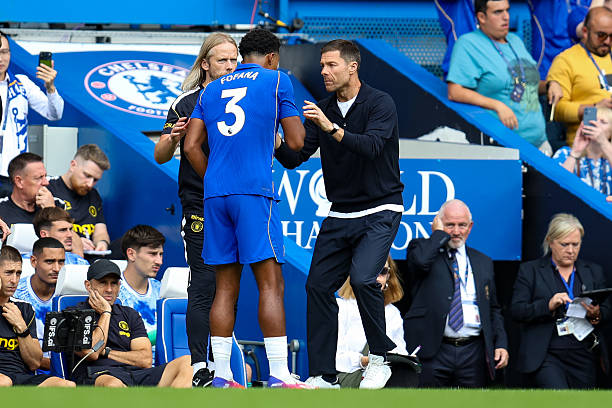
Chelsea has become one of the most entertaining teams in the Premier League at the start of the season. Under Xabi Alonso, the Blues are scoring plenty of goals, playing with aggression, and appear to have rediscovered a genuine attacking identity. But this promise comes with a major problem: the team is conceding an enormous number of goals. After three league games, Chelsea had already conceded seven goals, almost 2.5 per game, while finding the back of the net eight times. This defensive vulnerability therefore does not appear to be a simple statistical accident. It is directly linked to Xabi Alonso’s tactical choices, the composition of his midfield, and a team that is still very much under construction.
A system that priotizes chaos over control
The first explanation lies in Xabi Alonso’s philosophy. The Spaniard has not immediately tried to reproduce the dominant Chelsea side that many might have imagined before his arrival. Instead, his team regularly accepts having less possession and allows the opponent to have the ball in order to exploit spaces in transition.

This represents a significant shift from the image traditionally associated with Chelsea. The Blues are less focused on systematically controlling games through possession and more interested in turning matches in their favor through their attacking speed. The team can therefore be extremely dangerous when it wins the ball back, but in return, it accepts having to defend more transition situations.
This approach partly explains the current paradox: Chelsea can be highly effective offensively while also giving the impression that they are constantly close to conceding. The problem is not necessarily that the team defends every individual action poorly. It is that they accept playing in situations where one mistake can immediately turn into an opponent’s chance.
The match against Brighton, which Chelsea won 4-3, is particularly revealing. Chelsea created enough chances to score four goals, but they also conceded three. The analysis of the game particularly highlighted the Blues’ difficulties defending set pieces, with several goals conceded from those situations.
This philosophy also explains why Chelsea’s games can quickly become difficult to control. When they take the lead, the Blues do not always look to slow the game down and protect their result through a long spell of possession. They continue to play forward, maintaining a high level of risk.
The result is spectacular for the spectator, but much more concerning for a team that has ambitions of competing near the top of the table.
Middfield the Blues’s main problem
The second problem is probably more structural: Chelsea lacks stability in midfield.
The absence of Moisés Caicedo has made Alonso’s job considerably more difficult. The problem became even more significant with Enzo Fernández’s departure to Manchester City and the club’s inability to find a genuine replacement for him before the transfer window closed. Roméo Lavia, meanwhile, is gradually returning to his best level after his physical problems.
Alonso has therefore had to improvise.
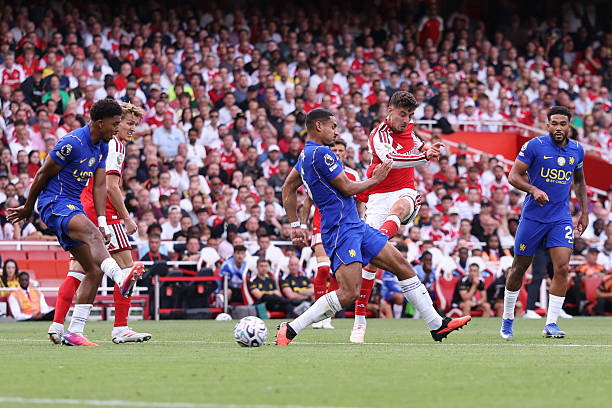
Against Arsenal, Chelsea notably used two fullbacks in midfield positions. This solution allows the team to maintain some of Alonso’s tactical principles, but it has an obvious drawback: Chelsea loses presence and control in the central area.
Arsenal exploited this perfectly. The Gunners were able to create numerical advantages in midfield and attack the spaces between the lines. The tactical analysis of the game notably highlighted how Arsenal was able to create a five-versus-two situation in the center, exposing the structural vulnerability of Chelsea’s system.
The problem is particularly visible when Chelsea loses the ball.
With such an attacking-minded team, numerous players find themselves ahead of the ball. If the initial press fails, the opponent can then attack a defensive line that is not always sufficiently protected by the midfield.
This is where Caicedo represents an essential piece. The role of a defensive midfielder is not simply to win the ball back: he must also prevent the opponent from running directly at the defense, slow down transitions, and allow his teammates to recover their positions.
Without that protection, Chelsea’s defenders find themselves exposed much more frequently.
The problem is therefore less about an isolated defense than about a team whose different lines are not yet perfectly connected. Alonso has an enormous number of attacking players capable of making a difference, but his team is still searching for the right balance between those qualities and the defensive demands of his system.

A team still under construction
The third explanation may be the most important: Chelsea still needs to learn how to play as an Alonso team.
The change in manager, the numerous signings, and the changes to the squad have created a situation in which chemistry and automatisms cannot appear instantly. Alonso has different profiles from those he had at Bayer Leverkusen and therefore has to adapt his ideas to a group that has not yet been completely shaped according to his philosophy.
The Spaniard himself acknowledged that his team is still under construction and needs to find more balance between its attacking potential and defensive solidity.
This learning process is particularly noticeable in situations where Chelsea has to defend for long periods.
Against Fulham, for example, the Blues managed to win 3-2, but at times allowed their opponent back into the game. The tactical analysis of the match showed that the new attacking trio of Cole Palmer, Morgan Rogers, and João Pedro represents a particularly dangerous weapon, but that this attacking power exists within a team that is still searching for its balance.
The League Cup match against Leeds is even more revealing. Alonso made nine changes, a massive rotation that significantly disrupted Chelsea during the first half. The Blues were trailing 2-0 before the introduction of several starters, notably Cole Palmer and Morgan Rogers, completely transformed the game. Chelsea eventually won 6-3, but the match also served as a reminder of the difference between a team capable of scoring a huge number of goals and a team capable of controlling a game.
It is precisely this notion of control that represents Alonso’s biggest challenge right now.
Chelsea already possesses an impressive attacking weapon. Under the Spaniard, the Blues had scored 16 goals in five games across all competitions, proof that the problem is absolutely not their ability to create chances and score.
But to take the next step, they will have to learn how to choose their moments.
Alonso does not necessarily need to abandon his attacking style of soccer. Chelsea was specifically built to play with intensity, verticality, and movement. The objective will instead be to make that aggression more controlled: better protect against turnovers, stabilize the midfield, improve set-piece defending, and above all, prevent every game from turning into an exchange of punches.
For now, Chelsea is therefore a team capable of beating anyone when it imposes its rhythm, but also capable of putting itself in danger. The attacking potential is obvious. The defensive structure, however, still needs to be built.
And that is probably the real question for Xabi Alonso: can he preserve the chaos that makes his Chelsea so dangerous while giving them enough control to become a team capable of winning consistently at the highest level?