

After finishing 14th in their first season back in the Premier League, Leeds United are entering the new campaign with higher ambitions. Daniel Farke has kept the foundations of his team while benefiting from an ambitious recruitment strategy, highlighted by the arrivals of James Trafford, Tarik Muharemovic and Harry Wilson. With a convincing preseason and a squad that appears to have gained greater depth, can the Whites challenge for the European places?
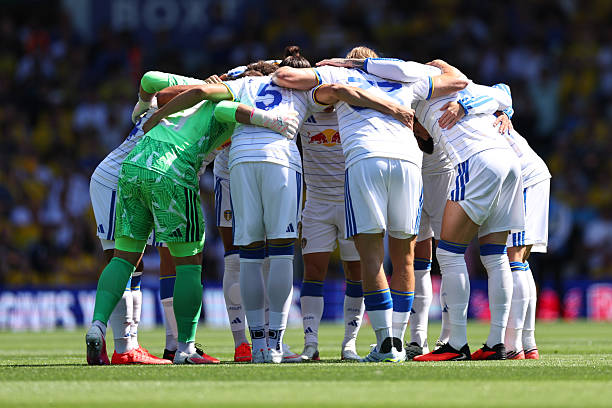
A second season followed by a great dynamic
Leeds endured a particularly difficult first half of the 2025-26 season. By November, Daniel Farke was even under pressure, before his change of system transformed the look of his team. Switching to a 3-5-2 allowed the Whites to find greater stability and improve their results. Over the second half of the season alone, Leeds would have finished around seventh place, an indication that naturally fuels optimism ahead of this new campaign.
The challenge now will be to confirm that progress over an entire season. Leeds are no longer a promoted side whose only objective is to avoid relegation: the club now has a squad competitive enough to look upward. The recruitment has also strengthened an already solid core. James Trafford was signed from Manchester City for a club-record £40 million, while Tarik Muharemovic arrived from Sassuolo for around £34 million. The Bosnian defender particularly impressed during preseason thanks to his physical impact, ability to play out from the back and versatility in both a back three and a back four.
In goal, Trafford also represents a step up in ambition. At just 23, the England international has an excellent reputation, particularly for his distribution and composure under pressure. His spell at Burnley confirmed his potential, but his return to Manchester City had left him in a backup role. At Leeds, he will finally have the opportunity to be the No. 1 and establish himself permanently in the Premier League.
The other major question concerns Dominic Calvert-Lewin. The English striker remains essential to Farke’s system, and his physical condition could largely determine Leeds’ ceiling. When fit, Calvert-Lewin provides an aerial presence, the ability to hold up the ball and a threat inside the box that gives the Whites’ attack another dimension. But his injury history naturally calls for caution.
Harry Wilson and the idea of an evolving idea

To support Calvert-Lewin, Leeds pulled off an excellent move by signing Harry Wilson. A free agent after leaving Fulham, the Wales international was wanted by several clubs before choosing Elland Road. His arrival above all illustrates Leeds’ changing status: the club is no longer simply recruiting players to stay up, but is now looking for players capable of helping it take another step forward.
Wilson was attracted by the project presented by the club’s owners, but also by Daniel Farke. The Welshman already knows the demands of top-level soccer and believes the methods of his new manager remind him of Jürgen Klopp’s approach at Liverpool. The comparison is not simply about the intensity of training sessions: Wilson was particularly struck by the amount of work demanded during preseason.
That intensity fits perfectly with what Farke wants to build. The German coach knows that Leeds cannot compete individually with the teams at the top of the table. His team therefore has to compensate through its organization, work rate and ability to remain disciplined. Farke reiterated that message ahead of the trip to Nottingham Forest: Leeds must continue working on its fitness while remaining tactically flexible.
The preseason appears to have allowed the squad to take another step forward. Leeds faced several quality opponents and finished their preparations with an emphatic 4-0 victory over Augsburg. Farke says the new signings have settled in quickly and that the atmosphere within the squad is excellent. The club therefore enters the season with more confidence than it had 12 months ago.
That progress is also largely down to Farke’s work. Long associated with the image of a manager who could get his teams promoted but was less comfortable once reaching the top flight, the German has managed to keep Leeds in the Premier League while also taking them to the FA Cup semifinals. His pragmatism has now become one of the club’s main strengths.
Could Leeds become an European contender ?
The circumstances surrounding this season could also work in the Whites’ favor. The 2026-27 Premier League season will see nine English clubs competing in European competitions: five in the Champions League, three in the Europa League — Bournemouth, Sunderland and Crystal Palace — and Brighton in the Conference League.
For teams in the middle of the table, this situation could be decisive. Bournemouth, Sunderland and Crystal Palace will have to deal with European travel and weeks featuring multiple matches, while Brighton will also have to manage its continental campaign. Leeds, by contrast, can devote all of its energy to the league and domestic cups. That difference in scheduling could become particularly significant as the months go by.
This is even more important because Farke now has a squad built to meet the physical demands of the Premier League. The German coach knows his players will need to maintain a high level of intensity throughout the season and believes Leeds may even have to work harder on their fitness than some teams accustomed to competing near the top of the table.
The stated objective nevertheless remains measured. Farke refuses to get carried away despite the excitement surrounding the club. The German manager prefers to point out that Leeds are only coming off their first season back in the top flight and that the second season after promotion can be particularly dangerous. But with a strengthened squad, a tactical identity that is now well established, an Elland Road that remains as intimidating as ever and several quality additions, there are plenty of reasons for optimism.
The redevelopment of the stadium also symbolizes this new ambition. Elland Road is currently undergoing a major transformation, with a project aimed at increasing its capacity from around 38,000 to 53,000 seats. Behind the stadium expansion lies a broader ambition to grow Leeds both athletically and financially. The club’s owners, 49ers Enterprises, want to establish Leeds as a permanent fixture among the important clubs in English soccer.
Leeds may not yet have the resources to regularly challenge the Big Six, but the club now has the foundations to move closer to them. Last season’s second half had already shown that the potential was there. With Trafford in goal, Muharemovic in defense, Wilson supplying the attack and Farke seemingly having found the right formula, the Whites can reasonably aim much higher than their 14th-place finish last season.