

For a long time, Arsenal embodied a certain vision of European soccer. An elegant club, faithful to its principles, driven by Arsène Wenger’s almost romantic philosophy. Yet behind the domestic titles and iconic teams of the 1990s and 2000s, the Gunners’ continental history remains defined by missed opportunities. Three European finals symbolize Arsenal’s complicated relationship with Europe: the penalty shootout defeat against Galatasaray in the 2000 UEFA Cup, the heartbreak against Barcelona in the 2006 Champions League final in Paris, and the collapse against Chelsea in the 2019 Europa League final. Three finals, three scars, and the lingering feeling that Arsenal never managed to turn its prestige into continental dominance.

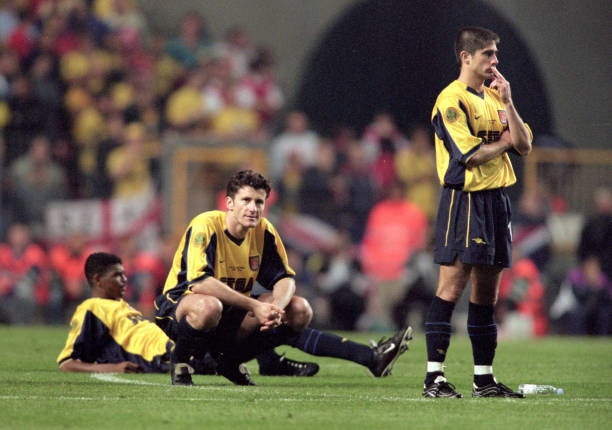
2000 : Galatasaray and the first disappointement
By the end of the 1990s, Arsenal was already an English powerhouse. Under Wenger, the Gunners had won the domestic double in 1998 and possessed an impressive squad combining defensive discipline with attacking creativity. Tony Adams, Patrick Vieira, Emmanuel Petit, Marc Overmars, and Dennis Bergkamp gave the London club genuine European credibility. Yet the Champions League still felt out of reach, and the UEFA Cup became an opportunity for continental validation.
The 1999-2000 campaign was paradoxical. Arsenal dropped down from the Champions League after a frustrating group stage but transformed into a pragmatic machine afterward. The Londoners eliminated Nantes, Deportivo La Coruña, Werder Bremen, and Lens. The semifinal against Lens perfectly summarized this team: solid, disciplined, capable of suffering before striking.
Across from them, Galatasaray represented far more than an underdog. The Turkish side was built around an exceptional generation featuring Hagi, Bülent Korkmaz, and Claudio Taffarel. At a time when Turkish soccer was still largely underestimated in Western Europe, this final represented a historic opportunity. The atmosphere surrounding the match in Copenhagen was electric. Violent clashes between supporters before kickoff only heightened the tension.
The final itself was tense, physical, and almost suffocating. Arsenal controlled possession but lacked efficiency in front of goal. Thierry Henry was unavailable, while Bergkamp was suspended. The Gunners were missing their primary attacking genius, and the game turned into a physical battle. Vieira was sent off during extra time, and Arsenal gradually lost emotional control of the occasion.
In the penalty shootout, Galatasaray showed no fear. Taffarel saved Davor Šuker’s attempt before Popescu converted the decisive penalty. Arsenal collapsed. For Galatasaray, it was a historic triumph: the first major European trophy won by a Turkish club. For Arsenal, it marked the beginning of an uncomfortable reputation: a club unable to finish the job on the continental stage.
The defeat also left a lasting impression. Arsenal probably possessed more individual talent, but Galatasaray had greater collective belief. Wenger had already discovered what would often haunt his teams in Europe: a lack of emotional control in critical moments.
2006 : Paris and the peak of Arsenal ?
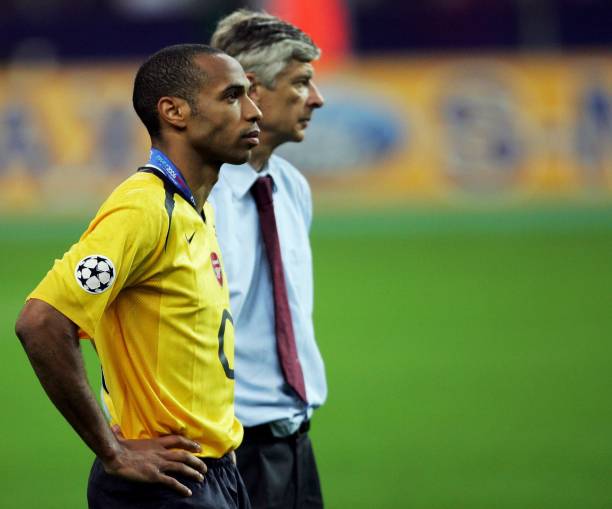
If there is one final that still haunts Arsenal supporters, it is the Champions League final against Barcelona on May 17, 2006, at the Stade de France. Because it was far more than a lost match: it symbolized the end of Arsène Wenger’s first great cycle.
That European campaign remains extraordinary. Arsenal eliminated the Galácticos of Real Madrid thanks to Thierry Henry’s legendary goal at the Bernabéu. Then came Juventus and Villarreal. At the back, the Campbell-Touré partnership, protected by Jens Lehmann, kept clean sheet after clean sheet and established a Champions League defensive record.
But this final went beyond soccer itself. Behind the scenes, Arsenal was preparing to enter a new era with the construction of the Emirates Stadium. The club was leaving Highbury and taking on massive debt to finance the project. Wenger already knew this economic transition would fundamentally alter the club’s trajectory. Investments would be limited for years, major stars would eventually have to be sold, and Arsenal would gradually lose the financial power to compete with Europe’s elite.
This final therefore represented one last moment of freedom before austerity.
Facing Ronaldinho, Eto’o, and Deco’s Barcelona, Arsenal entered as underdogs. Yet the Gunners produced a heroic start. Everything changed in the 18th minute when Jens Lehmann was sent off after bringing down Eto’o. Wenger sacrificed Robert Pirès to bring on Manuel Almunia — a painful and almost cruel decision that symbolized the turning point of the match.
And despite that setback, Arsenal resisted. Even more impressively, Sol Campbell headed the Gunners into the lead just before halftime. For over an hour, Arsenal defended with extraordinary discipline. Thierry Henry even had several chances to kill the game but was denied by Víctor Valdés.
Then came the collapse.
In the 76th minute, Samuel Eto’o equalized. Four minutes later, Juliano Belletti gave Barcelona the lead. In just a few moments, the dream shattered completely. Arsenal had been minutes away from the greatest title in club history, but Barcelona’s technical superiority ultimately prevailed.
With hindsight, this final feels like the peak of Wenger’s original project. A team still capable of competing at the highest European level, but already condemned to operate under difficult economic realities. After 2006, Arsenal would never come this close to continental glory again.
The gradual departure of key players reflected this rupture. Ashley Cole, Arsenal’s academy product, left for Chelsea only months later. Thierry Henry departed for Barcelona in 2007, followed by emerging stars like Cesc Fàbregas, Samir Nasri, and Robin van Persie, all frustrated by Arsenal’s lack of trophies. The Emirates became a magnificent stadium, but also a symbol of a decade filled with sporting frustration.
For many supporters, Paris 2006 remains less a defeat than a historical turning point — the moment Arsenal shifted from European contender to a club merely trying to survive among the elite.
2019 : beaten by his rival and former player
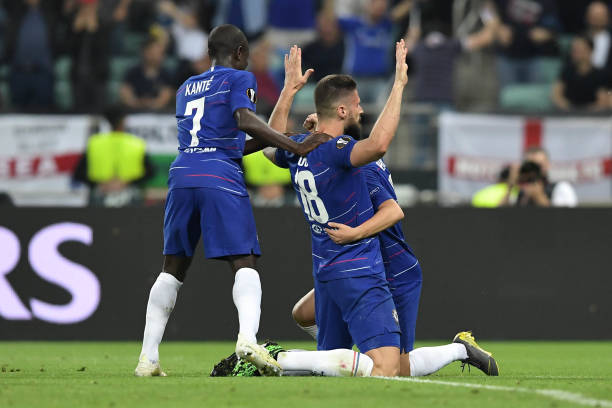
Thirteen years after Paris, Arsenal returned to a European final. But the context was completely different. Wenger had left in 2018 after twenty-two years in charge, and the club was trying to rebuild its identity under Unai Emery, a coach renowned for his Europa League success.
Yet this European campaign masked the squad’s deeper limitations. Arsenal was no longer a true European powerhouse. The club was primarily fighting to return to the Champions League, and the Europa League final against Chelsea in Baku represented a massive opportunity.
Facing a Chelsea side already qualified for the Champions League through the Premier League, Arsenal could secure its own return to Europe’s elite with victory and erase the disappointment of a poor end to the domestic season. The financial and symbolic stakes were enormous.
The first half was balanced, tense, and cautious. Arsenal believed it could compete. But everything exploded after halftime. Olivier Giroud, the former Gunner often criticized in London, opened the scoring against his old club. Then Pedro and Eden Hazard completely dismantled Arsenal’s defense.
In thirty minutes, Chelsea turned the final into a public humiliation.
Hazard, playing his final game for the Blues, delivered a masterclass with two goals and an assist. Arsenal mentally and defensively collapsed. The Gunners looked incapable of handling the pressure of the occasion. The final 4-1 scoreline perfectly reflected the gap between the two teams that night.
The defeat had massive consequences. Arsenal missed out on Champions League qualification, lost crucial revenue, and sank even deeper into European decline. Emery would not survive much longer after the failure, and the club entered a period of instability.
Symbolically, the final also confirmed Chelsea’s complete dominance over Arsenal throughout the 2010s. While the Blues collected Champions League and Europa League trophies, Arsenal seemed incapable of taking the final continental step despite its historical prestige.
 Arsenal
 Chelsea
 FC Barcelona