

By signing Bruno Guimarães for around £75 million, Arsenal have not simply added another midfielder to an already crowded department. The London club have acquired a player capable of operating in several roles and addressing different tactical problems for Mikel Arteta. The former Newcastle captain arrives with extensive Premier League experience and a profile that combines defensive aggression, technical quality, and the ability to make forward runs. At first glance, however, his arrival raises an obvious question: how can Guimarães find a place alongside Declan Rice, Martín Zubimendi, and Martin Ødegaard? That depth could actually become one of Arsenal’s biggest strengths. Rather than viewing Guimarães as a starter in one fixed position, Arteta can use him as a versatile piece capable of changing the balance of his midfield depending on the opponent.
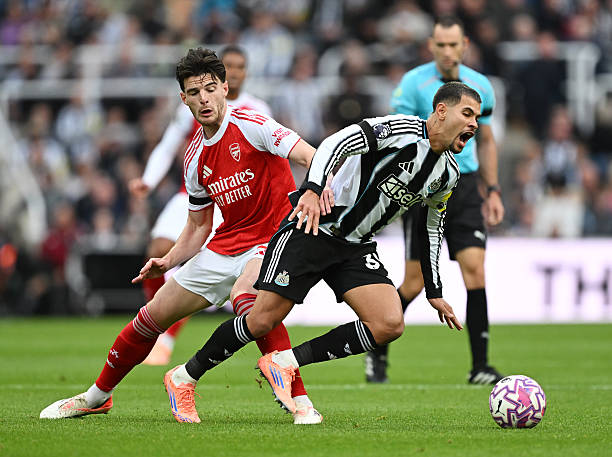
Guimaraes can play anywhere to give Arteta more freedom
Guimarães’ first major strength is his versatility. The Brazilian can play as a holding midfielder in front of the defense, but he can also operate in a No. 8 role higher up the pitch. This ability to change roles fits perfectly with Arteta’s demands, as his system relies on players capable of occupying multiple zones and adjusting their positioning depending on the phase of play.
Guimarães could therefore be used as a genuine midfield Swiss Army knife.
In a 4-3-3 structure, Arteta could line him up alongside Zubimendi and Rice, with each player given different responsibilities. Zubimendi would take on more responsibility during the initial buildup and provide protection in front of the defense, while Guimarães could operate slightly higher up the pitch. His ability to resist pressure, carry the ball, and contribute offensively would allow him to play as an aggressive No. 8.
But the opposite is also possible. Guimarães can drop in front of the defense and allow Rice to operate higher up. This option becomes particularly interesting against opponents defending in a low block: rather than asking Rice to constantly remain behind the ball, Arteta could give that responsibility to the Brazilian and use the England international’s ability to make forward runs.
This flexibility could also allow Arsenal to deal more effectively with injuries. The limited availability of some midfield regulars has increased the need for a player capable of covering multiple positions.
A solution for Odegaard
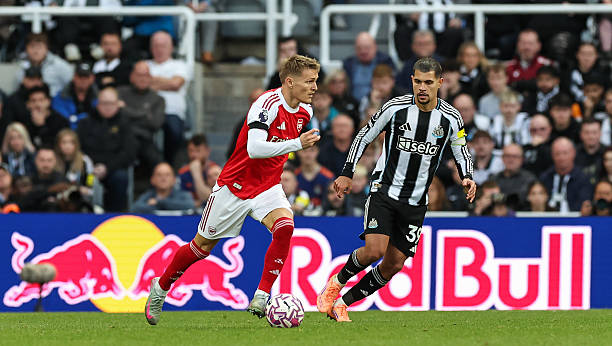
The Brazilian’s arrival inevitably raises questions about the midfield hierarchy. Arsenal already have Rice, Zubimendi, Ødegaard, and Merino. But this competition can become a strength if Arteta manages to create complementary partnerships rather than simply selecting his best individual players.
One of the most interesting combinations could be Guimarães and Rice.
The two players share certain characteristics: intensity in duels, the ability to cover large areas, and a willingness to make forward runs. But their profiles are not identical. Rice is particularly valuable when he can carry the ball over long distances and attack spaces, while Guimarães possesses a greater ability to play under pressure and initiate attacks from deeper positions.
This complementarity could allow Arteta to constantly rotate their roles. When Rice pushes forward, Guimarães can provide cover. When the Brazilian advances, Rice can take his place in the double pivot. The objective is to maintain a structure balanced enough that attacking movements do not leave the team vulnerable.
Zubimendi offers another possibility. With the Spaniard behind him, Guimarães could have more freedom and operate as a No. 8. Arsenal would then have an extremely technical midfield capable of controlling possession through Zubimendi, progressing through Guimarães, and creating through Ødegaard.
But the Brazilian could also have an indirect impact on the captain. Ødegaard’s limited availability makes it necessary to have solutions capable of changing the midfield structure without disrupting the team. Guimarães can contribute to that by occasionally taking on a more creative role and allowing Arsenal to maintain a strong presence through the middle.
The signing should therefore not be interpreted as a challenge to Zubimendi or Rice. Instead, it gives Arteta the ability to create more combinations and adapt his midfield to every match scenario.
An new weapon for set pieces
Guimarães’ integration will not be limited to the way Arsenal’s midfield functions. His profile can also strengthen two essential aspects of Arteta’s soccer: winning the ball back and set pieces.
The Brazilian is particularly effective at disrupting opposition transitions. His aggression in duels allows him to stop counterattacks before they become dangerous. He also possesses an important quality in Arteta’s football: he draws a huge number of fouls. Since his Premier League debut, Guimarães has been the player who has won the most fouls, with 410 fouls drawn according to data cited by The Guardian.
This characteristic may seem secondary, but it fits Arsenal’s profile perfectly. A team that dominates possession and regularly attacks in the opponent’s half naturally benefits from free kicks and corners won around the penalty area.
And this is precisely where Guimarães can offer more than simply his presence in midfield.
Since 2022, the Brazilian has scored 12 goals from set pieces, one of the best totals among midfielders and forwards during that period. Arsenal, already extremely dangerous from corners and free kicks thanks to the work of their specialized coaching staff, could therefore add another threat to their arsenal.
His connection with Gabriel is also interesting. The two Brazilians could become key targets during attacking set pieces, while Guimarães would provide an additional option for second balls and shots from the edge of the box.
But his value is primarily holistic: he can win the ball, draw fouls, combine with teammates, make forward runs, and threaten from set pieces. This versatility explains why his arrival should not be viewed simply as the addition of another midfielder.
At Arsenal, Guimarães could ultimately become a tactical accelerator. His presence gives Arteta more options to change his team without fundamentally altering its identity. He can play behind, ahead of, or alongside Rice or Zubimendi, while bringing the aggression and personality he developed during his years at Newcastle.
For a coach obsessed with controlling space and positional flexibility, the ability to change roles without changing players represents a considerable weapon. Guimarães therefore does not need a permanent place in Arsenal’s starting XI to be essential: his true value could lie precisely in his ability to make Arteta’s team more adaptable, more intense, and more unpredictable.
 Arsenal
 Bruno Guimaraes