

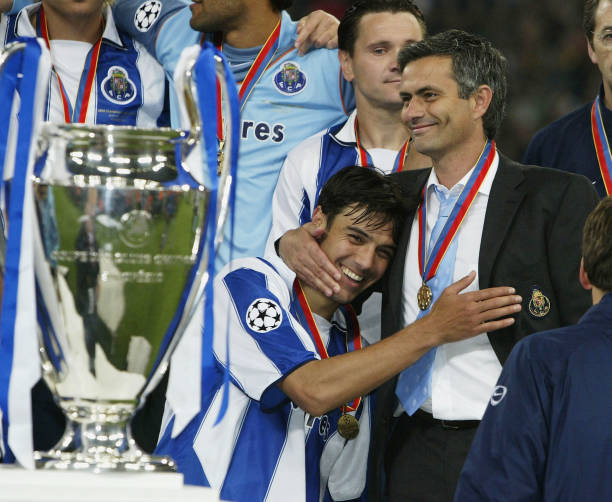
On May 26, 2004, in the heat of Gelsenkirchen, FC Porto permanently entered European soccer legend. Facing Didier Deschamps’ AS Monaco, the Portuguese side won 3-0 and lifted the second Champions League trophy in club history, seventeen years after their first triumph in 1987. But beyond simply winning the title, this campaign remains one of the greatest surprises in modern European soccer history. At a time when financial giants were already beginning to dominate the competition, seeing a Portuguese club eliminate Manchester United, Olympique Lyonnais, and Deportivo La Coruña before overwhelming Monaco felt almost unreal. This journey also marked the worldwide emergence of a coach still relatively unknown to the general public: José Mourinho.
Mourinho, architect of a perfect machine
When Mourinho arrived at Porto in 2002, nothing suggested he would become, two years later, the face of European soccer. A former translator for Bobby Robson and assistant to Louis van Gaal, he arrived obsessed with one thing: total control. Every detail was studied, every movement rehearsed, every transition analyzed.
Porto was already coming off an excellent season. In 2003, the club won the Portuguese league title, the Portuguese Cup, and most importantly the UEFA Cup against Celtic FC. But Mourinho wanted more. He built a team without global superstars, yet one that was perfectly complementary.
The spine of Porto’s 2004 side quickly became legendary. In goal, veteran Vítor Baía brought experience and composure. In defense, Ricardo Carvalho and Jorge Costa formed a partnership that was both intelligent and aggressive. On the flanks, Paulo Ferreira and Nuno Valente perfectly embodied Mourinho’s tactical demands.
In midfield, Costinha’s work in the shadows allowed Maniche to break lines and, above all, gave Deco the freedom to express his genius. The Brazilian-born Portuguese playmaker became the symbol of this Porto team: creative, intelligent, unpredictable. Up front, Benni McCarthy and Derlei tormented European defenses with relentless movement and runs behind the back line.
Tactically, Mourinho created a team capable of defending deep, suffocating space, and striking in transition with surgical efficiency. Porto may not have had Europe’s biggest names, but nobody looked better organized. This team played like a single unit, almost mechanical in its precision.
The European campaign that changed everything
The European journey began with uncertainty. Drawn into a difficult group with Real Madrid, Olympique de Marseille, and FK Partizan, Porto quickly had to prove their UEFA Cup triumph had not been a fluke. The Portuguese side eventually finished second behind Real Madrid and advanced to the Round of 16.
The real turning point came against Manchester United. At the draw, almost nobody imagined Porto could eliminate Sir Alex Ferguson’s team. In the first leg at the Estádio do Dragão, the English side struck early. But Porto turned the game around thanks largely to a Benni McCarthy brace and won 2-1.
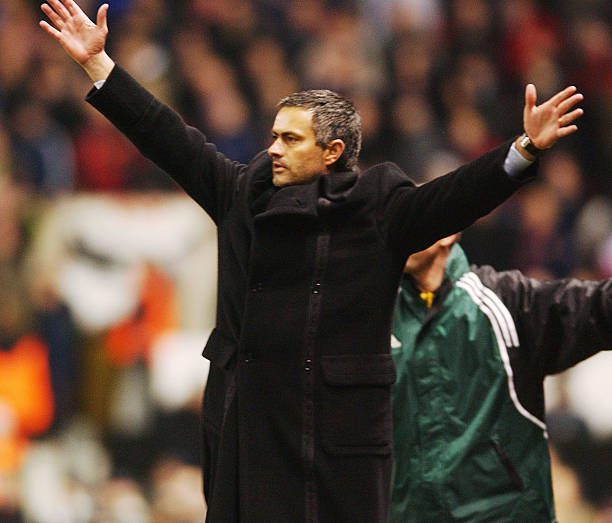
The return leg at Old Trafford became part of Champions League history. United led 1-0 and believed qualification was secured. Porto suffered, resisted, bent without breaking. Then, in the 90th minute, after a poorly cleared free kick, Costinha appeared and pushed the ball into the net. Mourinho exploded down the touchline in a sprint that instantly became iconic. That image traveled around the world. In one night, “The Special One” was born in the eyes of European soccer.
In the quarterfinals, Porto faced Olympique Lyonnais, then considered the dominant force in French soccer as back-to-back Ligue 1 champions. Once again, the Portuguese side impressed with their collective control. After an authoritative 2-0 win in Portugal, they held Lyon to a draw at Gerland, thanks in large part to a huge performance from Maniche. Mourinho delivered a true tactical lesson to Paul Le Guen, who realized he was facing an unstoppable machine.
The semifinal against Deportivo La Coruña was probably the tightest tie of Porto’s campaign. The Spaniards had just produced one of the greatest European comebacks ever by overturning a 4-1 first-leg defeat against defending champions AC Milan. But Porto completely neutralized the Galicians. A 1-0 win in the first leg followed by a perfectly controlled 0-0 draw in Spain sent Mourinho’s men to the final.
An easy final and an eternal legacy
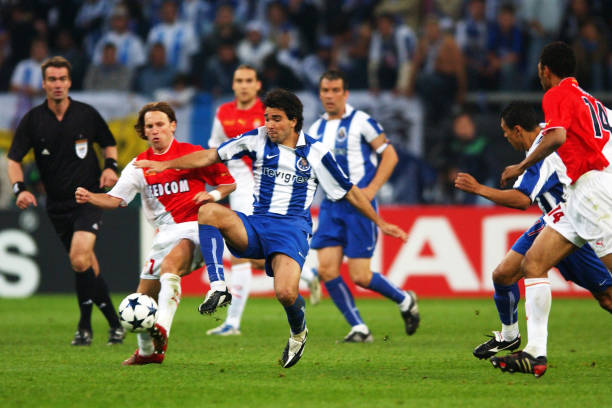
The final between Porto and Monaco surprised all of Europe. For the first time in years, none of the continent’s traditional giants had reached the ultimate stage. On one side, Monaco had eliminated Real Madrid’s Galácticos and Chelsea’s own star-studded project. On the other, Porto arrived overflowing with confidence.
For thirty minutes, the match remained balanced. Then Porto struck. In the 39th minute, young Carlos Alberto opened the scoring after a magnificent team move. Monaco began to collapse. In the second half, Deco completely took control of the game. The Portuguese playmaker scored the second goal before Dmitri Alenichev completed the demonstration.
The final score, 3-0, perfectly reflected the gap between the two teams that night. Porto did not win the Champions League through a miracle or a purely emotional run. The Portuguese side dominated the competition tactically, physically, and mentally. Mourinho would later say he already knew his team were champions before the final whistle.
This victory also marked the end of an era. A few weeks later, Mourinho joined Chelsea’s ambitious project. Ricardo Carvalho and Paulo Ferreira followed their coach, while Deco moved to Barcelona. FC Porto was dismantled, as often happens with surprise teams.
Twenty years later, this triumph still holds a unique place in Champions League history. Since Porto in 2004, no club outside Europe’s biggest leagues has managed to win the competition. In a soccer world increasingly dominated by financial powerhouses, this Porto side remains the last true underdog to conquer Europe.