

Switzerland is no longer one of international football’s surprise packages.
For nearly two decades, the Nati has established itself as one of the most consistent national teams in Europe. Round of 16 appearances at the 2006, 2014, 2018, and 2022 World Cups, along with quarterfinal runs at Euro 2021 and Euro 2024, have gradually earned the Swiss a reputation as a disciplined, organized, and extremely difficult team to face.
But as the 2026 World Cup approaches, the conversation has changed.
For the first time in a long while, the objective is no longer simply to advance from the group stage or reach the knockout rounds. After their impressive run at Euro 2024, where they pushed England to a penalty shootout in the quarterfinals, Murat Yakin’s men believe they can aim higher. The head coach himself has stated that he wants to achieve “the best World Cup in Swiss history.”
That ambition is fueled by an exceptionally balanced squad. Between experienced leaders such as Granit Xhaka, Manuel Akanji, Ricardo Rodríguez, and Remo Freuler, and a new generation spearheaded by Dan Ndoye, Johan Manzambi, and Noah Okafor, Switzerland arguably possesses one of the deepest groups in its modern history.
The group
Switzerland will compete in Group B alongside:
- Canada
- Bosnia and Herzegovina
- Qatar
- June 13: Switzerland vs. Qatar (San Francisco)
- June 18: Switzerland vs. Bosnia and Herzegovina (Los Angeles)
- June 24: Switzerland vs. Canada (Vancouver)
On paper, the Swiss enter as favorites to win the group. The greatest threat may come from Canada, fueled by the enthusiasm of a host nation and a talented generation led by Alphonso Davies and Jonathan David. Bosnia and Herzegovina possesses several individuals capable of deciding a match, while Qatar will be eager to erase the memories of its disappointing 2022 World Cup campaign.
Switzerland’s objective is clear: finish at the top of the group and enter the Round of 32 in the best possible position.
Key players
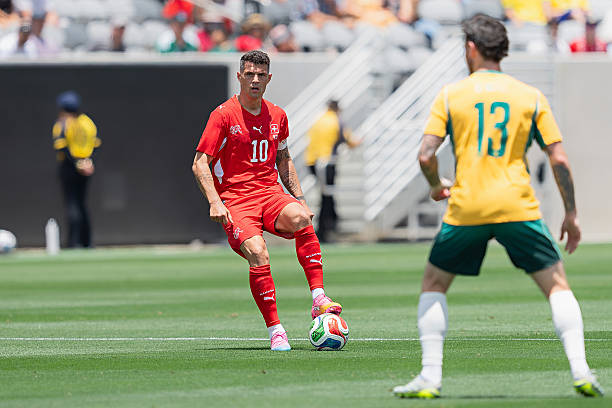
Granit Xhaka
The soul of the Nati.
With more than 140 international appearances, Xhaka has become a true institution in Swiss football. At 33 years old, he remains the heartbeat of the team, dictating the tempo of matches and providing the balance between defense and attack.
After playing a key role in Bayer Leverkusen’s historic Bundesliga title and then continuing his outstanding form in the Premier League with the surprising Sunderland side, he arrives at the World Cup in exceptional condition. For many observers, this tournament could represent his final major international competition.
Manuel Akanji
The leader of the defense.
The unquestioned reference point at the back, Akanji brings the experience he has accumulated at the highest level through both the Premier League and the Champions League. His reading of the game, composure in possession, and ability to perform in major matches make him indispensable to Murat Yakin’s system.
He arrives at the tournament fresh off an impressive Serie A and Coppa Italia double with Inter Milan.
Dan Ndoye
One of the team’s primary attacking weapons.
The Swiss winger has established himself as a player capable of unsettling any defense through his pace and directness. His profile adds a more vertical dimension to a team historically known for its tactical discipline.
His importance in transition situations will be crucial throughout the tournament. After an inconsistent season at Evangelos Marinakis’ often turbulent Nottingham Forest, Ndoye will now operate in a far more stable environment.
Johan Manzambi
The breakout star in waiting.
Many analysts already regard him as the brightest talent in Swiss football. Comfortable as a defensive midfielder, box-to-box midfielder, playmaker, or even in more advanced positions, the Freiburg youngster is widely viewed as the future of the national team.
Murat Yakin has even described him as a “secret weapon” for this World Cup. At just 20 years old, the 2026 tournament could mark his emergence on the international stage.
The face of Switzerland in 2026
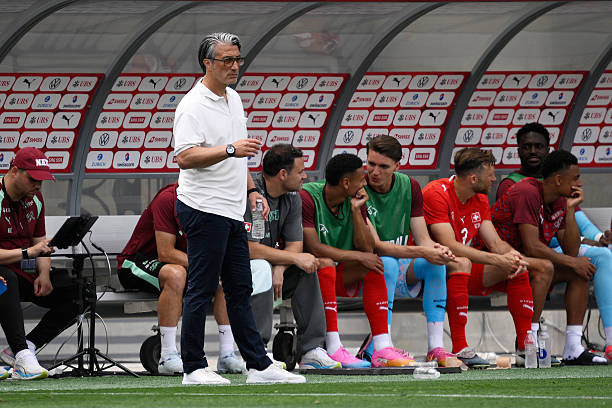
Switzerland arrives in North America with more confidence than it has carried into previous World Cups.
The qualification campaign was handled with authority. Murat Yakin’s side finished first in its group ahead of Kosovo, Slovenia, and Sweden without ever truly looking vulnerable. The campaign confirmed the progress that had already become evident during Euro 2024.
The main reason for optimism lies in the squad’s balance. Unlike previous generations that relied heavily on a handful of key individuals, this Swiss team now possesses quality in every area of the field. Gregor Kobel has established himself among Europe’s most reliable goalkeepers, Akanji leads an experienced defense, Xhaka and Freuler continue to provide security in midfield, while Ndoye, Okafor, and Breel Embolo bring greater pace and creativity in attack.
Another strength of this team is continuity.
In charge since 2021, Murat Yakin has gradually imposed his vision and strengthened his authority within the squad. Long criticized after certain disappointing results, particularly the heavy defeat to Portugal at the 2022 World Cup, the head coach now enjoys near-universal support.
His players frequently praise his ability to communicate with the group and adapt his tactical approach according to the opposition.
It is fair to suggest that this generation has the tools to produce the greatest World Cup run in Swiss history. The idea may seem ambitious for a nation that has never reached the semifinals, but it reflects the growing confidence surrounding the team. A quarterfinal appearance is no longer viewed as an impossible dream but rather as a realistic objective.
The challenge now is taking that final step.
Since 1994, Switzerland has consistently reached the knockout rounds without permanently joining the elite tier of world football. The 2026 World Cup may represent its best opportunity yet to change that perception.
The Swiss are not among the tournament favorites.
But they possess enough experience, talent, and stability to become one of the most dangerous teams in the competition. And if this generation can finally transform its potential into results, it may deliver the historic World Cup campaign Switzerland has been waiting for for more than half a century.