

For most of the 1990s and early 2000s, the 4-4-2 was soccer’s default setting. Two banks of four, two strikers up top, and a clear job for everyone on the field. It was simple, sturdy, and easy to coach at every level from youth academies to the World Cup final. When people picture old school soccer, this is the shape they see. Yet the game that fills stadiums and screens today looks almost nothing like it. The journey from that tidy grid to the shifting, positional systems of the modern era is one of the most fascinating stories in the sport.
The 4-4-2 dominated because it solved a basic problem: cover the width of the field while keeping numbers in defense. English soccer especially fell in love with it. Sir Alex Ferguson won trophies with variations of it at Manchester United, and Arsenal’s Invincibles rode a version of it through an unbeaten Premier League season in 2003 and 2004. The system rewarded work rate, direct wing play, and a reliable striker partnership. But it carried a hidden flaw. Two central midfielders could be outnumbered, and against a team with a playmaker floating between the lines, the 4-4-2 often found itself chasing shadows.
- Arsenal went 49 league games unbeaten between 2003 and 2004, the longest such run in English top flight history
The rise of the extra man in midfield
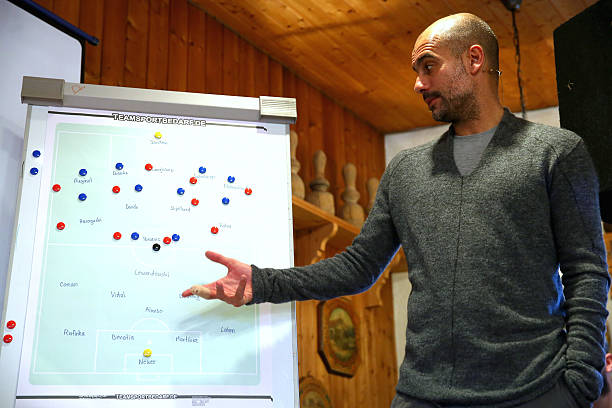
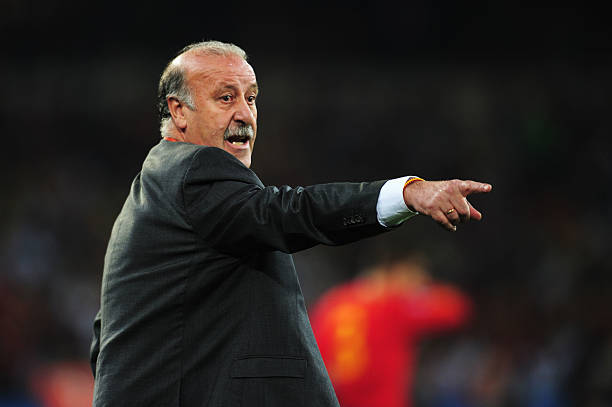
The first big shift was numerical. Coaches realized that whoever controlled the center of the field controlled the match. The answer was to sacrifice a striker and flood midfield. The 4-2-3-1 became the formation of the 2000s and 2010s, giving teams a solid double pivot in front of the defense and a creative attacking midfielder behind the lone forward. Spain won the 2010 World Cup and back to back European Championships in 2008 and 2012 playing a patient, midfield heavy game that suffocated opponents by simply keeping the ball.
That Spanish side, built around Barcelona’s core, introduced the world to tiki-taka: quick, short passing designed to move opponents around until a gap appeared. Under Pep Guardiola, Barcelona took possession to an art form and even revived the false nine, asking Lionel Messi to drop from the striker position into midfield and drag defenders out of shape. Suddenly the striker was not a fixed target but a moving problem.
- Spain completed the only run of three straight major titles in history between 2008 and 2012
Pressing changes everything
If possession was one revolution, pressing was the other. Jürgen Klopp arrived from Germany preaching gegenpressing, the idea that the best moment to win the ball is immediately after losing it, when opponents are unbalanced. His Liverpool teams turned defending into a form of attacking, hunting in packs and forcing mistakes high up the field. Around the same time, Diego Simeone built Atlético Madrid into a masterclass in the opposite approach: a compact low block that defended deep, stayed patient, then struck on fast breaks.
These two philosophies, pressing high and defending deep, framed the modern tactical debate. Both proved you could beat richer, more talented sides with organization and intensity rather than pure possession. The result was a game decided less by settled attacking phases and more by transitions, those chaotic seconds right after possession changes hands.
Fullbacks who think like midfielders
The most striking recent change involves the least glamorous position on the field. For decades a fullback had one job: defend the flank and occasionally overlap to cross. Guardiola tore that idea up. At Bayern Munich he turned Philipp Lahm into a hybrid, and at Manchester City he asked players like João Cancelo and later John Stones to tuck inside during buildup, stepping into central midfield when their team had the ball.
This tactic, known as the inverted fullback, quietly reshaped the geometry of the sport. A team lining up in a 4-3-3 could morph into a 3-2-5 the moment it won possession, packing the middle of the field and pinning defenders back. Arsenal used it through Oleksandr Zinchenko, and Liverpool weaponized it with Trent Alexander-Arnold, who at times operated as a playmaker from right back. What began as a curiosity is now standard at the highest level.
- Guardiola first deployed inverted fullbacks in his opening Premier League game in 2016, a system now copied across Europe
The fluid, shape shifting present
Modern tactics have blurred the old certainties. Elite teams no longer play one formation; they play several within a single match. A side might defend in a 4-4-2 block, build in a 3-2-5, and attack in something else entirely, rotating positions based on what the opponent shows. The back three has returned in force, with variations of the 3-4-3 and 3-4-2-1 rising across the major leagues, while the 4-2-3-1 and 4-3-3 remain the most common starting points.
Data drives much of this. Coaches now adjust in real time using tracking numbers on pressing, running distances, and passing lanes that did not exist a generation ago. Positions have become roles, and roles change by the phase of play. The rigid grid of the 4-4-2 has given way to a living, breathing system where every player must read space rather than simply hold a spot.
The evolution is not really about which formation wins. It is about control: of space, of tempo, and of the moments when a match tips one way or the other. From two flat banks of four to fullbacks moonlighting as playmakers, soccer has spent three decades making itself more complex, more fluid, and far harder to coach. And if history is any guide, whatever looks cutting edge today will feel old fashioned soon enough.
 FC Barcelona
 Spain
Spain