

For one of South America’s most expressive soccer nations, missing the 2022 World Cup was a genuine wound. Colombia stayed home while the rest of the continent played in Qatar, a humbling absence for a country that prides itself on flair, rhythm, and attacking talent. That makes this summer feel like a homecoming. Los Cafeteros are back among the world’s elite, and they arrive determined to remind everyone what they can do.
The road back was earned the hard way. Colombia finished third in the brutal CONMEBOL qualifying marathon, edging both Uruguay and Brazil on goal difference to secure their place. It was a campaign defined by resilience rather than fireworks, the mark of a side that coach Nestor Lorenzo has quietly turned into one of the toughest teams to beat in the region.
- CONMEBOL qualifying: finished 3rd with 28 points, ahead of Uruguay and Brazil on goal difference
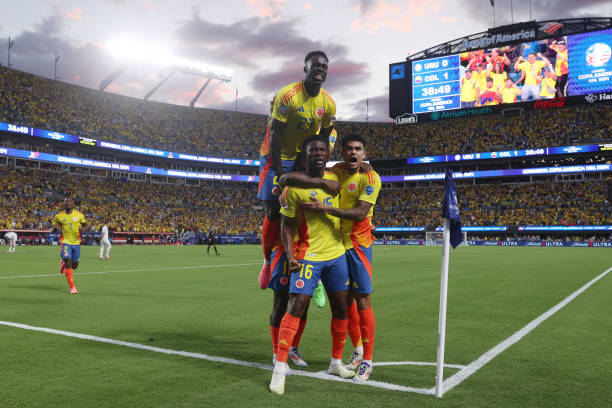
This is also a team carrying the sting of near glory. At the 2024 Copa America, Colombia reached the final before losing 1-0 to Argentina after extra time in Miami. That defeat lingers, but it also proved this generation can go toe to toe with the very best. The World Cup offers a chance at redemption on an even bigger stage.

James Rodriguez, one last World Cup story
Every Colombian campaign runs through James Rodriguez. The captain returns to the World Cup at 34, eight years after the tournament that made him a global name. Brazil 2014 was his masterpiece, a run to the quarterfinals lit up by some of the most beautiful goals of the competition, and it earned him both the Golden Boot and a move to Real Madrid. He is in the twilight of his career now, having joined Minnesota United in the MLS, but his vision and set piece quality remain central to everything Colombia do.
- James Rodriguez at the 2014 World Cup: 6 goals and the Golden Boot
The captain left his club in mid May to begin tournament preparations, a sign of how seriously he is taking what may be a final shot at World Cup glory. When James is on song, Colombia have a rhythm and creativity few teams can match.
Luis Diaz and the new generation
If James represents the past and present, Luis Diaz represents the explosive future. The winger arrives in arguably the best form of his career, having moved from Liverpool to Bayern Munich and lifted the Bundesliga title in his first season in Germany. His pace, dribbling, and fearlessness in one on one situations make him Colombia’s most dangerous weapon and the player most likely to win a game on his own.
- Luis Diaz for Colombia: 21 goals in 72 appearances
Around the two headliners, Lorenzo has built genuine balance. Veteran goalkeeper David Ospina travels to his third World Cup to marshal the back line, while Crystal Palace pair Daniel Munoz and Jefferson Lerma bring drive down the right and steel in midfield. Galatasaray’s Davinson Sanchez and Bologna’s Jhon Lucumi form a settled center back partnership, with the experienced Yerry Mina providing cover.
There is fresh energy too. Benfica midfielder Richard Rios has emerged as a key figure in the engine room, and Krasnodar forward Jhon Cordoba adds a different physical threat up front. The squad blends seasoned leaders with rising stars, exactly the mix Lorenzo wanted. Notable omissions include longtime servants Juan Cuadrado and Rafael Santos Borre, a reminder of how much depth this group now has.
The Lorenzo identity
Argentine coach Nestor Lorenzo has been the architect of Colombia’s revival. Since taking charge he has restored stability and self belief, building a competitive and well organized team that is far harder to break down than the Colombian sides of the recent past. His teams keep their traditional attacking identity, full of pace and dangerous wing play, but they now pair it with structure and discipline.
The result is a side that can hurt opponents in transition while also controlling games when needed. That blend of expression and balance is why many observers fancy Colombia to make a deep run if the draw opens up for them.
Group K and the road through the group stage
Colombia landed in Group K alongside Portugal, a returning DR Congo side back at the World Cup for the first time in 52 years, and tournament debutants Uzbekistan. None of these four teams have ever met at a World Cup, which adds an extra layer of intrigue to a group that looks winnable but far from straightforward.
Two of the three group games will be played in Mexico before a blockbuster finish in Miami.
- Colombia vs Uzbekistan: Friday, June 17, 10 p.m. ET, Estadio Azteca, Mexico City
- Colombia vs DR Congo: Tuesday, June 23, 10 p.m. ET, Estadio Akron, Guadalajara
- Colombia vs Portugal: Saturday, June 27, 7:30 p.m. ET, Hard Rock Stadium, Miami
The closing fixture is the headline act. A meeting with Cristiano Ronaldo’s Portugal in Miami could decide who wins the group, and if Colombia arrive with points already banked, a strong result there would set up an ideal path through the knockout rounds. With 32 of the 48 teams advancing, qualification should be within reach, but top spot would be a statement.
The objective is to go deep
For Colombia, simply returning is not enough. The stated goal is to advance beyond the group stage and compete seriously in the latter rounds, with matching or bettering the 2014 quarterfinal run the benchmark this group has set for itself. The talent is there, the experience is there, and the hunger born from missing the last World Cup is unmistakable.
This may also be the last great tournament for James, which adds an emotional charge to the campaign. With Diaz at his peak and a smart, settled coach pulling the strings, Colombia have every reason to believe they can light up the World Cup once again. Los Cafeteros are back, and they intend to make up for lost time.
 James Rodriguez