

There are teams that arrive at a World Cup chasing a dream.
And then there is France.
For nearly a decade, Les Bleus have not merely participated in major tournaments. They have dominated them. Euro 2016 finalists, World Cup winners in 2018, UEFA Nations League champions in 2021, and World Cup finalists again in 2022. Few national teams in modern football history have displayed such sustained excellence at the highest level. That consistency has fundamentally changed expectations surrounding the French national team. Nowadays, a quarterfinal appearance is viewed as a disappointment, while even a semifinal can be considered the bare minimum—or even a failure if the quality of play is not there, as was the case at Euro 2024.
As the 2026 World Cup approaches in the United States, Canada, and Mexico, France finds itself in a unique position. It arguably possesses the deepest squad in the tournament, is considered by many observers to be the favorite to win it all, and is preparing for Didier Deschamps’ final campaign as national team manager.
This World Cup is not simply a quest for a third star.
It is the final chapter of a golden era.
The final chapter of Deschamps’s era
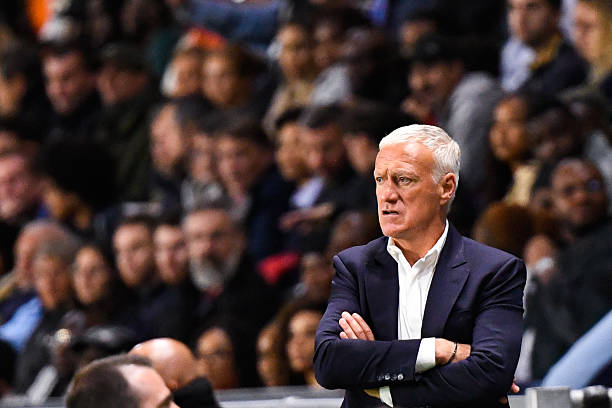
When he steps down after the tournament, Didier Deschamps will leave behind one of the greatest legacies in French football history.
Since taking charge in 2012, he has transformed a national team scarred by the failures of the late 2000s into a winning machine. No French manager has overseen as many major tournaments with such sustained success. His legacy extends far beyond the 2018 World Cup triumph.
Deschamps established a culture of relentless performance. A culture where talent is never enough on its own and where collective balance always takes precedence over individual brilliance.
For years, that philosophy drew criticism. Some accused him of promoting overly pragmatic football. Others argued that he restricted the creativity of his players. But results ultimately validated his approach, and the celebrations of 2018 left virtually no room for complaints about the style of play.
Now 57 years old, he enters his final tournament with a simple objective:
Leave the way he arrived—by winning.
Mbappé stand alone at the summit
In 2018, Kylian Mbappé was the prodigy.
In 2022, he was the superstar.
In 2026, he is the leader.
At just 27 years old, the French captain is preparing for his third World Cup. His influence on the national team extends far beyond goals and statistics. He has become the face of French football and one of the most recognizable athletes on the planet.
The major difference from previous tournaments lies in his role within the squad.
For years, France still belonged to the heroes of 2018: Antoine Griezmann, Hugo Lloris, Raphaël Varane, Olivier Giroud, and Paul Pogba. That era is over.
This is now Mbappé’s team.
Since becoming captain, his leadership has become central to every aspect of the group. On and off the field, he is the figure around whom the entire national team revolves.
Many observers already consider him a leading candidate for both the 2026 Ballon d’Or and the World Cup Golden Boot.
But perhaps the most impressive thing is this:
Mbappé is not alone.
France’s attacking depth is remarkable even by the standards of nations accustomed to producing elite talent.
Alongside Mbappé are Ousmane Dembélé, arriving as the reigning Ballon d’Or winner; Michael Olise, now a Bayern Munich superstar and one of the standout performers in the Champions League; Rayan Cherki, an almost old-fashioned creative talent in an era obsessed with intensity; Bradley Barcola and Désiré Doué, fresh off European glory with Paris Saint-Germain; and Marcus Thuram.
Few national teams can field so many players capable of dribbling past defenders, creating chances, and scoring goals.
The emergence of players such as Rayan Cherki and Michael Olise perfectly illustrates this new phase of French football.
For years, both were viewed as immensely talented but inconsistent players. Their respective transfers allowed them to reach a new level. Olise has spent two years refining his game at Bayern Munich, while Cherki has earned Pep Guardiola’s trust at Manchester City, even pushing local star Phil Foden onto the bench.
Olise’s football intelligence, technical quality, and ability to operate in tight spaces provide Deschamps with a profile unlike any other in the squad. Several pre-tournament analyses have identified him as a potential breakout star of the competition.
Where the 2018 team relied heavily on Mbappé’s pace and the creative partnership of Pogba and Griezmann, the 2026 version appears capable of adapting to virtually any scenario.
Facing a deep defensive block?
Olise and Cherki can unlock it.
A transition-heavy match?
Mbappé and Barcola become devastating weapons.
A physical battle?
Thuram and Jean-Philippe Mateta offer entirely different solutions.
That versatility may well be France’s greatest strength.
A less glamorous midfield ?
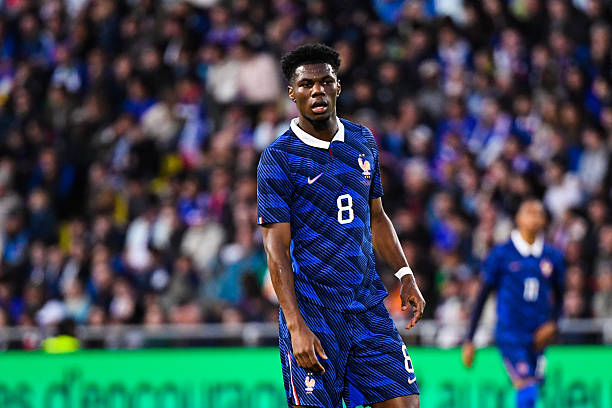
Media attention naturally gravitates toward attacking players.
Yet France’s success has always been built on its midfield, and Deschamps understands that better than anyone.
This is where the first genuine concerns begin to emerge.
Aurélien Tchouaméni has become the cornerstone of the midfield. Around him are several complementary profiles capable of maintaining the collective balance essential to French ambitions.
But can he dictate the tempo the way Paul Pogba did in 2018?
Having elite attacking talent is one thing. Delivering the ball to them in the right areas is another.
Dembélé can help through his movement and tendency to drop deep, but Tchouaméni does not possess the same playmaking instincts as João Neves or Vitinha.
This area could prove decisive.
Against technically dominant sides such as England or Spain, France may find itself at a disadvantage in terms of midfield control.
France is the main favorite
Being the favorite means every opponent treats your match as the biggest game of its year. It also means that anything short of lifting the trophy will be viewed as failure.
France has lived with that reality since 2018. Ultimately, the true significance of this World Cup extends far beyond the pursuit of a third title. A victory would elevate this generation into the conversation alongside the greatest national teams of all time. Two consecutive World Cup finals followed by a triumph four years later. A manager leaving the stage with one final masterpiece. An Mbappé performance that would cement his place among the greatest players in French football history.
The opportunity is enormous. And it explains why expectations are so high. For nearly a decade, France has become a global benchmark. A national team whose presence in the final four feels almost inevitable. A squad capable of navigating generational transitions without ever leaving the summit of world football. But sporting dynasties never last forever. That is why the 2026 World Cup feels like a defining crossroads.
The first tournament fully belonging to Kylian Mbappé. And perhaps the chance for this generation to leave a legacy comparable to that of the heroes of 1998.
Because great teams win trophies.
Legendary teams define eras.
And that is exactly what France is chasing in North America.
 France
 Kylian Mbappé
 Rayan Cherki