

Manchester City pulled off one of the most unexpected results of the early season. Reduced to 10 men in the 23rd minute after Phil Foden was sent off, Enzo Maresca’s side nevertheless managed to win 1-0 away at Manchester United. A victory that obviously owed a great deal to Erling Haaland, who scored the game’s only goal, but which ultimately tells a much more interesting tactical story.

Foden’s red card paradoxically simplified City’s game


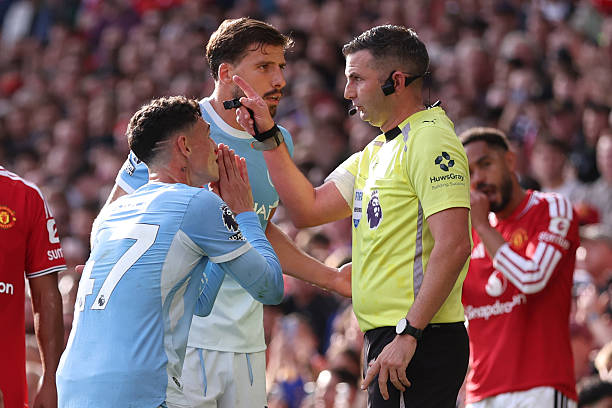
Before Phil Foden’s red card, Manchester City was not completely comfortable in its setup. Enzo Maresca had chosen an ambitious structure, with Rayan Cherki and Enzo Fernández operating in advanced midfield positions and looking to create numerical advantages through the middle. The idea was clear: draw Manchester United out and then find spaces between the lines.
The problem was that this setup could quickly become unbalanced. Fernández tended to drift well outside his zone or push very high up the field, leaving Elliot Anderson almost alone in midfield. City would then lose passing options through the middle and become particularly vulnerable whenever United won the ball back.
Foden’s red card suddenly changed that equation. With one fewer player, continuing to play as if nothing had happened would have been suicidal. Maresca therefore accepted sacrificing some possession and territorial control in exchange for something much more valuable: compactness.
At halftime, the Italian coach replaced Cherki with Iliman Ndiaye, and City gradually shifted into a much more recognizable 4-4-1. The lines moved closer together, the spaces between players became smaller, and Fernández was also forced to operate within a much more disciplined framework.
Ultimately, the entire philosophy of the game was reversed. City no longer needed to control United through possession. It now had to control the spaces.
City managed to turn this disadvantage as a trap for United

The most impressive aspect of Manchester City’s performance was therefore not simply defending with 10 men. It was preventing Manchester United from truly taking advantage of its numerical superiority.
After the red card, United had more players available to build attacks. But that numerical advantage never really translated into sustained attacking dominance. City dropped deeper, closed the middle and, above all, refused to leave space behind its defense. That was precisely what Maresca was looking for: preventing the quick transitions United could have exploited.
The statistics tell part of the story. Manchester United managed just two shots on target after the sending-off and finished the game with only three shots on target against Gianluigi Donnarumma. The Red Devils nevertheless had more than 67 minutes playing with a numerical advantage.
City could also rely on an exceptional defensive performance from Elliot Anderson, who was everywhere in midfield, as well as the solidity of its defensive line. The team accepted having to run more without the ball, but in return it drastically reduced the amount of space available to United.
And above all, Maresca never completely abandoned his attacking ambitions. That was probably one of the most important elements of his plan. With Ndiaye, Antoine Semenyo and Haaland, City still had three players capable of causing damage immediately after winning the ball back.
The objective was therefore not to sit back for an hour and desperately wait for the final whistle. City had to defend deep, win the ball back and then immediately attack the spaces United left behind.
That approach also explains why City gradually appeared more dangerous despite being down a player. United had more of the ball, but City knew exactly what to do with it whenever it recovered possession.
Haaland, Ndiaye and Maresca find the perfect game plan

Erling Haaland’s 60th-minute goal was ultimately the perfect illustration of this new approach.
Gianluigi Donnarumma regularly opted for long distribution to prevent City from having to build cleanly from inside its own penalty area. Rather than consistently trying to play through United’s press, the Italian goalkeeper could go directly toward Haaland. The Norwegian then became the focal point tasked with winning the first duel and allowing his teammates to collect the second ball.
That is exactly what happened in the buildup to the goal. Haaland won the aerial duel, Ndiaye recovered the ball before carrying it forward, and the move eventually reached Josko Gvardiol, whose cross found Haaland at the far post.
The goal was, of course, surrounded by huge controversy because Enzo Fernández’s involvement, with the midfielder in an offside position, was subjected to a lengthy VAR review. The goal was ultimately allowed to stand, before refereeing body Pro Ref acknowledged an error of judgment regarding the decision.
But beyond the refereeing controversy, the sequence perfectly sums up the transformation Manchester City underwent.
Before Foden’s red card, Maresca wanted his team to build and control. After the sending-off, he chose to reduce risks, defend as a unit and attack quickly. The numerical disadvantage therefore forced City to abandon some of its initial ambition and adopt a more direct and pragmatic style of soccer.
And that was precisely the change that unsettled Manchester United.
The paradox of this derby is ultimately a cruel one for the Red Devils: they played more than an hour with 11 against 10, yet it was Manchester City that appeared to have the clearer plan. United never truly found a way to move the opposing block, while City knew where to defend, where to send the ball and, above all, which players to use to hurt United in transition.
Enzo Maresca had asked his players to “embrace the noise” and the chaos of the derby. His players did exactly that. But more importantly, they learned how to control that chaos.
Manchester City did not win despite its numerical disadvantage. It won by adapting to it.
 Manchester City
 Manchester United