

For years Japan were the World Cup’s favorite plucky outsiders, admired for their discipline and organization but rarely feared. Those days are gone. The Samurai Blue arrive in North America as one of the most exciting and dangerous teams in the tournament, a side packed with players from Europe’s biggest leagues and carrying the swagger of a group that has learned how to beat the best.
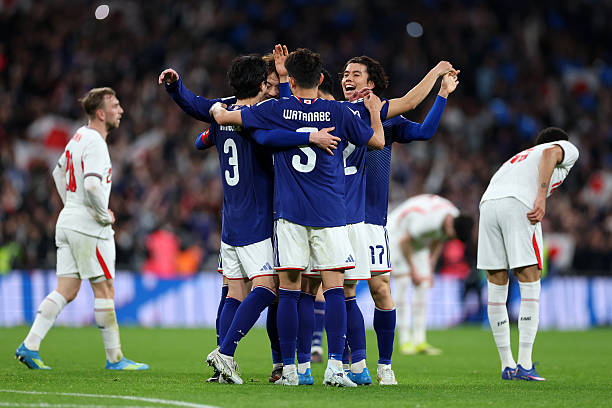
The evidence is recent and stunning. In March, Japan traveled to Wembley and beat England 1-0, the first time the Three Lions had ever lost to an Asian nation and only the second defeat of Thomas Tuchel’s reign. That result was no fluke. Since the last World Cup, Japan have also beaten Germany, Brazil, and Spain, a run of scalps that has rewired how the world sees them.
- World Cup appearances: 8, every edition since 1998 in one unbroken run
A flawless road to the finals
Japan booked their place in style. They became the first team outside the three host nations to qualify, clinching their spot in March 2025 with three games to spare. The campaign was a procession. In the second round of Asian qualifying they won all six matches, scoring 24 goals without conceding a single one, before topping their third round group ahead of the likes of Australia and Saudi Arabia.
- Second round of qualifying: 6 wins from 6, with zero goals conceded
That dominance reflects how far Japanese soccer has come. This is a nation that now develops technically gifted players in huge numbers and exports them across the top European leagues, giving the national team a depth and quality that simply did not exist a generation ago.
The Moriyasu project
At the helm sits Hajime Moriyasu, taking charge of his second World Cup after nearly eight years in the job. He masterminded the famous wins over Germany and Spain in Qatar that sent Japan top of their group, and he has built a team that can adapt its approach to any opponent. His side can press high, counter at speed, or patiently circulate the ball, switching styles depending on what a match demands.
Moriyasu is adamant that his players should be seen as dark horses rather than underdogs, and his record against elite opposition backs him up. The challenge now is to translate those famous one off results into a sustained run deep into the knockout rounds.
The players who will decide it
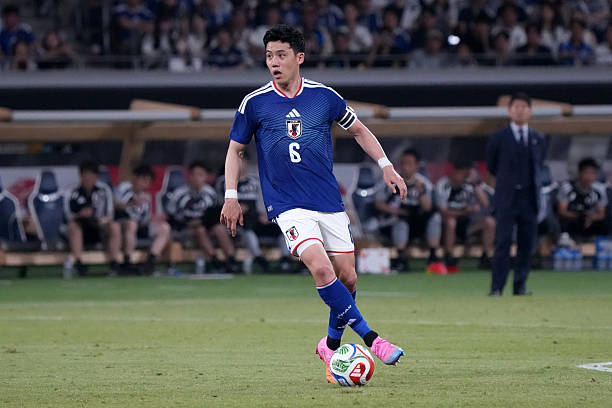
The team is captained by Wataru Endo, the Liverpool midfielder who does the unglamorous work that allows Japan’s attackers to flourish. He shields the defense, breaks up play, and sets the tone with his relentless energy, the perfect anchor for a side built on movement and intensity.
Ahead of him is where Japan truly sparkle. Takefusa Kubo, the Real Sociedad playmaker, is the main creative outlet, a gifted dribbler capable of unlocking the most stubborn defense. On the flank, Brighton’s Kaoru Mitoma is one of the most dangerous transition players in the world, able to beat his man and stretch defenses with his pace and trickery. Daichi Kamada adds further quality and goals from midfield, while the experienced Takehiro Tomiyasu returns from a long injury battle to bolster the defense.
It is a squad with genuine strength in depth, particularly in the wide and attacking areas. If there is a question mark, it sits at the back, where Japan will need to be sharper against the elite forwards waiting in the latter stages. But the attacking talent on show makes them a nightmare matchup for anyone.
Group F and the road through the group stage
The draw placed Japan in one of the most balanced groups in the tournament. They face the Netherlands, the strongest side on paper, along with a physical Sweden team dangerous from set pieces, and a compact, hard to break down Tunisia. There is no easy game, but there is also a clear path for a team of Japan’s quality.
The schedule sends them across the United States and Mexico, opening with the toughest test before two matches that will likely decide their fate.
- Netherlands vs Japan: Sunday, June 14, 4 p.m. ET, AT&T Stadium, Arlington, Texas
- Tunisia vs Japan: Sunday, June 21, 12 a.m. ET, Estadio BBVA, Monterrey, Mexico
- Japan vs Sweden: Thursday, June 25, 7 p.m. ET, AT&T Stadium, Arlington, Texas
That middle game carries a slice of history. Played late on a Saturday night in Monterrey, it kicks off in the small hours of Sunday morning for fans on the East Coast, and it stands as the 1,000th match in World Cup history.
- A milestone moment: the meeting with Tunisia is the 1,000th match ever played at a World Cup
With 32 of the 48 teams advancing, qualification looks well within reach. Getting a result against the Netherlands would put Japan in the driving seat, and even a third place finish could be enough to progress. The real ambition lies beyond the group.
The objective is to finally go further
Japan have a well established ceiling at the World Cup, and breaking it is the entire point of this campaign. They have reached the round of 16 four times, including each of the last two tournaments, but have never once managed to go beyond it. A place in the quarterfinals would be the deepest run in the nation’s history, and given recent form, nobody is dismissing the idea.
The pieces are in place to make it happen. A proven coach who knows how to beat the giants, a squad full of players thriving at the highest club level, and a belief, forged in those wins over Germany, Spain, and England, that no opponent is beyond them. Japan are no longer satisfied with simply showing up and impressing. The Samurai Blue arrive in North America convinced that this is the year they finally smash through the barrier that has held them back.