

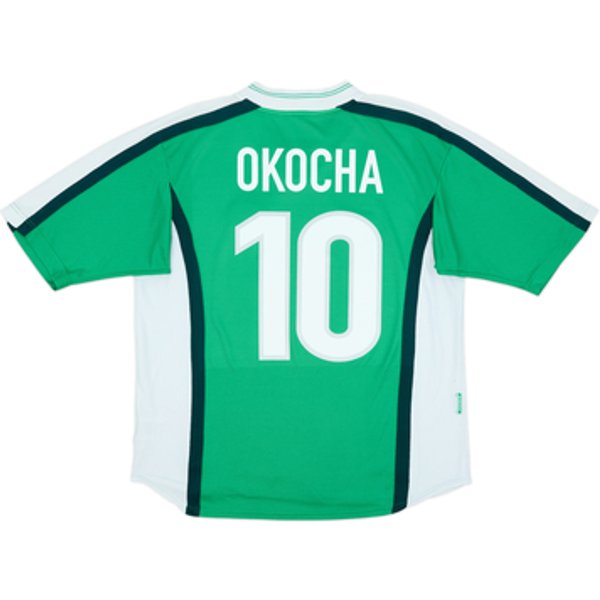
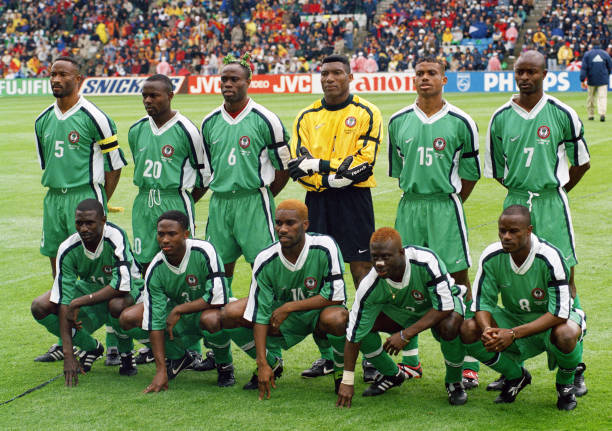
At the 1998 World Cup in France, Nigeria arrived with an already massive reputation. Olympic champions two years earlier in Atlanta, the Super Eagles embodied the future of African soccer. Led by a golden generation featuring Jay-Jay Okocha, Nwankwo Kanu, Sunday Oliseh, and Taribo West, the Nigerian national team finally seemed capable of breaking the glass ceiling for African soccer at the World Cup. For a few days, this team made the entire planet dream before collapsing brutally. More than just an elimination, France ’98 remains the great missed opportunity of an exceptional generation.
A golden generation pushing Africa in new dimension
Nigeria arrived in France with a special status. Since the 1996 Atlanta Olympics, where the Super Eagles defeated Brazil and then Argentina to win gold, the entire world had been watching this team with fascination. African soccer was entering a new era, and Nigeria had become its symbol.
The team coached by Bora Milutinović possessed a rare combination of physical power, creativity, and technical brilliance. Jay-Jay Okocha dazzled with his dribbling ability, Kanu brought elegance and the ability to change a game at any moment, while Sunday Oliseh imposed his authority in midfield. At the back, Taribo West and Uche Okechukwu provided real defensive solidity. Many observers viewed Nigeria as the African team most capable of finally reaching the semifinals of a World Cup.
The draw, however, looked difficult. Nigeria landed in a group with Spain, Paraguay, and Bulgaria. But this team played without fear. Right from their opening match, they made a huge statement by defeating Spain 3-2 in one of the greatest games of the tournament. Trailing and under pressure, the Super Eagles turned everything around thanks to their boldness and a thunderous strike from Sunday Oliseh late in the game. That victory practically eliminated Spain in the group stage and permanently established Nigeria as one of the tournament’s biggest attractions.
After beating Bulgaria, Nigeria finished top of the group despite a loss to Paraguay with a heavily rotated lineup. The entire country started dreaming of a historic achievement. The bracket even looked open, and many already imagined the Super Eagles reaching the semifinals.
The unexpected collapse against Denmark
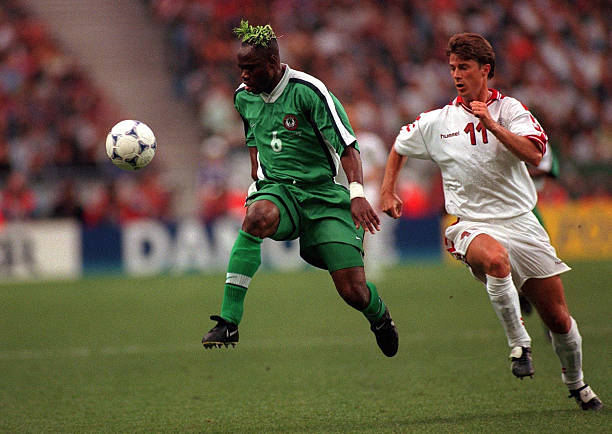
On June 28, 1998, at the Stade de France, Nigeria faced Denmark in the Round of 16. On paper, the Nigerians appeared to be favorites. Their group-stage performances had impressed everyone, while the Danes had finished second in their group behind France. But the game quickly turned into a disaster.
Just three minutes in, Peter Møller opened the scoring. A few minutes later, Brian Laudrup doubled the lead. Disorganized, defensively naïve, and unable to rediscover their dazzling soccer, Nigeria was completely overwhelmed by Denmark’s control of the match. The Scandinavians dominated from start to finish and eventually won 4-1 despite a consolation goal from Tijani Babangida.
The defeat shocked many because of how brutal the contrast with the group stage had been. Only days earlier, some observers believed Nigeria could challenge France or Brazil. Instead, the Super Eagles exited the tournament in the anonymity of a heavy defeat.
With hindsight, that game still fuels enormous regret. Taribo West later spoke about a team that may have believed too quickly in its own superiority. The former defender also revealed disciplinary issues within the squad before the Denmark match, claiming that some players had invited women to the team camp before the Round of 16. According to him, several internationals were physically diminished by the time they faced the Danes.
Is the greatest what if of African football history ?
Nigeria’s elimination in 1998 remains one of the greatest regrets in the history of African soccer. This generation seemed to have everything required to become pioneers. Individual talent, European experience, and the confidence built after Atlanta made the Super Eagles a team capable of disrupting the global hierarchy.
Instead, Nigeria once again exited the World Cup in the Round of 16, just as they had in 1994 against Italy. And contrary to expectations, this generation never truly reached another global peak afterward. In 2002, the Super Eagles were eliminated in the group stage, and several key players from France ’98 had already lost their shine.
Yet despite the immense frustration, Nigeria 1998 left a deep legacy. Their spectacular soccer, attacking freedom, and complete lack of fear helped change the way African national teams were perceived. This team showed that an African representative could not only compete with the world’s biggest powers but also make them collapse. Spain was the first victim.
If Morocco in 2022 became the first African nation to reach a World Cup semifinal, many still believe that the Nigeria team of 1998 already had the potential to accomplish that feat nearly a quarter-century earlier. And that is precisely why this campaign remains, even today, such a massive missed appointment.