

Since its inception in 1930, the FIFA World Cup has been the stage for football’s greatest triumphs—but also for controversies that have sometimes overshadowed the game itself. Before the arrival of modern technology, refereeing mistakes could determine the fate of an entire nation. Some changed the course of football history, while others fueled conspiracy theories and endless debates for decades.
Here’s a look back at the most infamous refereeing scandals in World Cup history.
When politics invaded the pitch
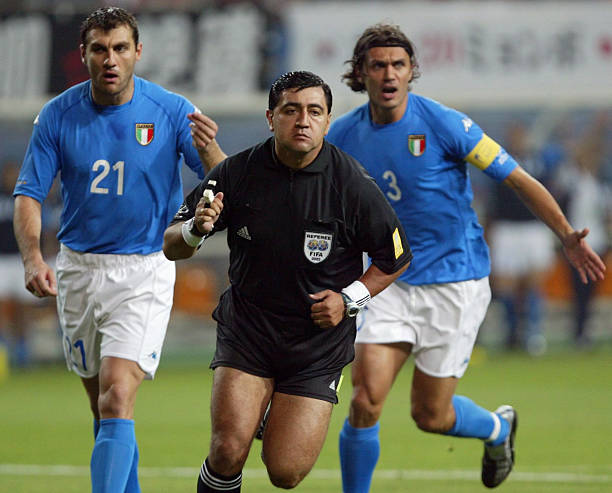
On June 21, 1982, France faced Kuwait in the group stage.
As Les Bleus controlled the match, Alain Giresse scored what appeared to be France’s fourth goal to make it 4-1. However, Kuwaiti players stopped playing, claiming they had heard a whistle from the crowd.
What happened next remains one of the most bizarre moments in World Cup history.
The Emir of Kuwait’s brother—who also served as president of the Kuwaiti Football Association—left the stands and walked directly onto the field to protest the decision with Soviet referee Miroslav Stupar.
Under intense pressure, the referee astonishingly agreed to disallow France’s goal.
Rarely has political interference had such a direct impact on an officiating decision during a World Cup match.
Ghost goal ?
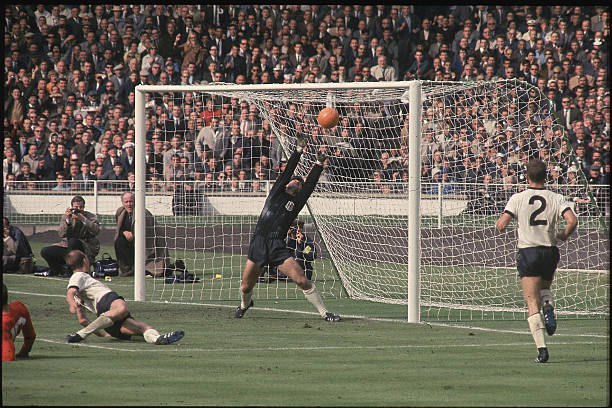
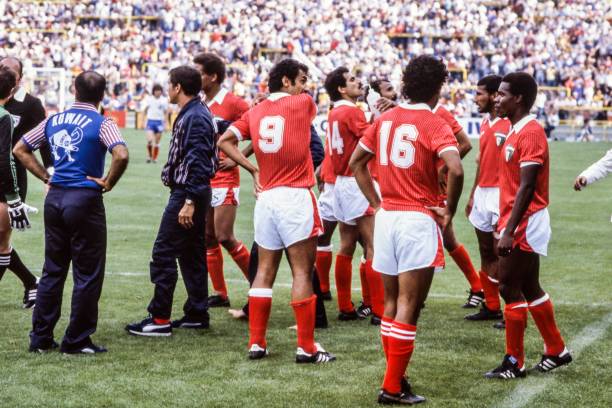
Wembley Stadium. July 30, 1966.
England and West Germany were tied 2-2 after 90 minutes in the World Cup Final.
In the 101st minute of extra time, Geoff Hurst unleashed a shot that struck the crossbar before bouncing downward and back into play. Swiss referee Gottfried Dienst hesitated before consulting his Soviet assistant referee, Tofik Bakhramov.
After a brief discussion, the goal was awarded.
England took the lead and eventually won 4-2.
The controversy?
No one has ever been able to prove beyond doubt that the entire ball crossed the goal line. Computer simulations, 3D reconstructions, and scientific analyses have been conducted for decades without producing a universally accepted answer.
For England, it remains one of the most iconic goals in football history.
For Germany, it is still viewed as one of the greatest injustices the sport has ever seen.
Byron Moreno 1-0 Italy
If there is one match that stands above all the others, this is probably it.
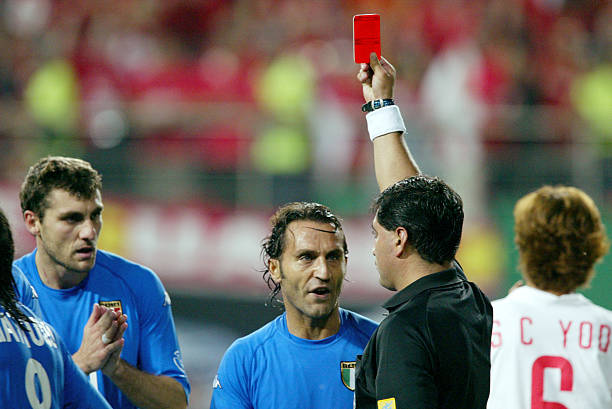
On June 18, 2002, co-host South Korea faced Italy in the Round of 16. Led by Francesco Totti, Paolo Maldini, Christian Vieri, and Gianluigi Buffon, the Italians entered the match as overwhelming favorites against an impressive but supposedly inferior Korean side.
Very quickly, the officiating of Ecuadorian referee Byron Moreno became the center of attention. South Korean players repeatedly escaped punishment for heavy challenges, while nearly every controversial decision seemed to go against Italy.
The breaking point came in extra time.
Francesco Totti was sent off for alleged simulation inside the penalty area, despite replays showing clear contact. Minutes later, Damiano Tommasi appeared to score Italy’s winning goal, only for it to be disallowed for an extremely questionable offside decision.
Soon afterward, Ahn Jung-hwan scored the golden goal that eliminated Italy.
The reaction in Italy was explosive. Newspapers described the match as a “robbery,” a “conspiracy,” and even a “sporting assassination.” More than two decades later, it is still widely regarded as one of the worst refereeing performances ever seen at a World Cup.
After Italy… even worse
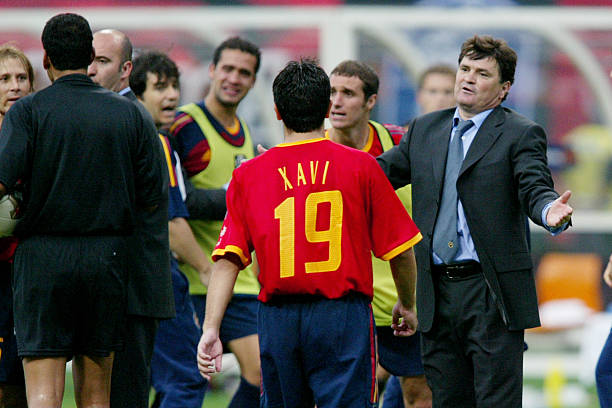
Just days after Italy’s elimination, Spain found itself on the wrong end of another highly controversial officiating performance.
In the quarterfinals, La Roja dominated the match but had two goals ruled out. The first was disallowed for a debatable foul. The second, scored by Fernando Morientes, was canceled after the assistant referee incorrectly judged that Joaquín’s cross had gone out of play before reaching the box.
Television replays appeared to show that the ball had remained in play.
After a scoreless draw, South Korea advanced on penalties to become the first Asian nation to reach a World Cup semifinal.
For many European observers, the back-to-back controversies against Italy and Spain cast a lasting shadow over the 2002 World Cup. Even today, South Korea’s remarkable run remains inseparable from the officiating debates that surrounded it.
Hand of God
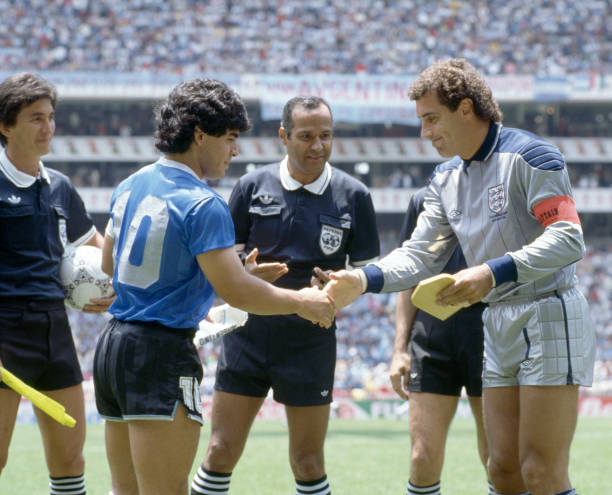
On June 22, 1986, Argentina faced England in Mexico City, just four years after the Falklands War.
In the 51st minute, Diego Maradona challenged England goalkeeper Peter Shilton for a high ball. Too short to win the aerial duel fairly, Maradona discreetly punched the ball into the net with his left hand.
Tunisian referee Ali Bennaceur allowed the goal to stand.
England’s protests were immediate—but futile.
Just minutes later, Maradona scored the “Goal of the Century,” dribbling past nearly the entire English team before finding the net. Argentina won 2-1 and went on to lift the World Cup.
The “Hand of God” remains perhaps the most famous image in World Cup history, symbolizing both Maradona’s genius and his willingness to bend the rules.
 Argentina
 Italy
Italy Spain
Spain