

As Zinédine Zidane prepares to take charge of the French national team for the first time on Friday against Turkey, it is time to look back at the tournament that definitively propelled him to stardom and then to legendary status in French soccer. Twenty-eight years later, the 1998 World Cup remains associated with an almost perfect image of Zidane, the hero of July 12 and the symbol of a generation. Yet behind the myth lies a much more complex story. Before becoming the man who scored two goals against Brazil, Zidane endured a difficult tournament, a suspension that could have changed the course of his career and a final in which, extraordinary as his performance was, his contribution alone does not explain France’s success.
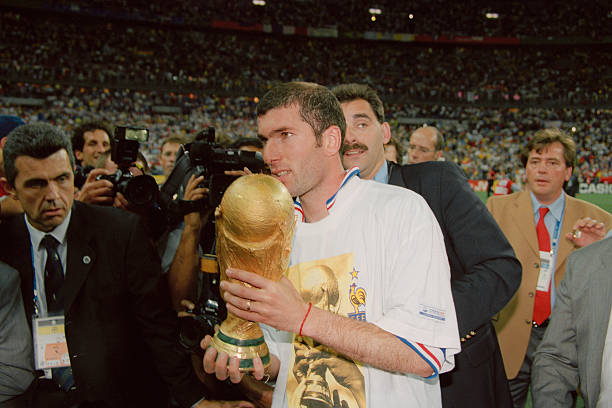
Zidane wasn’t the hero of the entire world cup
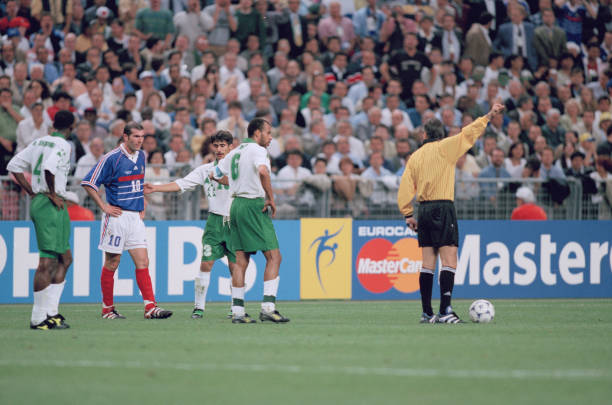
The first misconception to challenge is probably that of a Zidane who dominated the entire 1998 World Cup. Collective memory tends to reconstruct the tournament around his final, as if the No. 10 had gradually carried France all the way to the title. Reality was much less straightforward. In the opening game against South Africa, Zidane delivered a corner-kick assist to Christophe Dugarry, but his performance was still far from the image of the genius who would soon establish himself in the French imagination. Three days later, against Saudi Arabia, he committed an error that could have had historic consequences. With France leading 2-0, he deliberately planted his studs into Fuad Anwar’s thigh and was shown a red card. The incident earned him a two-match suspension and, in particular, ruled him out of the round of 16 against Paraguay. At that point, the future hero of the final was far from untouchable. Aimé Jacquet criticized his lack of composure, Didier Deschamps called the reaction stupid and the senior players in the locker room knew that the team had just lost its primary creator for a crucial part of the tournament. The paradox was enormous: the man who would become the ultimate symbol of French victory a few weeks later could very well have been associated with France’s elimination. Against Paraguay, France struggled and remained unable to find a breakthrough for a long time. Without Laurent Blanc’s golden goal in the 114th minute, the course of history could have been radically different. Zidane would then have been denied a quarterfinal and his World Cup would have been reduced to a red card and an assist. The importance of that night at Bollaert in the construction of his legend is therefore considerable. His return against Italy in the quarterfinals, followed by qualification on penalties, gradually allowed Zidane to reclaim his place in the tournament’s story. But even then, he did not immediately become the player who dominated the competition. France reached the final thanks to an exceptional defensive unit, an extremely complementary midfield and several individuals who took turns making the difference throughout the tournament. The Zidane myth was therefore built in retrospect: he became the face of the World Cup because his story had an extraordinary ending, not because he had been the dominant player throughout seven games.
No, Zidane didn’t have a 10/10 in the final
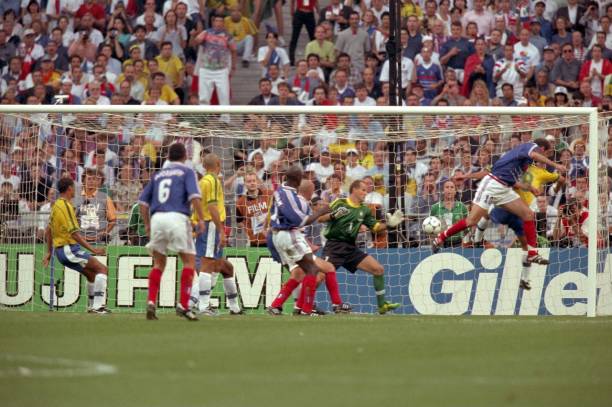
Another often-forgotten detail is that even the Zidane of the final did not deliver a perfect performance in the strictest sense. On July 13, 1998, the day after the 3-0 victory over Brazil, L’Équipe gave him a 9/10 rating. An exceptional score, but one that also reminds us that the famous brace does not erase everything else that happened during the game. Years later, that rating became a subject of debate within the newspaper’s own editorial staff: some journalists believe that, by today’s standards, Zidane probably would have received the maximum score. The detail is revealing of the way memory transforms sporting performances. Zidane in 1998 is now so closely associated with that final that it is easy to imagine an absolute individual performance, as if the Frenchman had dominated every minute of the game. Yet his influence was expressed above all in the decisive moments. His two goals came from corners and were remarkable headers, but they were also the result of collective work prepared by the French coaching staff. Aimé Jacquet had specifically identified Brazil’s weaknesses on set pieces and instructed his players to exploit what he considered insufficiently rigorous marking. Zidane himself would later explain that the manager had asked him to attack certain areas because of the profile of the Brazilian defenders. On the first goal, Emmanuel Petit found Zidane from a corner; on the second, Youri Djorkaeff delivered from the other side and the No. 10 appeared again. Individual brilliance was there, but it came within a meticulously prepared collective framework. Even the final, therefore, should not be told as the moment when Zidane, alone against everyone, decided to win the World Cup. France had a team capable of controlling Brazil that night, a defense that conceded no goals and a midfield that gradually imposed its rhythm. Zidane was its attacking symbol, but not its only architect. Emmanuel Petit’s third goal, scored in the final seconds, also served as a reminder that France’s triumph went far beyond its No. 10. His brace nevertheless definitively transformed his status. Before the final, Zidane was already a Juventus star and an internationally recognized player. After July 12, he became “Zizou.” His face appeared on the Arc de Triomphe, his name was chanted in the streets and he acquired a stature that transcended soccer. His two goals therefore do not sum up France’s collective performance, but they perfectly capture the birth of the Zidane myth.
Before 1998, between doubt and genius
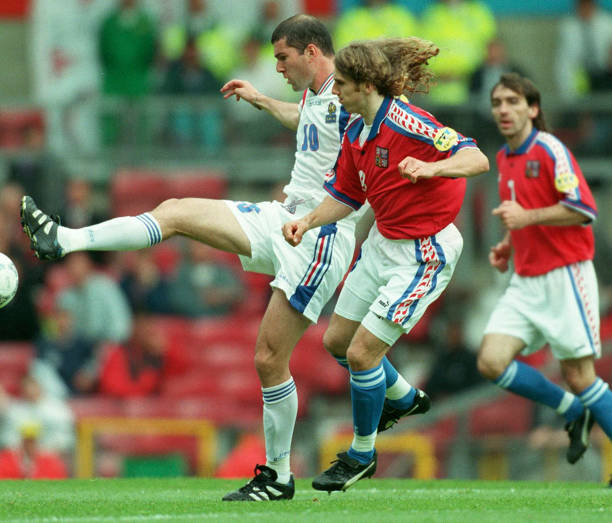
The final myth to challenge concerns the idea that Zidane arrived at the 1998 World Cup as an absolute certainty. There was no doubt about his talent, but his international career before the World Cup was marked by questions. His first appearance for France, in August 1994, had nevertheless immediately captured attention: coming on against the Czech Republic, he scored twice and helped Les Bleus salvage a draw. But that night did not instantly turn Zidane into the leader of the French national team. He still had to learn how to manage the expectations surrounding him and fit into Aimé Jacquet’s project. Euro 1996 is one of the clearest examples of the gap between today’s memory and the reality of the time. Zidane was far from his best there, and some observers remained disappointed by his performances. But that story also deserves to be put into context: a few weeks before the tournament, he had been involved in a car accident in Bordeaux and entered the competition seriously weakened. Vincent Duluc would later recount seeing a player in pain, with a thigh still marked by a hematoma. Zidane himself acknowledged that he had not played the European Championship he would have wanted to. He truly became France’s technical leader only over the months leading up to 1998, notably through his chemistry with Youri Djorkaeff and Aimé Jacquet’s constant trust in him. The manager did not build a team around a player expected to solve every problem. He built a team in which Zidane could express his talent. That evolution is what makes the story of 1998 so interesting. The genius did not appear on July 12 at the Stade de France: it had already been there for several years. What was born that night was something else: the myth. And that myth is partly built on a paradox. To become one of the greatest symbols in the history of French soccer, Zidane first had to go through a World Cup in which he was suspended, criticized and potentially close to becoming the man responsible for an early elimination. The victory over Brazil erased those darker moments from collective memory. It transformed an exceptional player into a national icon. That is precisely what makes his return to the French bench so unique: when he leads France for the first time on Friday against Turkey, Zidane will not return simply as a former World Cup champion or as a recognized coach. He will return carrying the image created on the night of July 12, 1998, that of a man whose international career changed forever in a final. But behind that perfect image was a player who experienced doubt, mistakes, suspension and criticism before becoming “Zizou.” And perhaps it is this much more human story, rather than the myth itself, that explains why the 1998 World Cup remains, to this day, the true starting point of Zidane’s legend.
 France National Team
 Zinédine Zidane