

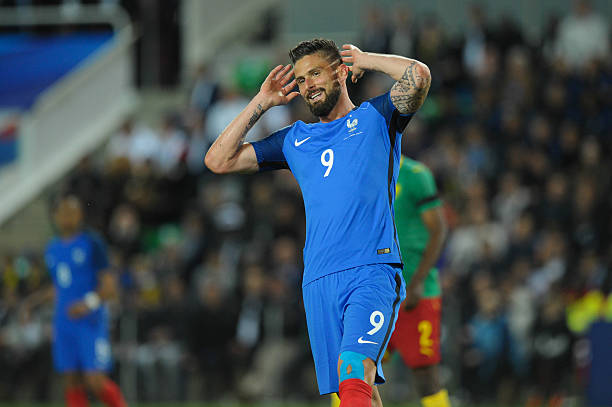
For more than a decade, Olivier Giroud occupied a unique place in the recent history of the French national team. Long criticized for his style of play and regularly compared with Karim Benzema, the striker nevertheless ended his international career with 57 goals, a record for Les Bleus until Kylian Mbappé eventually moved to the top of the scoring charts. From his debut in 2011 to his World Cup triumph in 2018 and then his remarkable 2022 World Cup, Giroud’s international career was defined by a constant paradox: he was indispensable while also being regularly questioned.
Giroud made his France debut in 2011, at a time when the national team was still searching for stability after several difficult years. His profile quickly stood out from that of other French forwards. Tall, powerful, and capable of playing with his back to goal, he was not simply expected to score. He also had to provide a focal point, hold up the ball, and allow the attacking players around him to play off his presence.
His first goal for Les Bleus came against Germany in February 2012. Coming off the bench, he helped France secure a 2-1 victory that gradually established his name within the national team’s attacking hierarchy.
A few months later, Giroud experienced one of his first major moments with France. In October 2012, against Spain, he came on as a substitute and scored a stoppage-time header to earn Les Bleus a 1-1 draw in Madrid. The goal already symbolized one of the defining characteristics of his international career: Giroud was not always the player in the spotlight, but he was regularly there when his team needed him.
His career, however, remained closely linked to that of Karim Benzema. For years, the two strikers represented two different interpretations of the No. 9 position. Benzema had a more mobile and creative profile, while Giroud was more of a focal point. Their contrast gradually became a major media topic, eventually fueling the perception of a rivalry between the two players.
In reality, their respective histories with Les Bleus were more complicated. Benzema was left out of the national team from 2015 onward, and Giroud became Didier Deschamps’ starting center forward. Yet the debate over the hierarchy between the two strikers never completely disappeared.
Giroud was therefore constantly forced to prove his legitimacy.
From booing to world Champion
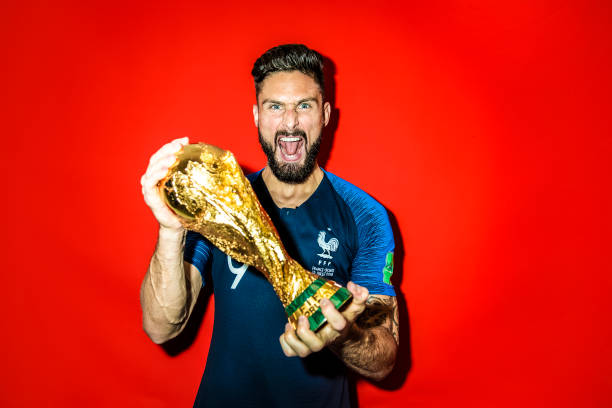
Euro 2016 represented an early turning point. Despite the criticism, Giroud scored three goals and became an important part of France’s run to the final. Once again, his role went beyond the statistics: his ability to play with his back to goal, his physical work, and his capacity to create space for Antoine Griezmann all contributed to the team’s collective functioning.
But the 2018 World Cup paradoxically reinforced the controversy surrounding him. Giroud played seven games without scoring a single goal. Despite that, Didier Deschamps continued to trust him and kept him at the top of his attack. The striker therefore became a world champion without finding the back of the net.
His situation quickly became one of the tournament’s great curiosities. Giroud finished the competition with zero goals but remained in the starting lineup for the final against Croatia. His influence could therefore not be measured solely by his goals. He provided a focal point, contributed to the pressing game, and created space for players arriving from deeper positions.
The episode perfectly summed up the paradox of his international career: part of the public expected a center forward to primarily score goals, while his coach evaluated his contribution through the overall functioning of the attack.
The criticism never completely disappeared. Giroud was even booed while playing for France, a situation he described as “ridiculous.” On several occasions, his style of play was questioned even though his statistics remained particularly strong. In 2017, while he was regularly criticized, he already had 26 goals in 62 appearances and had just scored a hat-trick against Paraguay.
His resurgence then came at the 2022 World Cup. After Karim Benzema’s injury, Giroud regained his starting role in Qatar and scored four goals during the tournament. More importantly, he became the leading scorer in French national team history with 53 goals before eventually taking his total to 57.
This final chapter was perhaps the most revealing of his career. The player who had spent years being compared with Benzema ultimately ended his time with Les Bleus as one of the greatest goalscorers in their history.
The controversy surrounding Giroud was therefore never entirely about his numbers. It was mainly about how his role should be interpreted. For some, a center forward’s primary responsibility was to score. For Deschamps, his importance also came from his ability to make those around him better.
That difference helps explain why his time with the French national team was so heavily debated. Giroud was criticized when he did not score, but he was also questioned at times when he scored regularly. He was compared with Benzema and then partnered with Griezmann, Mbappé, and other attacking profiles.
His story with Les Bleus is ultimately that of a player whose value was never unanimously recognized by the public, but whose longevity, statistics, and performances on the biggest stages gradually built a legacy that is difficult to erase. His record of 57 goals and his status as a world champion ultimately represent the clearest answers to the many questions that followed him throughout his international career.