

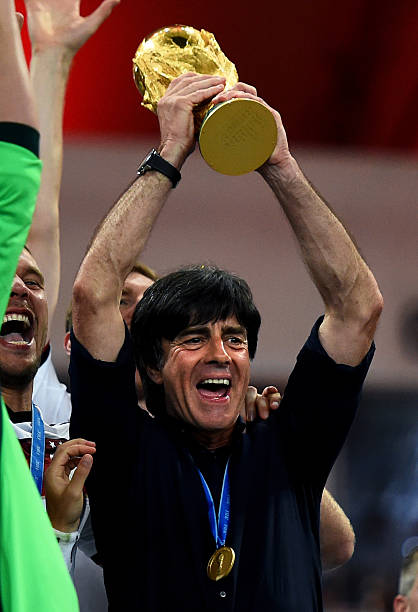
The man who rebuild Germany
It is difficult to tell the story of the great Germany of the 2010s without telling the story of Joachim Löw. For 15 years, from 2006 to 2021, the German coach witnessed and then shaped one of the greatest transformations in the recent history of the national team. Yet when Löw took charge of the national team, he was hardly a monument of German soccer. A former professional player turned coach, he was best known for having been Jürgen Klinsmann’s assistant during the 2006 World Cup. But behind the charismatic head coach was already the man many considered the brain behind this new Germany. In 2006, Die Mannschaft gradually moved away from a style based on physical battles, power and individual talent to adopt a more modern approach built around pressing, positional play, zonal defending and more ambitious ball circulation. Klinsmann was its public face, but Löw was widely regarded as one of the main architects of this revolution. This transformation did not disappear when Klinsmann left his position: Löw took over and continued the revolution. Under his leadership, Germany reached the Euro 2008 final, the 2010 World Cup semifinals and the Euro 2012 semifinals, before reaching its peak in Brazil in 2014. During that period, Die Mannschaft reached the semifinals of five consecutive major international tournaments between 2008 and 2016, an exceptional level of consistency at the highest level. But Löw was not simply the coach of a golden generation: he also played a major role in the evolution of its identity. In 2010, his Germany became a formidable team in transition, capable of destroying England and then Argentina through quick attacks. In 2012, he was already looking to go further, with a team increasingly focused on possession and controlling games. Then came 2014. After wavering between several approaches during the tournament, Löw understood that his team sometimes had to accept reacting rather than controlling. Germany overcame Algeria, eliminated France, and then produced one of the most spectacular performances in World Cup history by crushing Brazil 7-1 in the semifinals. A few days later, Mario Götze gave Germany its fourth World Cup title against Argentina. Löw had reached the peak of a project that had begun nearly a decade earlier. Perhaps the most impressive aspect of his journey was the ability of this team to reinvent itself. Winning the 2017 Confederations Cup with an extremely young squad seemed to signal the continuation of this dominance and demonstrated the extraordinary depth of German soccer. But the end of the Löw era would be far more difficult. The group-stage elimination at the 2018 World Cup, followed by the struggles in the Nations League and the inconsistent results that followed, exposed the limitations of a team that could no longer rediscover the soccer of its greatest years. His final tournament, Euro 2021, ended with a round-of-16 elimination against England. An exit that stood in stark contrast to the greatness of the era he had helped build. Yet reducing Löw to the end of his reign would mean forgetting the essential part of his legacy. For 15 years, he embodied Die Mannschaft and, above all, helped lead a revolution that profoundly changed German soccer. He gave an exceptional generation of players — Neuer, Lahm, Schweinsteiger, Kroos, Özil, Müller, Hummels, Boateng and Klose — a tactical framework capable of maximizing their qualities. He won a World Cup, reached four other semifinals in major competitions and established Germany at the top of world soccer for nearly a decade. Joachim Löw will therefore remain a paradoxical figure: the man who built part of the greatest Germany of the modern era before eventually encountering the limits of his own project. His legacy cannot be reduced to a World Cup title or a golden generation. It lies in the transformation of a German national team once associated with discipline and efficiency into a team capable of winning while playing soccer admired around the world. The Germany of 2014 was not born solely under Löw, but it carried his imprint deeply. And if Germany experienced such greatness during the 2010s, one of its main architects was named Joachim Löw.