

Twelve years after their last World Cup appearance, the Desert Foxes are back.
Algeria has long lived with the memory of that heroic Round of 16 match against Germany in 2014, when Vahid Halilhodžić’s men pushed the eventual world champions into extra time. Since then, the Greens missed both the 2018 and 2022 editions, enduring a series of disappointments despite winning the Africa Cup of Nations in 2019.
The 2026 World Cup therefore represents a form of rebirth.
Under Vladimir Petković, Algeria has rediscovered stability, ambition, and most importantly, its place among Africa’s leading nations. Yet as the tournament approaches, one question remains: what is the true level of this team?
While the results have been outstanding over the past two years, the Desert Foxes have only rarely been tested against the elite of world soccer.
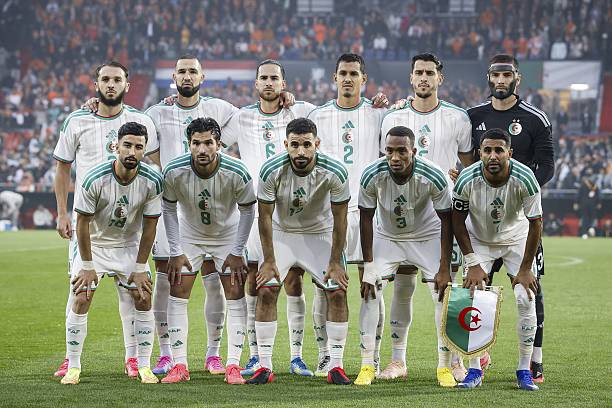
The Group
Algeria will compete in Group J, alongside:
- Argentina
- Austria
- Jordan
The opening match against Argentina will immediately set the tone.
Facing the defending world champions is an enormous challenge, but also a unique opportunity to measure the progress made under Petković. Behind La Albiceleste, the battle for qualification appears wide open, with an improving Austrian side and a Jordan team making its first-ever World Cup appearance.
With the new 48-team format, the top two teams from each group, along with several of the best third-place finishers, will advance to the knockout rounds.
Algeria’s objective is therefore clear: advance from the group stage and return to the Round of 16, a stage of the competition the Desert Foxes have reached only once, in 2014.
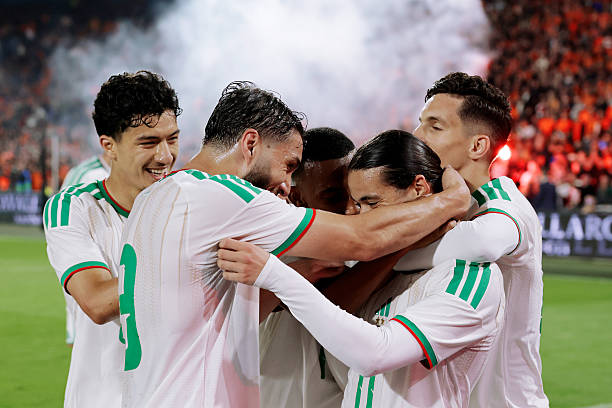
Key players
Riyad Mahrez
At 35 years old, Mahrez remains the face of Algerian soccer.
The captain may no longer possess the explosive pace that defined his best years at Leicester City and Manchester City, but his influence remains enormous. Vladimir Petković continues to rely on his experience, creativity, and ability to change a game with a single moment of inspiration.
His minutes are now managed more carefully in order to preserve his freshness for the biggest occasions.
This World Cup could be his last.
That alone is reason enough to believe one final masterpiece may still be possible.
Rayan Aït-Nouri
The left back has become one of the most important players in the national team.
Modern, attack-minded, and technically gifted, Aït-Nouri constantly creates overloads in wide areas. During the 2025 Africa Cup of Nations, Petković occasionally deployed him in highly aggressive systems where he operated almost like a winger.
His activity on the left flank is one of Algeria’s primary attacking weapons.
At just 25 years old, he also represents the future of this team.
Hicham Boudaoui
Less publicized than Mahrez or Amine Gouiri, Boudaoui is nevertheless one of the most indispensable players in the squad.
He is the unsung hero of this national team.
Capable of winning possession, starting attacks, and covering immense amounts of ground, the Nice midfielder provides the balance that allows Algeria’s attacking players to express themselves freely.
In a tournament where small details often decide matches, his importance could prove decisive.
Ibrahim Maza
If one player symbolizes Algeria’s new generation, it is probably him.
At only 20 years old, Maza is already considered one of the brightest talents in Algerian soccer. Technical, creative, and comfortable operating between the lines, he brings unpredictability to a team that has sometimes been criticized for relying too heavily on Mahrez for creativity.
The 2026 World Cup could be the tournament that introduces him to a global audience.
The face of Algeria in 2026
Algeria arrives in North America riding an extremely positive wave.
Since Vladimir Petković took charge in February 2024, the Desert Foxes have won 21 of their 28 matches, suffering only three defeats. Such progress convinced the Algerian Football Federation to extend the coach’s contract through 2028 just days before the tournament.
The African qualifying campaign was largely controlled from start to finish.
Algeria suffered only one defeat and secured its World Cup ticket with authority. Mohamed Amoura finished as the team’s leading scorer during qualifying with ten goals.
However, several observers have urged caution.
Most of Petković’s victories have come against relatively modest opposition. The 2025 Africa Cup of Nations probably provides the clearest indication of this team’s true level. Algeria played attractive soccer, showcased tactical flexibility, and demonstrated genuine depth before being eliminated in the quarterfinals by Nigeria.
That defeat served as a reminder that the team remains a work in progress when facing top-level opponents.
And that is precisely what makes this Algeria side so difficult to evaluate.
On paper, it possesses one of the most talented squads on the continent. Veterans such as Mahrez, Aïssa Mandi, and Houssem Aouar are complemented by emerging talents like Maza, Amoura, and Anis Hadj Moussa.
The blend is undeniably promising.
But the World Cup is a different environment altogether.
Against Argentina, Austria, and potentially stronger opponents in the knockout rounds, Algeria will need to prove that it can compete with teams accustomed to performing on the biggest stages.
The Desert Foxes therefore enter this tournament in an unusual position: that of an ambitious outsider.
Not experienced enough to be considered among the favorites, yet talented enough to dream of a memorable run.
Twelve years after Belo Horizonte and that unforgettable display of resistance against Germany, Algeria finally returns to the world stage.
And while nobody truly knows how far this team can go, one thing is certain:
The Desert Foxes are not coming to North America simply to participate.
 Algeria